










Why Extreme Weather Is Turning Electricity Resilience Into an Everyday Consumer Issue
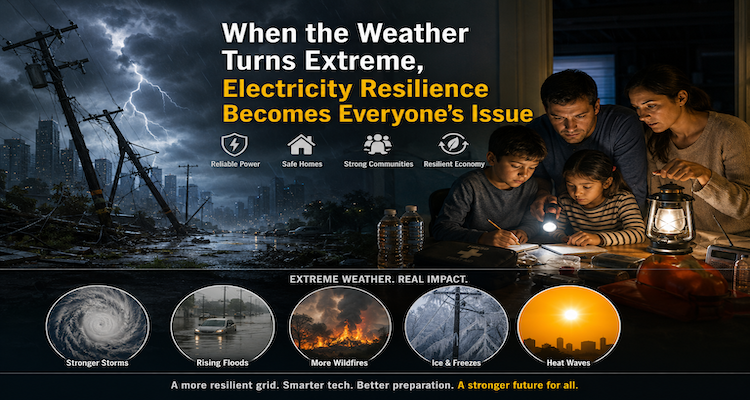
Electricity resilience used to sound like an engineering problem: transmission lines, substations, reserve capacity and utility control rooms. Extreme weather is changing that equation.
Heatwaves can push cooling demand sharply higher at the same time that equipment becomes stressed. Storms, floods, wildfires and high winds can physically damage distribution networks. Drought can reduce hydropower output. And as homes become more dependent on electricity for cooling, heating, communications, mobility and connected devices, an outage increasingly means more than a dark room.
The shift is visible in recent power-system data. The International Energy Agency says extreme weather events caused widespread electricity disruptions in 2024, while its 2026 analysis documents major weather-related outages continuing through 2025. In India, an intense May 2026 heatwave pushed peak electricity demand to 270 GW on May 21, while cooling demand also increased sharply at night.
That makes resilience an increasingly practical consumer question: How long can a household, apartment building or small business continue functioning when the grid is under stress or unavailable?
Key Takeaways
- Extreme weather can simultaneously damage electricity infrastructure and increase demand for power.
- Rising electrification makes reliable electricity increasingly important to ordinary household life.
- Solar panels alone do not guarantee backup power; storage and appropriate islanding equipment matter during outages.
- Smart appliances, batteries and demand-response programmes can make consumers part of the grid’s resilience strategy.
- Preparing for outages increasingly means protecting critical household services, not simply keeping the lights on.
- Grid resilience still depends primarily on investment, planning and action by utilities, regulators and governments.
Extreme Weather Can Attack the Grid From Both Sides
Power systems have always had to cope with storms and temperature extremes. What is changing is the combination of pressures.
During a heatwave, electricity demand can rise because households and businesses use more air conditioning. At the same time, high temperatures can affect the performance of some power-generation and transmission equipment. If generation, transmission or distribution infrastructure is already constrained, a relatively small additional problem can become harder to manage.
The IEA describes this as a growing reliability challenge because electricity supply and demand are becoming more weather-dependent. Heatwaves can increase demand while drought can reduce hydropower availability; storms can damage transmission and distribution infrastructure while simultaneously creating emergency demand.
The vulnerability is not theoretical.
The IEA’s Electricity 2026 report records widespread weather-related outages in the United States during 2025, including outages caused by winter storms, windstorms, thunderstorms, tornadoes and fires. In one April event, severe winds in Pennsylvania affected more than 450,000 consumers.
The important point for consumers is that resilience is not simply about whether enough electricity is generated nationally. The electricity has to reach the particular home, building or business that needs it.
A damaged local transformer, distribution line or substation can leave customers without power even when electricity is available elsewhere on the network.
India’s Heatwaves Show Why Demand Is Becoming Part of the Resilience Problem
India offers a particularly clear illustration of the changing relationship between weather and electricity demand.
In May 2026, northwest and central India experienced an extreme heatwave, with daytime maximum temperatures reaching 40–47°C in affected areas and some locations reaching 48°C. The IEA reported that national peak electricity demand reached 270 GW on May 21, compared with about 180 GW in 2019.
There is another important detail: electricity demand did not simply peak during the hottest part of the day.
As households turned on air conditioners at night, electricity demand increased again after sunset. That matters because solar photovoltaic generation cannot directly meet nighttime demand without storage or other sources of electricity.
This illustrates a broader resilience problem.
The consumer response to extreme heat—turning on cooling equipment is itself an important part of the electricity system’s stress profile.
The World Bank has similarly identified cooling as a major factor in India’s future electricity demand, noting that cooling demand is expected to grow substantially as temperatures, incomes and access to cooling increase.
For consumers, this means the resilience question is becoming two-sided:
Can the grid withstand extreme weather, and can consumers manage their electricity use when the system is under pressure?
The Home Is Becoming Part of the Electricity System
For much of the 20th century, electricity largely flowed in one direction from large generators through transmission and distribution networks to customers.
That model is changing.
Rooftop solar, batteries, electric vehicles, smart appliances, heat pumps and other distributed energy resources increasingly sit on the consumer side of the meter. The IEA says these resources can give consumers greater control over when and how they use electricity, while also providing flexibility to the wider grid.
That creates an important distinction between energy independence and resilience.
A household with rooftop solar may generate substantial electricity during normal operation but still lose power during a grid outage if its solar installation is designed to shut down when the grid goes offline.
Solar combined with appropriately configured battery storage can provide a different outcome. The U.S. Department of Energy describes systems in which solar and storage automatically isolate from the grid during an outage and continue supplying selected loads.
The practical lesson is straightforward:
A solar panel is a generation asset. A resilience system requires generation, storage, controls and safe electrical isolation that are designed to work together.
Batteries Are Becoming More Important Than Simple Backup
Battery storage is no longer only a technology for large utilities.
The IEA reports that around 80% of new battery capacity added globally in 2025 was utility-scale, with the remainder installed behind the meter by commercial and residential consumers. The agency also says battery-storage durations are gradually increasing, with many projects moving beyond two-hour systems.
At grid scale, batteries can respond rapidly to changes in supply and demand.
At the household level, their role can be more tangible: shifting electricity use, reducing exposure to peak demand and, where the equipment and local rules permit, maintaining selected loads during an outage.
But batteries should not be treated as an automatic solution to every resilience problem.
Their usefulness depends on capacity, duration, charging conditions, the loads being powered and whether the system is actually configured for backup operation. A battery that can keep a refrigerator, router and lights running for several hours is solving a different problem from a system expected to power an entire home through a multi-day outage.
That distinction is often lost in consumer discussions about “backup power.”
Consumers Can Also Help Reduce Grid Stress
Resilience is not only about producing more electricity.
It is also about using electricity at the right time.
The IEA’s 2026 analysis of flexibility identifies demand response as an important tool. Households and businesses can sometimes shift or temporarily reduce electricity consumption in response to grid conditions, often in exchange for payments, rebates or bill credits.
Consider an air conditioner.
A conventional approach treats it purely as a source of electricity demand. A connected system can potentially become more flexible: pre-cooling a building when electricity is plentiful, adjusting temperature briefly during periods of system stress, or coordinating operation with a battery or rooftop solar installation.
The same principle can apply to electric-vehicle charging, water heating and other flexible loads.
The IEA estimates that only around 100 GW of demand response was being utilised globally in 2024, despite much larger potential across sectors. Residential air conditioning alone represents a particularly large potential source of flexible demand.
This is an important change in the consumer role.
The household of the future may not simply consume electricity. It may generate it, store it, shift its consumption and, under appropriate programmes, provide flexibility back to the electricity system.
What Resilience Means for an Ordinary Household
Consumers do not need to turn their homes into miniature power plants to improve resilience.
The starting point is understanding which services actually matter during an outage.
For many households, the priority list might include:
- Refrigeration and food preservation
- Internet connectivity and mobile-device charging
- Essential lighting
- Fans or limited cooling during heat events
- Heating during cold conditions
- Medical or other essential electrical equipment
- Security systems and communications equipment
- Water pumps where electricity is required
That list changes the way a household should think about backup power.
Instead of asking, “What size generator or battery should I buy?”, the more useful first question is:
“Which electrical loads must continue operating, and for how long?”
Once that is established, consumers can compare options such as portable batteries, home battery systems, rooftop solar with storage, generators or combinations of technologies.
The economics also differ dramatically by household. A battery that makes sense for a homeowner with solar may not make sense for a renter. An apartment resident may have little control over the building’s electrical infrastructure. A small business may place a much higher value on keeping refrigeration, communications or payment systems operating.
Resilience therefore cannot be reduced to a single consumer technology.
Backup Power Has Safety Risks Too
Preparing for an outage can create new hazards if equipment is used incorrectly.
Fuel-burning generators, for example, produce carbon monoxide. The U.S. Centers for Disease Control and Prevention advises that portable generators should be operated outdoors, more than 20 feet from windows, doors and vents, and never inside homes, garages or other enclosed spaces.
Electrical connections matter as well. The CDC warns against connecting generators to household electrical circuits without appropriate transfer equipment because improperly connected generators can energize external lines and create hazards for people restoring the grid.
This is why resilience should not be understood simply as having backup electricity.
It means having a backup system that is appropriately sized, correctly installed, maintained and operated.
The Bigger Challenge Is Still Outside the Home
There is a risk of putting too much responsibility on consumers.
A household battery cannot compensate for an underbuilt transmission network. A smart thermostat cannot repair a storm-damaged distribution line. A rooftop solar system cannot eliminate the need for resilient substations and distribution infrastructure.
The IEA’s 2026 assessment argues that resilience increasingly requires stronger grids, diverse flexibility resources, improved monitoring and updated operational frameworks.
The agency and the Coalition for Disaster Resilient Infrastructure also began work in 2026 on assessing risks to India’s infrastructure, reflecting the broader recognition that rising electricity demand and intensifying risks require more resilient energy infrastructure.
The U.S. Department of Energy likewise identifies the ability to withstand and rapidly recover from extreme weather as a critical function of the electricity grid and is supporting grid-modernisation and resilience programmes.
Consumers can prepare for outages, but they cannot engineer their way around systemic infrastructure weaknesses.
Resilience Is Becoming a Household Planning Question
The deeper change is psychological as much as technological.
Electricity has traditionally been treated as an invisible service: flip a switch, and power appears. Extreme weather exposes how much modern life depends on that assumption.
A prolonged outage can interrupt cooling, communications, internet access, refrigeration, mobility, commerce and other everyday services simultaneously. As transport, heating and other parts of the economy become increasingly electrified, the consequences of unreliable electricity can extend further.
The IEA’s 2026 resilience assessment describes resilience as the ability of energy systems to prepare for disruption, withstand shocks while maintaining operations and restore services rapidly. It also notes that integrating resilience during planning can be more cost-effective than retrofitting infrastructure after failures occur.
That principle applies at different scales.
For utilities, it means stronger networks and better planning.
For governments and regulators, it means standards, investment and incentives that recognise changing climate and demand risks.
For businesses, it means understanding which electrical services are operationally critical.
And for households, it means recognising that reliable electricity is no longer something to think about only after a storm warning.
Conclusion
Extreme weather is turning electricity resilience from an infrastructure issue into an everyday consumer concern because the modern household is becoming increasingly dependent on continuous electricity and because the same weather events that threaten the grid can also drive electricity demand higher.
The answer is not simply to buy a battery or generator. Resilience works as a system: stronger public infrastructure, better forecasting, flexible demand, energy storage, distributed generation, sensible consumer preparation and safe backup practices all have a role.
The most useful shift for consumers is therefore not toward energy self-sufficiency at any cost. It is toward energy preparedness: knowing which services matter, understanding how long they need to operate, and choosing technologies and behaviours that make the household less vulnerable when the grid comes under stress.
As electricity takes on a larger role in everyday life, resilience is becoming something consumers experience at the wall socket not just something engineers discuss in a control room.
The information presented in this article is based on publicly available sources, reports, and factual material available at the time of publication. While efforts are made to ensure accuracy, details may change as new information emerges. The content is provided for general informational purposes only, and readers are advised to verify facts independently where necessary.
Related News
- The Energy Paradox of Efficiency: Why Using Less Electricity Does Not Always Mean Using Less Energy
- Why Energy Independence Is Becoming a Household Decision, Not Just a National Strategy
- The Hidden Energy Cost of Keeping Everything Available Instantly
- Why Cheap Electricity Could Become the Next Competitive Advantage for Cities