









The Nighttime Energy Problem: Why Solar Power Needs Storage After Sunset
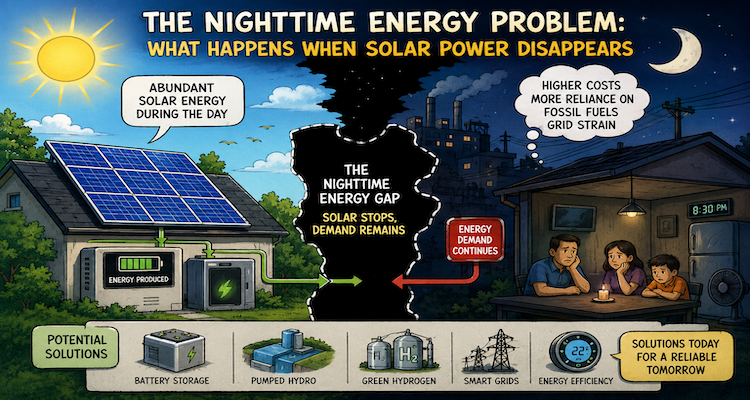
Solar power has changed the economics and timing of electricity generation. But a basic physical fact remains: photovoltaic panels produce electricity only when sunlight is available, while people and businesses continue consuming electricity after the sun goes down.
That mismatch is becoming more important as solar takes a larger share of electricity generation. In 2025, global solar PV generation increased by about 600 terawatt-hours, the largest annual increase ever recorded for any electricity-generation technology, according to the International Energy Agency. Battery storage also expanded rapidly, with roughly 110 gigawatts of new battery capacity added globally during the year.
The challenge, therefore, is no longer simply producing inexpensive solar electricity at midday. The harder question is increasingly how to move some of that electricity through time from hours of abundant sunlight to the evening and night when demand remains high.
Key Takeaways
- Solar can reduce daytime grid demand dramatically, but its output falls just as evening electricity use often rises.
- The resulting “duck curve” increases the amount of electricity that other flexible resources must supply quickly.
- Batteries can shift surplus daytime solar into evening hours, but storage duration matters.
- Grid operators also use hydropower, flexible generation, demand response, transmission and other resources to balance changing supply.
- As solar penetration grows, electricity-system planning increasingly depends on flexibility rather than generation capacity alone.
- The nighttime challenge does not make solar unreliable; it changes what must accompany solar to provide dependable electricity.
Solar’s Biggest Limitation Happens on a Predictable Schedule
Solar’s intermittency is often discussed as though the main problem is unpredictability. Clouds and weather certainly matter, but the most predictable limitation is much simpler: the sun sets every day.
Electricity systems must continuously balance generation with consumption. When solar production is strong around midday, solar panels can supply a large portion of demand and reduce the amount of electricity required from conventional generators.
As the afternoon progresses, however, two things can happen simultaneously: solar output declines while electricity demand remains high or begins increasing.
The U.S. Department of Energy describes this timing problem directly. Peak electricity use can occur during summer afternoons and evenings, when solar production is already falling. Storage allows electricity generated during periods of high solar output to be delivered later, when demand is higher.
This is why simply comparing a solar plant’s total daily electricity production with daily electricity consumption can be misleading. The timing of the electricity matters almost as much as the quantity.
The “Duck Curve” Explains the Evening Problem
Grid planners use the term net load to describe electricity demand that remains after variable renewable generation, such as solar and wind, has been accounted for.
Imagine a grid where electricity demand is fairly substantial throughout the day. Add a large amount of solar generation at midday, and the amount that conventional generators need to supply falls sharply.
Then the sun begins to set.
Solar output drops while consumers may still be using or beginning to use large amounts of electricity. The remaining net load can therefore rise quickly.
This creates the characteristic shape known as the duck curve. NREL researchers identified the underlying phenomenon in their work on high levels of photovoltaic generation, and the concept became an important way of explaining the operational challenge created by large amounts of midday solar.
The important point is that the duck curve is not evidence that solar generation itself suddenly becomes defective. It is a description of how the residual electricity requirement changes when large amounts of solar are added to the system.
NREL has documented how the evening transition can require dispatchable resources to ramp upward as solar generation disappears.
What Happens When the Sun Goes Down?
The grid does not simply lose electricity when solar production falls. Other resources take over.
Depending on the electricity system, evening demand can be supplied by a combination of:
- Battery storage
- Hydroelectric generation
- Natural-gas and other thermal generators
- Nuclear generation operating as part of the broader system mix
- Wind generation when available
- Interregional transmission
- Demand-response programs
- Electricity already stored in other forms
The precise combination differs substantially between countries and regions.
That distinction matters because there is no universal “solar backup” technology. A grid with abundant hydropower has different balancing options from one dominated by thermal generation. A region connected to neighboring electricity markets has options unavailable to an isolated grid.
The evening problem is therefore better understood as a system-flexibility challenge than as a simple solar problem.
Batteries Turn Midday Electricity Into Evening Electricity
Battery storage is one of the most direct solutions because it changes the timing of electricity.
A battery can charge when solar generation is abundant and electricity demand or prices are relatively low. Later, it can discharge when solar production declines and demand rises.
The Department of Energy describes this as one of the central benefits of combining solar with storage: electricity generated during periods of high production can be stored and supplied after sunset.
The distinction between power and energy is crucial here.
A battery rated at a certain number of megawatts describes how quickly it can deliver electricity. Its megawatt-hour rating describes how much energy it can deliver over time.
For example, a hypothetical 100 MW battery with 400 MWh of usable energy could theoretically deliver 100 MW for four hours under idealized conditions. A different system could have the same power rating but substantially less energy duration.
That means adding battery capacity does not automatically solve every nighttime problem.
A system designed to cover a two-hour evening peak is different from one expected to provide electricity through an extended period of low renewable generation.
The Challenge Is Growing Because Solar Is Growing
The nighttime issue would be relatively small if solar remained a minor source of electricity. Its importance increases as solar becomes a much larger contributor.
The IEA reported that solar PV supplied more than 2,700 TWh of electricity globally in 2025, representing more than 8% of global electricity generation. Solar generation increased by approximately 600 TWh during the year.
The IEA’s 2025 electricity outlook also projected that solar PV would account for roughly half of global electricity-demand growth through 2027.
More solar brings an important paradox.
During some daylight hours, there can be too much solar electricity relative to immediate demand and available grid capacity. At other times particularly after sunset the system needs electricity from other resources.
That is why the future electricity challenge is not simply about building more generation. It is increasingly about coordinating generation, storage, transmission and demand at the right time.
Too Much Solar Can Become a Problem Too
It is tempting to think of renewable electricity as something the grid should always accept in unlimited quantities. In practice, electricity systems have physical and economic constraints.
When generation exceeds what the system can absorb or export, operators may curtail some renewable output.
NREL’s work on the duck curve identified this issue years ago: very high midday solar production can create periods when conventional generators cannot reduce output quickly enough, forcing some solar generation to be curtailed.
The IEA has more recently highlighted growing periods of renewable overabundance in markets with high shares of solar and wind, alongside the need for additional flexibility. Its 2026 analysis points to batteries, demand-side flexibility, improved market signals and other measures as ways of managing these periods.
This creates an unusual situation: a grid can have abundant clean electricity at one moment and still need additional electricity a few hours later.
Storage helps bridge that temporal gap.
Storage Is Powerful, But It Is Not the Whole Answer
Batteries are increasingly important, but they should not be treated as a universal replacement for every other form of grid flexibility.
The IEA’s World Energy Outlook 2025 notes that battery deployment is growing rapidly, while also emphasizing that batteries cannot address every flexibility requirement, particularly where longer-duration or seasonal flexibility becomes important.
This distinction becomes important during prolonged periods when renewable output is low.
A battery optimized for daily solar shifting can be highly effective at moving afternoon electricity into evening hours. It is a different proposition from providing electricity through several cloudy days, prolonged periods of weak wind and solar, or seasonal changes in renewable production.
Different problems require different tools.
Demand Can Become Part of the Solution
The electricity system does not necessarily have to meet demand at exactly the same times consumers have traditionally used power.
Some electricity consumption can potentially be shifted.
Electric vehicles, water heating, industrial processes, building cooling and other flexible loads can sometimes be scheduled when electricity is abundant rather than concentrated during the evening peak.
This creates another way of addressing the duck curve: instead of only asking how to generate more electricity after sunset, grid operators can also ask which electricity uses can move toward the hours when solar generation is strongest.
The IEA’s 2026 electricity analysis places greater emphasis on demand-side flexibility as an increasingly important component of power-system balancing.
In practical terms, the most efficient future grid may not simply produce more electricity. It may become better at coordinating when electricity is generated, stored and consumed.
Solar Plus Storage Is Already Changing Grid Operations
The shift is visible in real-world electricity systems.
The U.S. Department of Energy’s assessment of the 2024 summer grid found that solar and storage contributed significantly to meeting peak electricity demand. In Texas, solar generated approximately 18 GW during the state’s peak-demand hour, accounting for about 21% of total generation at that time. DOE also noted an important consequence: solar shifted the period of highest system risk toward the evening, while storage helped contribute to evening demand.
That example illustrates an important evolution.
Solar can reduce the amount of conventional generation needed during the daytime. But once solar penetration becomes substantial, the system must increasingly plan around what happens after solar output falls.
Storage can effectively move part of solar’s contribution later in the day.
What This Means for the Future Grid
The growth of solar is changing the definition of a well-designed electricity system.
Historically, planners could focus heavily on whether enough generation capacity existed to meet the highest demand. With large amounts of variable renewable generation, the timing of renewable availability becomes increasingly important.
NREL describes this shift through the concept of net load: the amount of demand remaining after renewable generation is taken into account. Periods of system stress can increasingly occur when electricity demand is high while renewable output is low.
That has consequences for grid investment.
More solar can require:
- More transmission capacity to move electricity between regions
- More energy storage
- More flexible generation
- Better renewable forecasting
- Smarter electricity markets
- Demand-response programs
- Grid modernization
- Inverters and controls capable of supporting changing grid conditions
The IEA has warned that grid investment is not keeping pace with the rapid expansion of generation and electricity demand in some markets, creating congestion and connection challenges.
The central issue is therefore broader than whether solar panels can produce enough electricity.
The question is whether the entire electricity system can move and manage that electricity when it is actually needed.
What Consumers Should Understand About Solar at Home
For households considering rooftop solar, the nighttime issue has a particularly practical implication.
Solar panels alone generally do not provide electricity during a grid outage. Standard grid-connected systems are normally designed to shut down when the grid goes down for safety reasons.
A properly configured solar-plus-storage system can operate differently, depending on the equipment and system design. DOE explains that batteries and appropriately configured inverters can allow solar systems to provide backup power and, in some configurations, operate in an islanded mode during a grid outage.
That means the phrase “I have solar” does not necessarily mean “I have nighttime backup power.”
The battery, inverter configuration, electrical architecture and supported loads all matter.
The Bigger Energy Transition Is About Timing
The rapid growth of solar is a major change in the global electricity system. The IEA says solar PV was the largest contributor to growth in global energy supply in 2025, while battery storage was the fastest-growing power-sector technology that year.
Those developments are connected.
As solar supplies more inexpensive electricity during daylight hours, the value of technologies and practices that shift electricity across time becomes greater.
That includes batteries, flexible demand, transmission and other forms of storage and system flexibility.
The result is a subtle change in how the energy transition should be judged. A country does not become more resilient simply by adding a large amount of solar capacity. It needs the infrastructure and operational flexibility required to make that electricity useful across the hours when people need it.
Conclusion
The disappearance of solar power at sunset is not a flaw that can be engineered away. It is a predictable feature of photovoltaic generation.
What changes is how the grid responds.
The next phase of solar expansion will increasingly depend on the ability to store midday electricity, shift flexible demand, strengthen transmission and maintain enough other resources to cover periods when renewable output falls.
The most important question is therefore not whether solar can generate enough electricity while the sun is shining. It is whether the grid can carry the value of that electricity into the hours when the sun is gone.
That is where batteries, flexible demand, transmission and other forms of grid flexibility become essential not as evidence that solar has failed, but as part of what a high-solar electricity system requires to work reliably.
The information presented in this article is based on publicly available sources, reports, and factual material available at the time of publication. While efforts are made to ensure accuracy, details may change as new information emerges. The content is provided for general informational purposes only, and readers are advised to verify facts independently where necessary.
Related News
- The Energy Paradox of Efficiency: Why Using Less Electricity Does Not Always Mean Using Less Energy
- Why Extreme Weather Is Turning Electricity Resilience Into an Everyday Consumer Issue
- Why Energy Independence Is Becoming a Household Decision, Not Just a National Strategy
- The Hidden Energy Cost of Keeping Everything Available Instantly