










Why People Are Starting to Protect Their Unscheduled Time
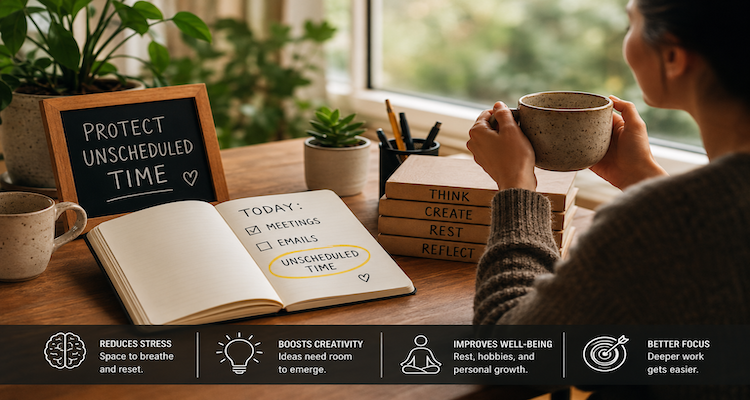
An empty space on the calendar used to look like wasted time. Increasingly, it can look like something worth defending.
That shift reflects a broader change in how people experience their days. Work messages arrive outside conventional hours, meetings appear with little warning, and digital services make it possible for other people’s requests to reach us almost continuously. Microsoft’s 2025 Work Trend Index, based on aggregated Microsoft 365 productivity signals, found that employees in its highest-volume group were interrupted by meetings, emails or chats roughly every two minutes during core work hours. The same report found that after-hours digital communication was also increasing.
Against that backdrop, unscheduled time has acquired a different meaning. It is no longer simply time when nothing is planned. It can be time that has not yet been claimed by work, notifications, appointments, errands or other people’s priorities.
Research on time pressure and well-being helps explain why that distinction matters. Studies have linked greater control over time with better well-being, while research on time-saving purchases suggests that reducing time pressure can improve daily mood and life satisfaction.
Key Takeaways
- Unscheduled time creates room for recovery, spontaneity and decisions that are not dictated by a calendar.
- Digital communication has made the boundary between available and unavailable time increasingly difficult to maintain.
- Research suggests that feeling time-poor can affect well-being even when a person is not objectively short of hours.
- Protecting free time is different from filling every empty period with entertainment or productivity.
- The most useful form of unscheduled time may be time whose purpose is deliberately left undecided.
The Calendar Is Becoming More Than a Planning Tool
For many people, a calendar once existed mainly to organize appointments. Now it can become a map of obligations.
Meetings, deadlines, exercise sessions, social commitments, school activities, errands and reminders can occupy nearly every visible gap. Digital calendars also make scheduling easier, which can create an unintended temptation: if an empty period exists, it can be filled.
The result is a subtle change in the meaning of free time.
A person can technically have several hours without a formal appointment while still feeling that those hours belong to something. An unanswered email may be waiting. A message may require a response. A task may have been postponed. Tomorrow’s meeting may need preparation.
This distinction between having time and feeling that time is available is important.
Research published in PNAS examined this broader problem through the concept of time scarcity. Across studies involving more than 6,000 participants in the United States, Canada, Denmark and the Netherlands, researchers found that people who spent money on time-saving services tended to report greater life satisfaction. A preregistered experiment involving working adults also found that spending money on a time-saving purchase, rather than a material purchase, reduced reported time stress and improved end-of-day positive affect.
The finding does not mean that everyone should outsource household chores or spend money to become happier. Its more interesting implication is that the subjective experience of having control over one’s time matters.
Why Unscheduled Time Feels Different
Not all free time is psychologically equivalent.
A two-hour block labeled “catch up on work” is free from meetings but not necessarily free from obligation. A two-hour block labeled “watch television” contains a predetermined activity. A completely open block offers something different: choice.
That choice can be valuable because it leaves room to respond to how a person actually feels at the moment.
Someone might walk outside, call a friend, read, cook, do nothing, pursue an unexpected idea or simply rest. The important feature is not the particular activity. It is the absence of a predetermined requirement.
Research on leisure supports a nuanced version of this idea. A 2024 longitudinal study of older adults in Japan found a positive association between leisure-time management and subsequent subjective well-being, although the researchers also noted that the practical effects were relatively modest.
That qualification matters. The evidence does not establish that an empty calendar automatically produces happiness. How free time is used, the person’s circumstances and the quality of the activities all matter.
The broader lesson is that time can be managed without every minute needing to be optimized.
The Hidden Cost of Constant Availability
The pressure to remain reachable adds another layer.
Digital communication has weakened the physical boundaries that once separated work from home. An office could close. A phone can continue receiving messages.
A 2025 study of 1,372 employees examined email overload during both work and leisure time. The researchers found that email overload during work was associated with higher job stress and lower job and life satisfaction, while overload extending into leisure was also associated with higher job stress and lower life satisfaction.
This does not prove that every notification damages well-being. Nor does it mean digital communication should be eliminated.
The more useful distinction is between communication that someone chooses to engage with and communication that continually demands attention.
When leisure becomes a period for catching up on unfinished work, responding to messages or monitoring notifications, the hours may remain technically outside working time while psychologically functioning as an extension of it.
That is one reason an unscheduled hour can become valuable. It provides a buffer against the expectation that every available moment should be immediately usable.
AI Could Make This Tension More Important
Artificial intelligence introduces an interesting contradiction.
AI can automate tasks, summarize information and reduce some administrative work. In principle, that should create more discretionary time.
But efficiency does not automatically create freedom.
If a task that once took an hour takes 20 minutes, an organization can use the remaining 40 minutes for additional work. Faster communication can generate more communication. Easier scheduling can produce more meetings.
Microsoft’s research illustrates this tension. Its 2025 Work Trend Index described a workday increasingly extending into early mornings, evenings and weekends. Its telemetry found that the average employee in the analyzed population received 117 emails and 153 Teams messages per weekday, while meetings beginning after 8 p.m. had increased 16% year over year. The data excluded education and European Union tenants, so it should not be interpreted as a universal picture of every workforce.
This is an important distinction for the AI era:
Saving time is not the same as creating free time.
The first is a productivity outcome. The second is a choice about what happens to the time that has been saved.
If organizations and individuals automatically fill every efficiency gain with additional obligations, technology may make people faster without making them feel less busy.
Protecting Time Means Protecting Choice
There is a temptation to turn unscheduled time into another productivity technique: schedule “nothing” from 3 to 4 p.m., track how effectively you relax, or create a carefully optimized leisure routine.
That can miss the point.
The value of unscheduled time is partly that its outcome is unknown.
It can allow boredom, spontaneity, reflection or simply a change of mind. It can also absorb the small disruptions that inevitably appear in real life. A schedule with no flexibility leaves little room for unexpected events, which means even minor delays can make the entire day feel like a failure.
Protecting open time therefore does not necessarily mean having more leisure hours. It can mean creating temporal slack a margin between obligations that allows a person to choose rather than react.
That margin can be particularly valuable for people whose schedules are controlled by other demands, including caregivers, managers, service workers and parents. An hour that looks empty on paper may already contain invisible responsibilities.
What Protecting Unscheduled Time Can Look Like
The idea does not require a radical lifestyle change.
A practical approach is to distinguish between scheduled free time and unscheduled free time.
Scheduled free time might include a gym session, dinner reservation or planned movie. These activities can be enjoyable and restorative.
Unscheduled time is different because no outcome has been assigned to it.
People trying to create more of it might:
- Leave a small part of the day without an appointment.
- Avoid automatically filling canceled meetings with new tasks.
- Establish periods when work notifications are not expected to receive immediate responses.
- Resist turning every productivity gain into another commitment.
- Keep some weekends or evenings deliberately less structured.
- Decide what to do with open time only when it arrives.
None of these practices guarantees better well-being. Their purpose is more modest: to restore some control over how available time is used.
That matters because the research on time-saving and leisure points toward the same broader idea from different directions: time has value beyond the activities performed during it.
The New Status Symbol May Be an Empty Calendar
For decades, being busy could signal importance. A packed calendar suggested demand, productivity and social connection.
But a permanently occupied schedule can also signal something less flattering: a lack of control over one’s time.
The growing interest in protecting unscheduled hours represents a quiet reversal. An empty space is no longer necessarily evidence that nothing is happening. It may indicate that someone has deliberately retained the ability to decide what happens next.
That distinction becomes increasingly relevant as digital systems make it easier to fill every gap.
The question is therefore not whether people should become less productive, less social or less organized. It is whether productivity should consume every piece of time it manages to create.
Conclusion
Unscheduled time is easy to underestimate because nothing measurable may happen during it.
Yet that may be precisely why it is becoming valuable.
When calendars, notifications and workplace systems continuously assign demands, an hour without a predetermined purpose can provide something productivity systems cannot: choice.
The emerging lesson is not that people need to do less. It is that some time may be worth protecting precisely because it has not yet been assigned a purpose.
In a culture increasingly capable of filling every available minute, leaving a few minutes empty can become an intentional act of control.
This content is published for informational or entertainment purposes. Facts, opinions, or references may evolve over time, and readers are encouraged to verify details from reliable sources.