










Why the World’s Power Grids Are Becoming More Important Than the Power Plants Connected to Them
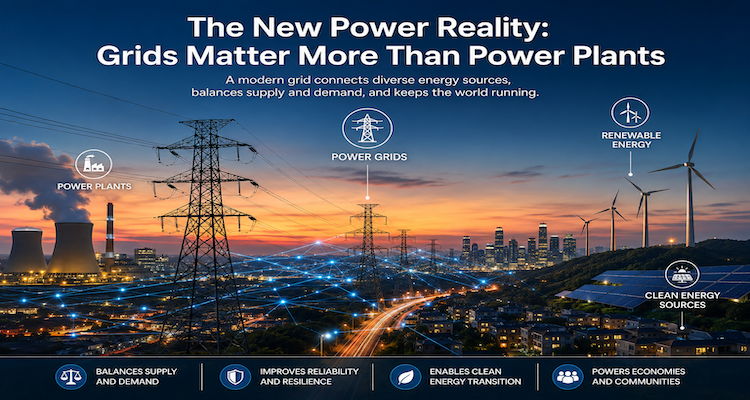
For most of the industrial age, the central question in electricity was relatively straightforward: Can we generate enough power? Build a coal plant, gas plant, hydroelectric dam, nuclear reactor or renewable project, and the problem appeared to be largely one of generation capacity.
That logic is becoming incomplete.
In 2026, the harder question in many electricity systems is increasingly whether the grid can move, balance and manage the electricity being produced and consumed. More than 2,500 gigawatts of renewable, storage and large-load projects including data centres are currently stalled in grid connection queues worldwide, according to the International Energy Agency (IEA). The agency says annual grid investment, now around $400 billion, would need to rise by roughly 50% by 2030 to keep pace with expected electricity demand.
That does not mean power plants have become unimportant. It means the economics and reliability of the electricity system increasingly depend on something less visible: the network connecting generators, batteries, factories, data centres and households.
Key Takeaways
- Electricity generation is expanding faster than many grids can connect and distribute it.
- More than 2,500 GW of projects are currently stalled in global grid connection queues.
- Data centres, electric vehicles and industrial electrification are creating new, highly concentrated electricity demand.
- Existing grids can sometimes deliver more capacity through smarter technologies before entirely new lines are built.
- Grid investment must increasingly focus on flexibility, digital control, storage and transmission not simply more generation.
- The emerging constraint is shifting from “Can we produce electricity?” toward “Can the system deliver it where and when it is needed?”
The Power Plant Is Only One Part of the Electricity System
A power plant produces electricity. A grid determines where that electricity can go, how much can move through a particular corridor, how different generators interact, and whether supply and demand remain balanced.
That distinction becomes critical when electricity generation is geographically separated from consumption.
A solar farm may have excellent sunlight but sit hundreds of kilometres from a major population centre. A wind project may produce abundant electricity in a remote region while factories and data centres are concentrated elsewhere. A nuclear plant can provide large quantities of steady generation but still requires transmission infrastructure to reach consumers.
The U.S. Energy Information Administration notes that new transmission is needed not only to maintain reliability but also to connect renewable resources that are often located far from major centres of electricity demand. Older transmission and distribution infrastructure also needs replacement or upgrading.
This makes the grid more than an electrical highway. It is becoming the coordination layer of the power system.
Generation Is Growing. The Network Has to Catch Up.
The imbalance is visible in global investment.
The IEA estimates that spending on electricity grids reached about $400 billion in 2024, after remaining around $300 billion annually for much of the previous decade. At the same time, renewable generation investment has expanded rapidly.
The problem is that a generation project and a grid project do not necessarily move at the same speed.
Solar and wind projects can often be developed comparatively quickly. Grid infrastructure can require lengthy planning, permitting, land acquisition, equipment procurement and construction.
The IEA’s 2026 analysis estimates that new grid infrastructure can take five to 15 years to plan and build, compared with roughly one to five years for renewable projects such as solar and wind.
That creates an unusual situation: the world can build electricity generation faster than it can build the infrastructure needed to use all of it.
The consequence is not necessarily a shortage of power plants. It can instead be a shortage of connection capacity.
The Queue Has Become a Strategic Problem
Grid connection queues are one of the clearest indicators of this shift.
Developers can have land, financing, equipment and a viable project but still be unable to operate because the local network cannot safely accommodate another generator or large consumer.
The IEA estimates that more than 2,500 GW of renewable, storage and large-load projects are currently stalled in connection queues worldwide.
The figure should not be interpreted as 2,500 GW of guaranteed future capacity. Projects can be cancelled, redesigned or withdrawn, and queue methodologies differ between markets.
But the scale is still revealing.
A queue is effectively a list of electricity projects waiting for permission from the physical network.
That changes the investment equation. Developers increasingly have to ask not just:
Where can we build the cheapest generation?
but:
Where can we actually connect it?
AI Is Turning Grid Capacity Into a Technology Bottleneck
Artificial intelligence adds another dimension because data centres concentrate enormous electricity demand in specific locations.
The IEA expects electricity consumption from data centres to more than double to around 945 TWh by 2030. In the United States, data centres are projected to account for nearly half of electricity-demand growth through 2030.
This creates a problem that cannot be solved simply by adding more generation somewhere on the planet.
A data centre needs electricity at its physical location, with the necessary transmission, substations, transformers and distribution infrastructure.
That is why grid availability is increasingly becoming part of the technology industry’s site-selection equation.
The IEA’s 2025 Energy and AI analysis found that grid constraints could delay around 20% of global data-centre capacity planned for construction by 2030.
This is one of the clearest examples of the changing relationship between electricity and technology.
For decades, computing companies largely treated electricity as an input they purchased. For the largest AI infrastructure projects, the availability and location of the electricity network can influence where computing capacity can be built.
America Is Seeing the Same Problem From the Other Direction
The issue is not confined to renewable energy or Europe.
In July 2026, the U.S. Department of Energy released a draft National Transmission Needs Study identifying additional transmission infrastructure as a pressing requirement because of load growth from data centres, domestic manufacturing, industrial electrification and new generation.
The DOE also highlighted an important characteristic of congestion: much of it is concentrated in a relatively small number of hours rather than occurring uniformly throughout the year.
That matters because it suggests that simply building enormous amounts of new transmission may not always be the only answer.
If a line is constrained for a handful of high-stress hours, better ways of managing the network may unlock useful capacity without immediately constructing an entirely new corridor.
The Next Grid May Be Smarter Before It Is Bigger
One of the most important developments in electricity infrastructure is therefore not a new type of power plant.
It is the growing ability to extract more capacity from infrastructure that already exists.
The IEA’s 2026 grid analysis identifies several approaches, including:
- dynamic line rating, which can adjust transmission limits according to actual conditions;
- advanced power-flow control;
- reconductoring existing lines;
- voltage uprating;
- more flexible, non-firm connection agreements;
- better congestion management;
- co-location of generation and battery storage.
Together, the IEA estimates that such measures could potentially unlock enough capacity to connect around 1,200–1,600 GW of advanced-stage projects currently stuck in queues.
This is a crucial distinction.
The solution to an electricity bottleneck does not always have to be another power station or another transmission corridor. Sometimes it is better information, better control, different operating rules or better use of existing physical infrastructure.
That makes software and power electronics increasingly important parts of the electricity system.
Flexibility Is Becoming as Important as Capacity
Traditional electricity systems were designed around relatively predictable demand and controllable generation.
The emerging system is more complicated.
Solar output changes with sunlight. Wind output changes with weather. Batteries can charge or discharge. Electric vehicles can create new peaks. Heat pumps increase demand under particular weather conditions. AI data centres can create very large, geographically concentrated loads.
The IEA therefore places growing emphasis on system flexibility the ability of electricity systems to respond to changing supply and demand without compromising reliability.
That flexibility can come from several places:
Generation: Some power plants can increase or decrease output quickly.
Storage: Batteries can absorb electricity when supply is abundant and return it when needed.
Demand response: Consumers and businesses can shift some electricity use away from periods of system stress.
Transmission: Stronger connections allow electricity to move between regions with different supply and demand conditions.
Digital control: Better monitoring and automation can allow operators to manage increasingly complex networks.
The result is an electricity system that behaves less like a one-way pipeline and more like a continuously coordinated network.
Why Building More Power Plants Alone Can Fail
Imagine a region that needs another 5 gigawatts of electricity.
A conventional response might be to build several new power plants.
But suppose the local transmission system cannot carry the additional electricity during peak conditions.
The new plants may still be valuable, but they cannot solve the immediate bottleneck.
This is why the distinction between generation capacity and deliverable electricity matters.
A megawatt of generation capacity in the wrong location is not equivalent to a megawatt of dependable electricity available to a constrained load centre at the required moment.
The same principle applies to renewable energy. A country can install enormous quantities of solar and wind capacity while still needing substantial investment in transmission, storage, balancing resources and distribution networks.
The IEA has previously described grids as a potential bottleneck for clean-energy transitions because grid investment has lagged behind the rapid expansion of renewable generation.
The Business Consequence: Location Is Becoming an Energy Decision
This shift has consequences far beyond utilities.
For technology companies, electricity-intensive data centres increasingly have to consider grid availability alongside land, fibre connectivity, cooling, taxes and construction costs.
For manufacturers, reliable electricity can determine whether a new factory can operate at the intended scale.
For renewable developers, access to transmission can influence whether a project is commercially viable.
For investors, a generation project without a credible path to grid connection can carry very different risks from one with secured interconnection.
For governments, transmission planning is becoming an industrial-policy issue as well as an energy-policy issue.
The U.S. DOE’s 2026 transmission study explicitly links transmission needs with data centres, manufacturing, industrial electrification, reliability and congestion.
That is an important evolution in the role of the grid.
It is no longer merely infrastructure that sits underneath the energy economy. It increasingly helps determine where the energy economy can grow.
The Grid May Become the Most Valuable Constraint to Solve
There is a temptation to interpret the grid story as an argument against building more generation.
That would be the wrong conclusion.
The world still needs additional electricity generation, storage and transmission capacity. Renewable generation is continuing to expand, while electricity demand is rising because of transport electrification, cooling, industry, data centres and other uses.
The more important lesson is that these investments can no longer be treated independently.
A power plant, battery, transmission line, substation and large electricity consumer increasingly form one interconnected investment decision.
The IEA estimates that annual grid investment would need to increase by approximately 50% from today’s roughly $400 billion level by 2030 to meet projected electricity demand.
That is not simply a construction challenge. It involves permitting, regulation, manufacturing capacity, skilled labour, planning methodologies, cost allocation and coordination between regions.
In other words, the electricity transition is becoming partly a network-management problem.
What This Means for the Next Decade
The most consequential electricity infrastructure may not always be the facility that produces the largest number of megawatt-hours.
It may be the infrastructure that allows many different sources and consumers to operate together.
That means transmission corridors connecting regions, distribution upgrades serving new loads, substations, transformers, batteries, advanced power-flow controls, digital monitoring systems and rules that allow electricity users to respond more intelligently to grid conditions.
The distinction between “power generation” and “the grid” is therefore becoming less useful as a way of understanding the electricity economy.
The real asset is increasingly the whole system.
A solar farm without transmission can be stranded. A data centre without sufficient grid capacity cannot operate at its intended scale. A battery without an appropriate connection cannot provide its full value. And a transmission line without flexible resources may still struggle to manage increasingly variable electricity flows.
The power plant remains essential.
But the grid is becoming the infrastructure that determines whether the power plant, battery, factory or data centre can actually perform its economic role.
Conclusion
The electricity industry’s centre of gravity is shifting from a simple question of how much electricity can be generated toward a more complicated question: how effectively can electricity be moved, balanced and delivered when and where it is needed?
That is why grids are becoming strategically more important.
The world’s energy transition, industrial expansion and AI infrastructure boom are all converging on the same physical system. Generation can be built relatively quickly, but networks take longer to plan, permit and construct. Meanwhile, smarter grid technologies and flexible operating rules can sometimes unlock capacity before major infrastructure arrives.
The defining electricity challenge of the coming decade may therefore be less about building one more power plant and more about making millions of components work together.
The grid is becoming the system that turns electricity capacity into usable economic capacity.
The information presented in this article is based on publicly available sources, reports, and factual material available at the time of publication. While efforts are made to ensure accuracy, details may change as new information emerges. The content is provided for general informational purposes only, and readers are advised to verify facts independently where necessary.
Related News
- The Energy Paradox of Efficiency: Why Using Less Electricity Does Not Always Mean Using Less Energy
- Why Extreme Weather Is Turning Electricity Resilience Into an Everyday Consumer Issue
- Why Energy Independence Is Becoming a Household Decision, Not Just a National Strategy
- The Hidden Energy Cost of Keeping Everything Available Instantly