









The Power Plants That Get Paid to Stop Producing Electricity
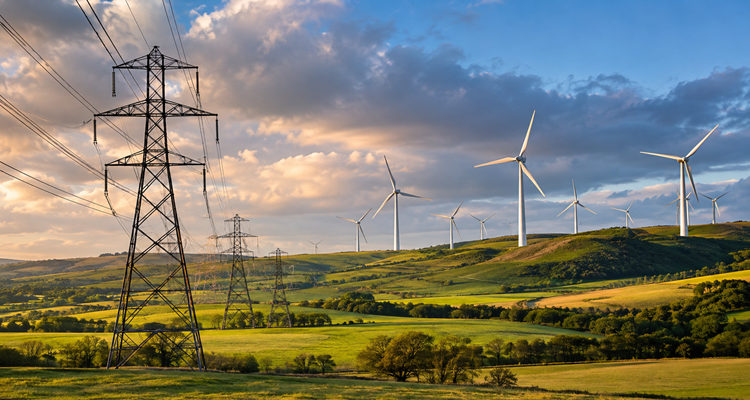
Why wind farms sometimes earn money for switching off, how electricity grid bottlenecks create costly contradictions, and what this reveals about the future of clean energy.
Imagine a wind farm surrounded by powerful winds, its turbines capable of producing electricity for thousands of homes. The equipment is working, the energy is available, and people elsewhere still need electricity.
Yet the grid operator tells the wind farm to reduce production.
Even more surprisingly, the operator may receive payment for generating less electricity.
This is not a hypothetical flaw in the energy system. It is an established feature of electricity markets, particularly in places where renewable generation has expanded faster than the infrastructure needed to transport its output.
In Great Britain, for example, wind farms received £370 million in payments to reduce generation during the 2024–25 financial year, according to the UK government’s electricity-market reform documentation. Meanwhile, increasing output from gas-fired power stations to help replace constrained generation cost approximately £910 million.
The apparent contradiction has a technical explanation: producing electricity and delivering it to the people who need it are two different challenges.
Understanding that distinction reveals why electricity can be wasted even when it is valuable, why consumers can end up paying for power that was never generated, and why building more renewable capacity is only part of the energy transition.
Why Would Anyone Pay a Power Plant to Switch Off?
Electricity networks must continuously balance generation and consumption while keeping power flows within safe operating limits.
Unlike water stored in a reservoir, electricity moving through a conventional grid cannot simply accumulate in transmission lines until somebody needs it. Supply and demand must remain closely matched, with storage and other flexible resources helping manage differences.
But matching total supply and demand is not enough.
Electricity must also be able to travel through the network without overloading cables, transformers, and other equipment.
Consider a simplified example.
A region has wind farms capable of producing 5,000 megawatts (MW) of electricity. Local consumers need only 1,000 MW, leaving 4,000 MW potentially available for other regions.
However, the transmission network can safely export only 2,500 MW.
Illustrative electricity grid bottleneck
Hypothetical example, not actual grid data. The bottleneck prevents all available electricity from reaching distant consumers.
The wind farms could produce more electricity, and consumers elsewhere could use it, but the connecting infrastructure cannot carry the full amount.
The grid operator therefore instructs some generators to reduce output. This process is called generation curtailment.
When generators are compensated for reducing output because of network limitations, the payments are commonly called constraint payments.
Britain’s National Energy System Operator (NESO) explains that such actions help prevent equipment from overheating and allow the electricity system to operate securely.
The payment is not necessarily a reward for wasting energy. It is part of a market arrangement for changing previously scheduled generation to accommodate the physical limits of the network.
How Wind Farms Can Earn Money Without Generating Electricity
The financial mechanism is more complicated than simply paying a company to turn off a switch.
Electricity generators may have sold power in advance, entered contractual arrangements, or expected revenues linked to their electricity production.
When a grid operator instructs a generator to reduce output, the intervention can change that generator’s financial position.
In Britain’s Balancing Mechanism, generators submit prices indicating what they are willing to pay or receive to change their output.
For certain wind farms, reducing production can mean losing revenues associated with renewable electricity support arrangements. Their balancing offers may therefore involve receiving compensation for turning down.
Other generators can behave differently. A gas-fired plant asked to reduce output may save fuel costs and submit an offer that results in money flowing back to the system operator.
Consequently, not every power plant receives money when it stops producing electricity.
The direction and size of a payment depend on the market rules, the generator’s commercial arrangements, and the circumstances of the intervention.
NESO’s 2026 technical analysis also makes an important distinction: some subsidy-related costs appearing in balancing payments would otherwise have been paid through different mechanisms. They should not automatically be interpreted as entirely new costs to consumers.
A simplified example of a curtailment payment
Suppose a wind farm has been scheduled to produce 100 megawatt-hours (MWh) of electricity during a particular period.
The grid operator needs it to reduce that output to zero because a transmission line is congested.
The wind farm has submitted an accepted bid under which it receives £50 for every MWh of reduced generation.
ILLUSTRATIVE CALCULATION
Reduced generation
100 MWh
Payment per MWh
£50
Total curtailment payment
£5,000
Hypothetical figures showing how a payment can be calculated. This is gross payment, not necessarily the generator’s profit.
The wind farm has received £5,000 despite producing none of the scheduled electricity during that period.
But the grid operator may still need to replace that electricity with generation somewhere else.
That leads to the second, often more expensive, part of the problem.
The Double Cost: Paying One Plant to Stop and Another to Start
Imagine strong winds across Scotland while electricity demand is high in southern England.
Scottish wind farms may be capable of producing substantial amounts of electricity at low operating cost. But if the transmission network connecting the regions is congested, all that power cannot reach consumers farther south.
The system operator may respond by taking two actions:
-
Reduce wind generation on the constrained side of the network.
-
Increase generation, often from gas-fired power stations, on the other side.
Both actions can cost money.
The wind farm may receive a payment to reduce production, while the replacement generator may receive payment to increase its output.
In the 2024–25 financial year, the UK government’s breakdown of direct thermal-constraint actions reported £370 million in wind turn-down payments and £910 million associated with increasing gas generation.
This is an important distinction because discussions of wind curtailment sometimes focus exclusively on what wind farms receive.
In reality, the cost of replacing constrained electricity can be considerably greater.
There are also environmental consequences. When available wind electricity is curtailed and fossil-fuel generation is increased elsewhere, the replacement generation can produce emissions that would have been avoided if the renewable electricity could have reached consumers.
The underlying issue is not necessarily a shortage of generating capacity.
It is a shortage of usable transmission capacity in the right places.
How Big Is the Problem?
Britain provides one of the clearest documented examples of the financial consequences of electricity transmission congestion.
According to NESO’s November 2026 Thermal Constraints Update, thermal constraints accounted for approximately 65% of electricity balancing costs in the 2025–26 financial year, equivalent to around £2 billion.
Britain’s thermal constraint costs, 2025–26
Constraint costs
~£2bn
Share of balancing costs
~65%
Source: NESO, November 2026. Figures are approximate and refer to thermal constraints, not just payments to wind farms.
These costs matter because electricity system balancing expenses are ultimately recovered from consumers through electricity charges.
NESO reported that broader balancing-service charges represented approximately 4.3% of a typical domestic electricity bill in 2025–26, or around £41 annually. That figure includes more than just transmission constraints, so it should not be treated as the direct household cost of wind curtailment alone.
The problem also extends beyond the immediate expense.
A renewable electricity system requires investment in wind farms, solar installations, storage, transmission lines, and other infrastructure. When these components develop at different speeds, some investments cannot deliver their full potential.
A wind turbine might be technically available but commercially constrained. A transmission line might be fully utilized while consumers elsewhere still rely on more expensive generation.
The result is a system with plenty of generating equipment but insufficient flexibility to use it efficiently.
Why Not Just Build More Power Lines?
Expanding transmission capacity is an obvious response, but constructing major electricity infrastructure is neither quick nor inexpensive.
New transmission projects can require years of planning, environmental assessments, regulatory approval, land access negotiations, equipment procurement, and construction.
Large projects may also encounter public opposition, particularly when overhead lines cross landscapes or communities.
Even after approval, obtaining transformers, specialized cables, and other electrical equipment can introduce delays.
Britain’s National Audit Office has warned that delays to transmission upgrades could increase consumer costs as renewable electricity generation expands. Its assessment identified substantial risks to the delivery schedules of planned network improvements.
There is also an economic question.
It would be possible to build a transmission system large enough to carry nearly every conceivable peak in renewable generation. But such a network could be extraordinarily expensive and underused for much of the year.
Some curtailment may therefore be economically rational.
The important question is not whether every lost megawatt-hour can be eliminated. It is whether the cost of avoiding curtailment is lower than the benefits of doing so.
A new transmission line that costs billions might be worthwhile if it prevents even larger costs over its lifetime. But building expensive infrastructure to eliminate a small amount of occasional curtailment might not represent good value.
NESO emphasized this distinction in its 2026 assessment: reducing constraint costs is not automatically the same as minimizing the overall cost of electricity to consumers.
Is This the Same as Negative Electricity Prices?
No. Although both situations can involve excess generation, they are different market phenomena.
Curtailment payments arise when a generator is instructed to reduce production, often because of a transmission constraint or another operational requirement.
Negative electricity prices occur when wholesale market conditions result in electricity being priced below zero.
During negative-price periods, some generators may effectively pay to supply electricity rather than receive payment for it.
That can happen when a generator has strong financial or technical reasons to keep operating.
For example, shutting down and restarting a large thermal power station can be costly. Some renewable generators may also have contractual or policy incentives that make continued production economically attractive even when wholesale prices turn negative.
The U.S. Energy Information Administration has documented how technical limitations, generation incentives, and transmission congestion can contribute to negative wholesale prices.
| Situation | What happens? |
|---|---|
| Curtailment payment | A generator may receive compensation for reducing output |
| Negative wholesale price | A generator may pay to continue supplying electricity |
| Network congestion | Electricity cannot move freely between locations |
| Oversupply | Available generation exceeds demand at a particular time or location |
Negative prices can also encourage flexible consumers to use more electricity when supply is abundant.
For instance, an industrial facility that can shift its operations may benefit from consuming electricity during low-price periods.
But a negative wholesale price does not necessarily mean households receive free electricity. Retail tariffs include network charges, taxes, supplier costs, and other components, and only certain contracts directly expose customers to short-term wholesale prices.
Can Batteries Solve the Problem?
Electricity storage offers a promising way to reduce wasted renewable generation.
Instead of shutting down a wind farm when local production exceeds available demand or transmission capacity, a nearby battery can absorb some of the electricity.
That stored energy can be released later, when demand increases, renewable output declines, or transmission capacity becomes available.
Their usefulness depends on their storage capacity, charging and discharging power, location, and the duration of the constraint.
A battery designed to store electricity for two hours cannot necessarily absorb several days of surplus wind production.
Storage can also be ineffective for relieving a particular bottleneck if it is located on the wrong side of the constrained transmission line.
Other forms of flexibility may help, including pumped-storage hydropower, shifting industrial electricity demand, and using surplus renewable generation for suitable energy-intensive processes.
The location and timing of these solutions are just as important as their total capacity.
Could Electricity Be Used Instead of Wasted?
One alternative to curtailment is to increase demand where excess renewable electricity is available.
This is sometimes called demand-side flexibility.
For example, industrial facilities might schedule electricity-intensive activities during periods of abundant wind or solar generation.
Electric vehicles could charge when electricity is plentiful, provided charging infrastructure and user requirements allow it.
Some heating systems could store thermal energy for later use.
Hydrogen production through electrolysis is another possibility, although its economics depend on equipment costs, utilization rates, electricity prices, and the eventual demand for hydrogen.
None of these approaches automatically eliminates curtailment. They require the right infrastructure, economic incentives, and operational flexibility.
Nevertheless, they point toward a different way of thinking about electricity systems.
Historically, grid operators largely adjusted electricity generation to follow consumer demand.
Increasingly, some electricity demand can also be adjusted to follow the availability of renewable generation.
That shift could make renewable-heavy systems more efficient without requiring every unit of electricity to travel long distances.
Are Power Companies Exploiting the System?
Payments for reducing electricity production can understandably appear unfair, especially when consumers face expensive bills.
But receiving a constraint payment is not, by itself, evidence of wrongdoing.
The payment may reflect legitimate contractual obligations, lost revenue, or the market rules established to maintain electricity system reliability.
At the same time, market design can create incentives that deserve scrutiny.
If generators can profit disproportionately from network constraints, the system may encourage commercially rational behavior that does not minimize costs for consumers.
The challenge for regulators is to distinguish reasonable compensation from excessive costs and incentives that encourage inefficient outcomes.
Transparency matters here.
Publicly available balancing-market data can help reveal which generators are being instructed to change output, how frequently constraints occur, and how much the resulting actions cost.
But individual payment totals must be interpreted carefully. A large payment does not automatically establish an equally large profit, because it may offset revenues that the generator otherwise would have earned.
A meaningful assessment must consider contracts, subsidies, operating costs, alternative revenues, and the costs imposed on the wider electricity system.
What Needs to Change?
The long-term response requires more than one technology or policy.
Expand capacity where the long-term benefits justify the costs, while improving how existing lines are used.
Install batteries and other storage technologies where they can absorb surplus generation and relieve congestion.
Encourage suitable industrial and consumer activities to shift consumption toward periods and places with abundant electricity.
Design pricing, contracts, and balancing arrangements that better reflect network limitations and overall system costs.
Britain’s April 2026 Reformed National Pricing delivery plan includes measures intended to improve investment decisions, reduce constraints, and encourage more efficient electricity system operation.
NESO’s November 2026 assessment likewise identifies network reinforcement, strategic planning, market reform, and operational improvements as central priorities.
It also reports that initiatives to make better use of the existing network and improve constraint management delivered approximately £430 million in avoided thermal-constraint costs during 2025–26.
That finding is significant because it shows that reducing waste does not always require waiting for entirely new power lines.
Better coordination and operational decisions can produce measurable benefits using infrastructure that already exists.
The Bigger Lesson: More Electricity Is Not Always More Useful Electricity
The story of power plants being paid to stop producing electricity illustrates a fundamental challenge of the energy transition.
The goal is not simply to generate as much clean electricity as possible.
It is to deliver reliable, affordable, low-emission electricity when and where people need it.
A wind farm that produces electricity during a period of high demand can be extremely valuable. But if its output cannot reach consumers, its immediate usefulness is limited.
Similarly, a battery may be valuable not because it creates electricity, but because it makes existing electricity available at a better time.
A transmission line may be valuable because it allows distant renewable generation to replace more expensive or higher-emission local generation.
These components are interconnected. Their economic value depends partly on how well the entire system works.
The paradox of paying power plants to stop producing electricity is therefore not proof that renewable energy is inherently wasteful.
It is evidence that electricity generation, transmission, storage, and demand must develop together.
As electricity systems become increasingly dependent on wind and solar power, the most important investments may not always be the ones that produce additional electricity.
Sometimes, they will be the investments that make better use of electricity already available.
And that is the central lesson behind one of the energy industry’s strangest-sounding payments: a power plant can be paid to stop producing because the grid is not yet equipped to make full use of what it could generate.
The information presented in this article is based on publicly available sources, reports, and factual material available at the time of publication. While efforts are made to ensure accuracy, details may change as new information emerges. The content is provided for general informational purposes only, and readers are advised to verify facts independently where necessary.
Related News
- The Electricity Your Neighbour Uses That Could Make Your Own Power Bill Smaller
- The Electricity We Waste Because Buildings Cannot Predict an Empty Room
- The Energy Paradox of Efficiency: Why Using Less Electricity Does Not Always Mean Using Less Energy
- Why Extreme Weather Is Turning Electricity Resilience Into an Everyday Consumer Issue