








The Cheese That Gets Its Flavour From Tiny Creatures Living on Its Surface
In parts of Europe, cheesemakers deliberately allow microscopic animals to live on their cheese. Far from being an accident, these tiny creatures help create flavours, aromas and textures that ordinary ageing cannot produce in quite the same way.
Most people expect cheese to be made with milk, salt, cultures and time. They might also know that certain cheeses depend on bacteria or mould to develop their distinctive character.
But some traditional European cheeses have an even more unusual ingredient: living cheese mites.
These tiny, spider-related creatures inhabit the outer surface of certain cheeses as they mature. They feed, move and reproduce on the rind, gradually changing its appearance and contributing to the cheese’s flavour.
Two remarkable examples are France’s Mimolette and Germany’s Milbenkäse. Both demonstrate how cheesemaking can turn an organism usually regarded as a pest into part of a carefully managed food tradition.
And scientists have discovered something particularly surprising: at least one flavour associated with these cheeses comes directly from chemicals produced by the mites themselves.
Meet the tiny creatures responsible for the flavour
They are attracted to the nutrient-rich environment of ageing cheese, particularly its natural rind.
In ordinary cheese production, an uncontrolled mite population is generally considered undesirable. The mites can damage the rind, affect the cheese’s appearance and create hygiene or quality problems.
However, certain traditional cheesemakers deliberately work with these organisms.
The distinction is important. A mite infestation is not automatically a desirable part of cheesemaking. In specially developed mite-ripened cheeses, the organisms are incorporated into an established maturation process.
According to the American Society for Microbiology, the relationship between cheese mites and cheesemaking has a long history, particularly in European traditions where the mites are intentionally used during ripening.
Mimolette: The French cheese with a cratered rind
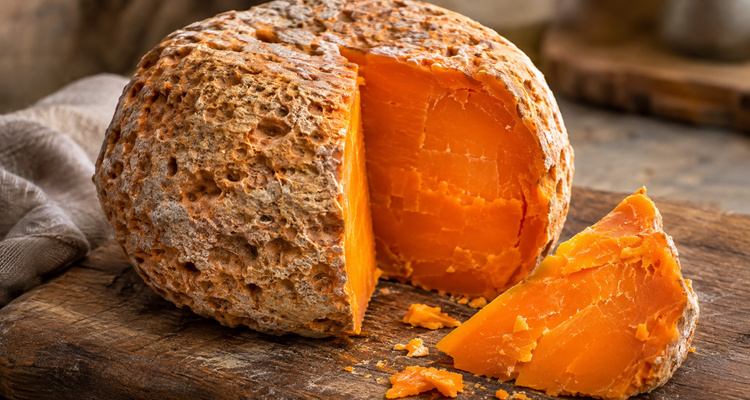
At first glance, an aged wheel of Mimolette can resemble a small, weathered planet.
Its exterior is hard, uneven and covered in tiny pits. Cut through the rind, however, and the cheese reveals a striking deep-orange interior.
Mimolette is a firm French cheese whose character develops through ageing. It is often described as having nutty, savoury and sometimes caramel-like notes, especially when well matured.
The unusual rind is part of what makes it distinctive.
During traditional ageing, cheese mites inhabit the surface and contribute to its rough, cratered appearance. Their activity is associated with changes in the rind and the cheese’s sensory characteristics.
The mites do not simply decorate the exterior. Their presence forms part of the biological environment in which the cheese matures.
Research published in the Journal of Dairy Science has examined the mite species associated with Mimolette and Germany’s Milbenkäse, helping establish the organisms involved in these unusual ageing processes.
The result is a cheese that illustrates how the outside of a wheel can be just as important to its development as the interior.
Milbenkäse: Germany’s cheese matured with mites
In the German village of Würchwitz, cheesemaking takes the relationship with mites even further.
The local speciality, Milbenkäse, literally means “mite cheese”.
Unlike cheeses where mites are considered unwanted visitors, Milbenkäse is intentionally matured in their presence. Traditional production involves keeping the cheese with mites in wooden containers, allowing their activity to contribute to the ripening process.
The organisms help transform the cheese as it ages, while their secretions contribute distinctive aromatic compounds.
This tradition is sufficiently important to the area’s identity that Würchwitz even has a sculpture celebrating the cheese mite.
The American Society for Microbiology describes Milbenkäse as a striking example of how organisms typically associated with food spoilage can have a deliberately beneficial role in a traditional food.
Its significance extends beyond unusual culinary curiosity. Milbenkäse preserves a specialised cheesemaking technique in which the living creatures are essential to the product’s identity.
The science: How can a tiny mite change the taste of cheese?
The most fascinating aspect of mite-ripened cheese is not simply that tiny animals live on its surface.
It is that their biology can directly influence what people smell and taste.
In 2016, researchers investigating Mimolette and Milbenkäse identified a compound called neral in secretions produced by the cheese mites.
Neral is also found in lemon oil and has a citrus-like aroma.
The researchers found that this compound was associated with the mites and was absent from the headspace of corresponding cheeses without them. This supported the conclusion that the lemon-like aromatic note came from mite secretions rather than cheese fermentation alone.
That finding adds an unexpected dimension to the science of food flavour.
We often think of flavour development in cheese as a process driven by bacteria, moulds and enzymes acting on milk proteins and fats. Those processes remain fundamental, but mite-ripened cheeses demonstrate that tiny animals can also introduce aromatic substances.
A subsequent study published in Experimental and Applied Acarology in 2022 investigated mite secretions across several traditional cheeses, including Mimolette, Milbenkäse and French Artisou.
It reinforced the importance of neral in the characteristic lemon-like aroma associated with mite-ripened cheeses, while also showing that the chemical relationship between mites and cheese can vary between varieties.
This does not mean that every flavour in Mimolette or Milbenkäse comes from mites. Milk composition, salt, microbial activity, moisture and maturation conditions still matter.
Instead, the mites add another layer to an already complex biological process.
Why cheesemakers sometimes welcome organisms others try to remove
The difference between a valued ageing organism and an unwanted pest often comes down to control, tradition and the intended result.
In conventional cheesemaking, producers generally work to prevent mite damage. Uncontrolled populations can compromise the quality of cheese and create unwanted surface changes.
In traditional mite-ripened varieties, however, the organisms are part of the production method.
This distinction resembles the way certain moulds are welcomed in blue cheeses or soft-ripened cheeses but would be considered spoilage in products where they do not belong.
The lesson is not that infestation makes food better. It is that some food traditions have developed specific ways of using biological processes that would be undesirable in other circumstances.
The same organism can therefore be a problem in one cheesemaking environment and a useful contributor in another.
Is cheese made with mites safe to eat?
The idea of eating cheese that has hosted tiny animals naturally raises questions about food safety.
The answer depends on the cheese, how it has been produced and handled, and the individual consuming it.
Cheese mites can be associated with allergic reactions, particularly in people sensitised to mites. Uncontrolled infestations may also indicate problems with storage or cheese quality.
However, the presence of mites during the controlled production of a traditional cheese is not equivalent to discovering an unexpected infestation in food at home.
In some mite-ripened cheeses, the rind may be brushed or otherwise cleaned before sale or consumption. This does not necessarily eliminate every trace of the organisms or their activity.
Research into the sensory qualities of mite-ripened cheeses should not be confused with proof that every product containing mites is safe. Food safety depends on appropriate production standards, handling and individual sensitivities.
For consumers, the sensible approach is to purchase cheese from reputable producers and follow their guidance about whether the rind is intended to be eaten.
People with known mite allergies should exercise particular caution.
Are cheese mites the same as the maggots found in Casu Marzu?
No. Although both involve small animals participating in cheese maturation, they are very different traditions.
Sardinia’s famous Casu Marzu is produced using larvae of the cheese fly, Piophila casei.
Unlike cheese mites, which are tiny arachnids, these larvae are immature insects. They work through the cheese itself, breaking down its structure and helping transform it into a soft, intensely flavoured product.
Casu Marzu also raises different food-safety concerns. European food regulations prevent its commercial marketing under the traditional production method because of the risks associated with live larvae.
Mimolette and Milbenkäse should therefore not be confused with Casu Marzu simply because all three involve animals in the ageing process.
Their organisms, production methods and safety considerations are different.
What these unusual cheeses reveal about food
Mite-ripened cheeses offer a fascinating reminder that food is often the product of relationships between humans and other living organisms.
Cheesemaking has always relied on biological transformation. Microorganisms convert milk into products with extraordinary differences in texture, aroma and flavour.
Mimolette and Milbenkäse expand that picture by showing how small animals can participate in the process.
Their unusual character also challenges a simple assumption: that any living creature found on food must be there by accident.
In controlled traditional production, the presence of these mites is intentional, and their activity contributes to the cheese’s distinctive qualities.
At the same time, their use requires knowledge and care. The fact that mites have a role in particular cheeses does not make uncontrolled infestation desirable or harmless.
Perhaps the most interesting discovery is that the mites are not merely changing the cheese indirectly. Scientific research has shown that their own secretions can contribute a recognisable citrus-like aroma.
That makes these cheeses remarkable examples of the complexity hidden within familiar foods.
A flavour created by an unexpected partnership
Mimolette and Milbenkäse may look like ordinary aged cheeses from a distance, but their surfaces reveal a much stranger story.
Their character develops through a combination of traditional cheesemaking, time, microbial activity and the presence of tiny animals that most people would never associate with food production.
What makes them special is not simply that mites live on their surfaces. It is that generations of cheesemakers have found ways to incorporate these creatures into distinctive culinary traditions.
And modern research has helped explain why the results can taste so unusual.
Sometimes, the secret behind a memorable flavour is not a rare ingredient or an elaborate recipe.
It is a tiny living creature doing what comes naturally.
This content is published for informational or entertainment purposes. Facts, opinions, or references may evolve over time, and readers are encouraged to verify details from reliable sources.