








The Fish That Change Their Sex When Their Social World Falls Apart
On coral reefs, the disappearance of a dominant fish can trigger an extraordinary biological transformation. Some fish change their behavior, reproductive organs, and even patterns of gene activity to take on a new role in their community.
On a Caribbean coral reef, a dominant male fish disappears from his territory. Perhaps a predator has taken him, or he has simply been removed from the group. Whatever the cause, his absence creates an opening in the social hierarchy.
For one of the females left behind, that opening can change almost everything.
Within minutes, she may begin behaving like a dominant male. Over the following days, her coloration can shift, her ovaries can transform into testes, and her body can become capable of producing sperm.
This is not science fiction or a rare biological accident. It is a natural reproductive strategy found in several groups of fish.
The phenomenon is known as sequential hermaphroditism, and it reveals something remarkable about life beneath the waves: in certain species, biological sex is not permanently fixed at maturity. Instead, it can change in response to social circumstances.
The bluehead wrasse provides one of the most dramatic examples. Clownfish demonstrate a different version of the same principle, changing from male to female when the dominant female disappears.
Together, these animals offer scientists an unusual opportunity to investigate how social relationships can influence hormones, gene activity, and the development of reproductive organs.
A Reef Society Where Rank Determines Reproduction
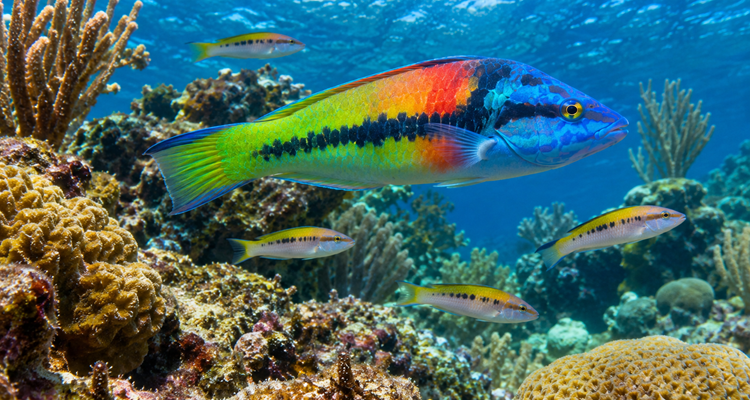
The bluehead wrasse (Thalassoma bifasciatum) lives on tropical western Atlantic coral reefs, including those of the Caribbean.
Its social organization can involve a large, brightly colored male defending a breeding territory where females gather. Smaller males may also be present, using different reproductive strategies.
The dominant male’s position matters because it provides access to reproductive opportunities. But that position is not necessarily permanent.
When a territorial male disappears, the social structure changes. A sufficiently large female may begin taking over the vacant role.
In a landmark 1991 study, researchers Robert Warner and Stephen Swearer experimentally removed dominant males from local bluehead wrasse populations. They observed females rapidly adopting male-associated behavior, with some spawning in the male role on the same day.
The researchers also examined control groups where dominant males were handled but returned. Those groups did not show the same pattern of sex change.
This distinction was crucial. It demonstrated that the disappearance of the dominant male, rather than simply the disturbance caused by researchers, could initiate the transformation.
The fish were responding to a change in their social environment.
How a Female Fish Can Become a Male in Days
The transformation of a bluehead wrasse involves several connected processes. Behavioral changes can begin almost immediately, while the reproductive organs require more time to reorganize.
The bluehead wrasse transformation
Approximate sequence observed in research; timing varies among individuals.
-
Within minutes to hours — Social behavior changes
Following the dominant male’s removal, a transitioning female can begin displaying territorial and courtship behavior associated with males.
-
Within the first few days — Appearance begins changing
Male-associated coloration becomes increasingly visible, while reproductive tissue undergoes substantial restructuring.
-
Around 8–10 days — Functional reproductive change
Under studied conditions, ovarian tissue can be transformed into functional testes capable of producing sperm.
Based on experimental observations and molecular research on bluehead wrasses.
pubmed.ncbi.nlm.nih.gov+1
What makes this process especially striking is that the fish is not simply displaying male-like behavior.
Its reproductive anatomy is changing.
Ovarian tissue is dismantled and testicular tissue develops. The transition involves coordinated changes in cellular activity, hormonal regulation, and gene expression.
In other words, the fish undergoes a genuine reproductive sex change, not merely a change in appearance or social identity.
The Molecular Switch Behind the Transformation
Scientists have long known that some fish can change sex. Understanding how their bodies accomplish such a transformation has proved more difficult.
A major advance came in 2019, when researchers published a study in Science Advances examining the molecular processes involved in bluehead wrasse sex change.
The team investigated patterns of gene expression and DNA methylation, a chemical modification associated with the regulation of gene activity.
Their findings suggested that social disruption activates a complex biological response involving stress-related signaling, reproductive hormones, and changes in how genes are regulated.
One important component is aromatase, an enzyme involved in producing estrogens from androgen hormones.
During female-to-male sex change, activity of the gene associated with aromatase decreases. This is accompanied by broader changes in genes involved in maintaining female reproductive function and developing male reproductive tissue.
The study also identified extensive changes in DNA methylation, suggesting that the transformation involves reprogramming aspects of the reproductive system’s molecular regulation.
This does not mean that a single gene acts as an on-off switch.
Instead, the evidence points to a coordinated biological process in which the fish’s social circumstances influence hormonal and molecular pathways that reshape its reproductive organs.
Does stress cause the fish to change sex?
Stress-related pathways appear to participate in the transformation, but the relationship is more complicated than saying that stress alone changes a fish’s sex.
The 2019 research suggested that the stress-response system helps connect environmental information with changes in reproductive biology.
However, social position, body size, reproductive opportunity, and species-specific physiology also matter.
Not every stressed fish changes sex. The response occurs in species with the biological capacity for it, under particular conditions.
The disappearance of a dominant individual is therefore better understood as a social cue that can initiate a specialized developmental process, rather than as a universal reaction to stress.
Clownfish Do the Opposite
In a typical clownfish group, the largest individual is a breeding female. The second-largest is her male partner, while smaller individuals occupy subordinate positions and generally do not reproduce.
If the dominant female disappears, the breeding male can become the new female. A subordinate fish may then mature into the breeding male.
This arrangement helps maintain a reproductive pair without requiring the surviving fish to abandon the safety of its sea anemone in search of a mate.
Research into clownfish has documented changes in behavior, reproductive tissues, and gene activity during this process. Unlike the rapid transformation observed in bluehead wrasses, complete reproductive sex change in clownfish can take considerably longer.
The two strategies have scientific names:
-
Protogyny: A fish begins reproductive life as female and later becomes male, as in bluehead wrasses.
-
Protandry: A fish begins reproductive life as male and later becomes female, as in clownfish.
Both are forms of sequential hermaphroditism.
The distinction matters because sex change is not a single biological process that works identically across fish species.
Different species have evolved different reproductive arrangements in response to their ecology and social systems.
Why Changing Sex Can Be an Evolutionary Advantage
At first glance, rebuilding reproductive organs seems like an extraordinary biological investment.
Why would natural selection favor such a demanding transformation?
The answer lies in reproductive opportunity.
In some species, the reproductive benefits of being male or female change as an individual grows larger or gains social status.
Consider a fish population in which a large territorial male can mate with several females. A smaller individual may have relatively limited reproductive success as a male, while reproducing as a female could be more advantageous.
For such a species, beginning reproductive life as female and becoming male after reaching sufficient size or social dominance can increase lifetime reproductive success.
Clownfish face a different situation.
Their close association with sea anemones makes relocation potentially dangerous. Maintaining a breeding pair within an established group can be more advantageous than searching for a new partner elsewhere.
When the dominant female disappears, the surviving male’s ability to become female helps preserve the group’s reproductive potential.
These patterns are consistent with the broader evolutionary idea that sex change can be favored when the reproductive benefits of being male or female differ according to size, age, or social circumstances.
Importantly, the fish are not consciously evaluating these advantages. Natural selection has shaped physiological systems that respond to particular social and environmental cues.
What Happens to the Brain During Sex Change?
Reproductive organs are only part of the story.
For a fish to assume a new breeding role, its behavior must also change. That means researchers need to understand what happens inside the brain.
In 2024, a study published in Scientific Reports examined the brains of clownfish undergoing adult sex change.
The researchers documented extensive reorganization in the forebrain associated with the transition from male to female.
These findings indicate that sex change involves more than the reproductive system. Neural structures and processes associated with reproductive behavior can also undergo substantial modification in adulthood.
The implications extend beyond fish biology.
Scientists studying developmental plasticity the ability of an organism to alter its characteristics in response to conditions—can use these species to investigate how adult tissues retain the capacity for significant change.
Still, the findings should not be interpreted as evidence that all vertebrates can naturally undergo the same transformation.
Sex-changing fish possess specialized biological mechanisms. Their abilities cannot simply be generalized to humans or other mammals.
Can Fish Change Sex More Than Once?
The answer depends on the species.
For many clownfish and wrasses, sex change normally proceeds in one direction. A clownfish that becomes female does not ordinarily return to being a functional male.
However, some gobies are capable of changing sex in both directions under suitable social circumstances.
This is known as bidirectional sex change.
Such flexibility can be advantageous in small social groups where the availability of breeding partners changes.
These differences demonstrate that fish reproductive biology is remarkably diverse. Even among species capable of sex change, the direction, speed, triggers, and reversibility of the process vary.
Sequential hermaphroditism is therefore not one uniform reproductive strategy, but a collection of evolutionary solutions to different ecological challenges.
What Scientists Still Do Not Fully Understand
Research has identified important components of socially controlled sex change, but several questions remain.
One concerns how fish detect and interpret changes in social hierarchy. Visual signals, behavior, aggression, and social interactions may all contribute, depending on the species.
Another concerns the precise relationship between the brain, endocrine system, and reproductive organs.
Researchers have identified molecular pathways associated with sex change, but determining which signals initiate the process, which maintain it, and which are consequences of the transformation remains an active area of investigation.
Scientists are also interested in why some fish species have retained the capacity for reproductive sex change while many other vertebrates have not.
Answering these questions could improve understanding of reproductive development, hormonal regulation, and tissue plasticity.
That scientific value does not depend on finding an immediate medical application. The fish are already important because they reveal biological possibilities that would otherwise be easy to overlook.
What Happens When a Reef’s Social Order Breaks Down?
The headline’s image of a social world falling apart captures something real, but it needs an important qualification.
When a dominant fish disappears, the group does not necessarily collapse into disorder.
In some species, the resulting vacancy creates a predictable opportunity for another individual to assume the breeding role.
What looks like a disruption can become a mechanism for restoring reproductive organization.
This is especially important for reef fish that live in relatively stable social groups, where access to breeding partners is shaped by dominance, territory, and body size.
Sex change can allow these groups to respond to the loss of a reproductive individual without depending entirely on the arrival of a new fish.
It does not make the population immune to environmental pressures, predation, habitat loss, or other threats. But it provides a form of reproductive flexibility that can be valuable under certain ecological conditions.
A Different Way to Understand Biological Sex
The existence of sex-changing fish challenges the assumption that every animal’s reproductive sex remains fixed throughout adulthood.
For humans and many other mammals, reproductive development generally follows a different biological pattern. But across the animal kingdom, evolution has produced a wider variety of reproductive systems.
Bluehead wrasses can respond to the disappearance of a dominant male by developing functional male reproductive organs. Clownfish can respond to the loss of a dominant female by becoming female themselves.
These transformations involve social information, hormonal regulation, gene activity, and extensive changes in adult tissues.
Perhaps the most remarkable part is not simply that these fish can change sex.
It is that, in their particular evolutionary circumstances, a change in social relationships can set an entire biological transformation in motion.
On a coral reef, the loss of one individual can become the beginning of a completely different reproductive future for another.
This content is published for informational or entertainment purposes. Facts, opinions, or references may evolve over time, and readers are encouraged to verify details from reliable sources.
Related News
- The Animals That Learn to Fear a Place Where Nothing Bad Has Ever Happened to Them
- The Birds That Remember a Forest Long After Its Trees Are Gone
- The Secret Lives of Animals That Begin Only After the Forest Falls Silent
- Mary the Elephant: The Animal They Executed for a Crime She Could Never Understand