






The Town Where a Deadly Fog Arrived Without a Storm and Changed History
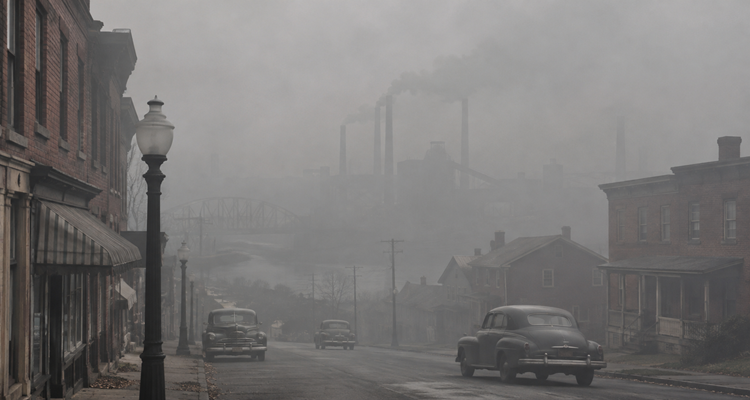
In October 1948, a Pennsylvania town was engulfed by a thick, poisonous fog. Within days, 20 people were dead and thousands were sick. What happened in Donora would transform how America understood air pollution.
On the morning of October 30, 1948, the people of Donora, Pennsylvania, faced a terrifying problem: the air around them had become dangerous to breathe.
There was no tornado, no raging wildfire, and no violent storm sweeping through the streets. Instead, a dense blanket of polluted fog had settled over the industrial town, turning familiar roads into nearly invisible passageways.
Residents struggled to breathe. Doctors received desperate calls. Firefighters moved through neighborhoods carrying oxygen to people trapped inside their homes.
The fog was so thick that emergency vehicles sometimes needed someone walking ahead with a flashlight to guide them.
By the time rain helped clear the atmosphere on October 31, at least 20 people had died and approximately 5,900 had become ill.
The event became known as the Donora Smog Disaster of 1948, one of the defining environmental health tragedies in American history.
But the most disturbing part of the story was not simply that the fog had killed people.
It was that the ingredients of the disaster had been present in Donora for years.
A Town Built Around Industry
Donora was a hardworking industrial community along the Monongahela River, roughly 25 miles southeast of Pittsburgh.
During the first half of the 20th century, steelmaking and zinc production shaped the town’s economy, employment, and identity.
Factories provided jobs and supported families. Their smokestacks were familiar features of the landscape.
The American Steel & Wire plant and Donora Zinc Works were among the major industrial operations in the area.
But the same factories that supported the local economy also released pollutants into the atmosphere.
Industrial smoke, sulfur-containing gases, and airborne particles were part of everyday life. Residents had grown accustomed to haze, dirty surfaces, and the smell of industrial emissions.
In a community where livelihoods depended heavily on manufacturing, pollution was not always treated as an urgent public health threat.
According to the U.S. National Park Service’s historical account, residents were often reluctant to criticize the plants because of their economic importance.
That dependence created a difficult contradiction: the industries that helped sustain Donora also contributed to the conditions that would endanger its population.
The Fog That Would Not Lift
The disaster began developing around October 26, 1948.
Autumn fog was not unusual in the Monongahela River Valley. Cool nights, moisture from the river, and industrial smoke could combine to produce poor visibility.
Initially, the conditions may have appeared familiar.
But this time, the atmosphere behaved differently.
A weather phenomenon called a temperature inversion prevented polluted air from dispersing.
Under ordinary conditions, warmer air near the ground can rise and mix with cooler air above it, helping carry pollutants away.
During an inversion, a layer of warmer air sits above cooler air near the surface. This arrangement suppresses vertical mixing, allowing pollution to accumulate close to where people live and breathe.
Donora’s valley geography made the situation particularly dangerous.
The surrounding hills restricted air movement, while the inversion acted like an atmospheric lid.
As factories continued operating, pollutants accumulated within the stagnant air.
The result was not simply natural fog. It was a concentrated mixture of moisture, industrial gases, smoke, and particles.
The atmosphere had become a confined space for pollution.
And the people of Donora were breathing inside it.
When Breathing Became an Emergency
As the days passed, conditions deteriorated.
Visibility became so poor that ordinary travel was dangerous. Residents could no longer rely on familiar streets and landmarks to navigate safely.
Meanwhile, the health effects were spreading.
People experienced coughing, sore throats, burning eyes, chest discomfort, and shortness of breath. Some suffered nausea and vomiting.
Those with existing heart or respiratory conditions were particularly vulnerable.
The town’s doctors faced a rapidly growing emergency, but the thick smog made reaching patients increasingly difficult.
Volunteer firefighters went from house to house, administering oxygen where possible.
The National Park Service records that doctors advised some residents with existing heart or lung problems to leave town. Yet visibility had become so poor that evacuation and emergency transport were severely restricted.
By early October 30, deaths were being reported.
A 2018 review published in the American Journal of Public Health describes how the emergency intensified rapidly, with 17 deaths occurring within approximately 12 hours of the first reported fatality.
The crisis overwhelmed the normal expectations of a small industrial community.
There was no single explosion, collision, or collapsing structure to identify as the source of danger.
The threat was distributed throughout the air itself.
The Rain That Finally Ended the Crisis
On October 31, changing weather conditions brought relief.
Rain and improved atmospheric circulation helped disperse the concentrated pollution that had remained trapped over Donora.
The dense smog gradually lifted.
Residents could see their streets again, and the immediate environmental emergency began to subside.
But the consequences were already devastating.
THE DONORA SMOG DISASTER IN NUMBERS
20
Documented immediate or shortly subsequent deaths
5,900+
Residents affected by illness
43%
Approximate share of the town affected
5 days
Approximate duration of the pollution episode
Figures reflect commonly cited historical estimates. Some later accounts use higher illness or death totals depending on definitions and follow-up periods.
The figures revealed something extraordinary: a pollution episode had affected nearly half the population of an American town.
For many residents, the consequences extended beyond the days of the disaster.
Researchers have examined possible longer-term health effects, although precisely separating the consequences of the five-day episode from years of industrial exposure remains difficult.
The 2018 historical review notes elevated cardiovascular disease and cancer rates observed in the region during the following decade, while acknowledging continuing questions about causation and long-term exposure.
The disaster had ended, but understanding its full impact would take much longer.
What Actually Made the Fog Deadly?
One of the most important questions was whether a particular chemical had caused the deaths.
Donora’s industrial operations released a mixture of pollutants, including sulfur compounds and particulate matter.
Investigators examined the relationship between industrial emissions, atmospheric conditions, and the illnesses reported during the disaster.
Sulfur dioxide and its chemical transformation products were considered significant contributors.
However, historical investigations did not establish that a single substance alone explained every illness and death.
A U.S. government scientific review noted that the observed effects were associated with a combination of chemical pollutants and particulate matter rather than one conclusively identified agent.
This distinction matters.
The disaster was not simply a case of an unusually toxic cloud appearing from nowhere.
It resulted from several conditions interacting:
-
Industrial emissions supplied hazardous gases and particles.
-
A temperature inversion prevented normal atmospheric mixing.
-
The valley’s geography contributed to stagnant conditions.
-
Continued exposure increased the danger to residents, particularly those with existing health problems.
The fog made the pollution visible, but the underlying danger came from what the air contained.
That was one of Donora’s most important lessons: air pollution becomes especially dangerous when harmful emissions accumulate faster than the atmosphere can disperse them.
The Disaster That Helped Change American Environmental Policy
Before Donora, industrial smoke was often viewed primarily as an inconvenience or an unavoidable consequence of economic development.
The tragedy made that interpretation much harder to defend.
Thousands of illnesses and multiple deaths demonstrated that polluted air could create an acute community-wide health emergency.
Donora attracted national attention and helped motivate scientific investigations into the health effects of industrial emissions.
It also contributed to the growing public pressure for government action.
The United States passed the Air Pollution Control Act in 1955, establishing an important federal role in supporting air pollution research and assistance.
The Clean Air Act of 1963 expanded federal involvement, and the landmark Clean Air Act amendments of 1970 established a much stronger national framework for regulating air pollution.
Donora did not single-handedly produce those laws. Other pollution disasters, expanding scientific evidence, public activism, and changing political priorities also shaped the legislation.
Nevertheless, Donora became a powerful example of why clean air could not be treated as a purely local industrial concern.
Its influence reached far beyond Pennsylvania.
The Scientist Who Helped Reveal the Danger
The disaster also became part of the history of environmental health research through the work of scientist Mary Amdur.
Amdur studied the effects of air pollutants on human health, including the respiratory consequences of sulfur-related industrial emissions.
Her work helped establish that substances released into the atmosphere could cause serious physiological harm, even when pollution had previously been accepted as an ordinary feature of industrial life.
Her research also illustrated an important challenge: scientific findings about environmental hazards can conflict with powerful economic interests.
The National Park Service’s biography of Mary Amdur documents her role in investigating air pollution and the professional resistance surrounding parts of her research.
The scientific legacy of Donora therefore involved more than identifying the conditions behind a single disaster.
It helped encourage a broader shift toward examining pollution as a measurable threat to human health.
Why Donora Still Matters Today
Modern air quality monitoring, pollution regulations, and public health warnings have changed how many communities respond to hazardous air.
Yet the basic atmospheric process behind Donora has not disappeared.
Temperature inversions still occur, particularly in valleys and urban areas where local geography and weather can restrict the movement of air.
When significant emissions are present, stagnant conditions can allow pollutants to accumulate.
The historical importance of Donora lies in three lessons.
First, ordinary weather can intensify an existing environmental hazard. A temperature inversion is not inherently a disaster, but it can become dangerous when large quantities of pollution are trapped beneath it.
Second, the health consequences of air pollution are not distributed equally. People with underlying heart and lung conditions can face greater risks during severe pollution episodes.
Third, environmental protection depends on recognizing hazards before a crisis becomes visible.
Donora demonstrated the consequences of waiting until pollution was impossible to ignore.
Its history also provides useful context for understanding modern air quality alerts, industrial emissions monitoring, and efforts to reduce exposure in vulnerable communities.
A Town Remembered for the Air It Could Not Escape
Today, Donora’s history remains closely associated with the development of American clean air awareness.
The Donora Historical Society and Smog Museum preserves the memory of the disaster and the community affected by it.
Its story is not simply one of an unfortunate weather event.
The weather helped create the emergency, but industrial pollution supplied the hazardous material that made the conditions deadly.
That distinction is central to understanding what happened.
The residents of Donora did not need to witness a spectacular natural catastrophe to experience an environmental disaster.
They needed only to breathe the air surrounding their homes.
In October 1948, a town discovered how dangerous that air could become when pollution, geography, and atmospheric conditions converged.
The fog eventually lifted.
The questions it raised about industry, public health, scientific responsibility, and government oversight remained and helped reshape American environmental history.
This content is published for informational or entertainment purposes. Facts, opinions, or references may evolve over time, and readers are encouraged to verify details from reliable sources.