





Why a Message From Someone Who Has Died Can Feel So Unsettling
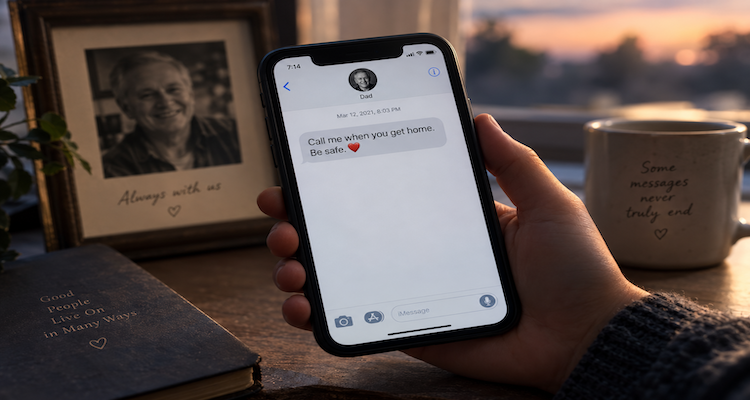
Finding an old message written by someone who is no longer alive can produce a strange emotional collision: the words are familiar, the sender is unmistakable, yet the person who wrote them is absent. Nothing supernatural has to be involved. The unsettling part is that digital communication can preserve the presence of a person long after their physical life has ended.
A text message, email, voice note, social-media post or handwritten note was created when the relationship was still active. Encountering it later can therefore feel less like looking at a historical record and more like unexpectedly stepping back into an unfinished conversation.
Psychological research has increasingly recognized that maintaining a connection with someone after death can be part of bereavement rather than evidence that a person has simply failed to “move on.” Researchers describe this as continuing bonds—the ways people preserve, transform or revisit relationships with people who have died. A 2024 systematic review covering 79 studies found that such bonds can involve memories, communication, possessions and other forms of connection, with experiences ranging from comfort to distress.
Digital technology adds another layer: unlike many physical objects, messages can suddenly reappear through searches, old devices, social-media memories or archived conversations.
Key Takeaways
- A message from someone who has died can reactivate a relationship that the mind knows has ended.
- Bereavement research recognizes continuing bonds as a common way people maintain connections with the deceased.
- Digital messages can feel unusually immediate because they preserve the person’s everyday language, timing and communication style.
- The same digital reminder can provide comfort to one person and distress another.
- New research suggests algorithms and digital platforms increasingly influence when and how memories of deceased people return.
- AI-generated “grief” technologies are extending this question from preserved messages to simulated conversations.
Why an Ordinary Message Can Suddenly Feel Extraordinary
Consider a message that once seemed completely ordinary:
“Call me when you get home.”
At the time, it was probably unremarkable. Months or years later, after the sender has died, the same sentence can acquire an entirely different meaning.
The words have not changed. The circumstances surrounding them have.
The reader knows something the original writer did not: there will be no future conversation in which that message can naturally lead. The sentence becomes simultaneously a piece of everyday communication and a document from a life that has ended.
That contradiction may help explain why such encounters can feel uncanny.
The message still uses the person’s familiar vocabulary, spelling, jokes, punctuation and expressions. It may even contain details that have become emotionally significant precisely because they were never intended to become memorial objects.
The digital artifact therefore sits between two categories. It is both communication and memory.
The Psychology of a Relationship That Does Not Simply Disappear
For much of the 20th century, some approaches to grief emphasized detachment from the deceased. Later bereavement research increasingly examined a different possibility: people can adapt to loss while retaining an ongoing relationship with the person who died.
This idea became known as continuing bonds.
The relationship changes because the other person is no longer physically present, but memories, values, possessions, conversations and internal representations can remain.
A systematic review published in Death Studies found evidence that continuing bonds can involve both comforting and distressing experiences. The researchers identified themes involving relationship and identity, meaning-making, spirituality, and the transformation of the relationship after death.
That distinction matters.
There is no universal emotional response to encountering a deceased person’s message. The same message could make one person smile and make another person cry.
The emotional effect can depend on the relationship, circumstances of the death, time since the loss, the content of the message and the person’s current stage of grieving.
Digital Messages Make the Past Feel Surprisingly Present
A photograph in an album generally requires a deliberate decision to look at it.
Digital communication is different.
A deceased person’s words may remain mixed into thousands of ordinary messages. Searching for an old conversation can unexpectedly reveal their name. An email account may contain years of correspondence. A social platform can preserve a profile, photograph or conversation long after the account holder has died.
Research into Facebook memorial pages has documented how people use these spaces to maintain connections with deceased loved ones. One study analyzing 2,533 messages posted on the profiles of ten deceased people found that communication changed over time: messages focused on processing the death and remembering the person declined, while expressions of continuing connection increased.
More recent research is examining this phenomenon as digitally mediated continuing bonds. A 2026 study based on interviews with 24 bereaved participants described digital spaces as places where relationships with deceased people can persist through conversations, archived material and algorithmically resurfaced memories.
This creates an important difference between a traditional keepsake and a digital one.
A physical letter normally stays where someone puts it.
A digital memory can come looking for you.
When Technology Brings the Person Back Without Warning
The unexpected appearance of a deceased person’s photograph or message can be particularly powerful because the bereaved person did not necessarily choose the moment.
A 2026 scoping review in BMJ Supportive & Palliative Care examined research on digital legacy in end-of-life and bereavement contexts. It found that digital material including photographs, videos, social-media content and messages could create feelings of closeness and comfort, but could also provoke distress, longing or a sense of losing control when reminders appeared unexpectedly.
That finding points to an overlooked feature of digital grief: timing matters.
A person may deliberately open an old message because they want to remember someone. The emotional experience is different when a platform unexpectedly surfaces a photograph or reminder on an ordinary morning.
The content may be identical. The psychological context is not.
This is one reason digital platforms increasingly raise questions about how much control people should have over posthumous accounts and reminders.
The Strange Difference Between a Preserved Message and an AI Simulation
There is another boundary emerging.
A preserved message is something the deceased actually wrote.
An AI-generated response is something produced after their death by a system trained or prompted using their digital remains.
That distinction may seem subtle, but psychologically and ethically it is significant.
Researchers have already studied posthumous messaging services in which people arrange for messages to be delivered after their death. A 2016 CHI study found that such messages could alter the relationship between bereaved people and the deceased and identified conflicts that could not be solved purely through technical design.
Generative AI pushes the concept further.
A “griefbot,” “deadbot” or similar system can be designed to simulate aspects of a deceased person’s personality, voice or appearance using their digital material. A September 2026 Journal of Medical Internet Research article noted that these technologies raise questions about privacy, consent and how the digital remains of deceased people are used.
The difference can be expressed simply:
An old message says what the person once said.
An AI simulation produces something the person never actually said.
That distinction could become increasingly important as synthetic voices, conversational AI and digital avatars become more convincing.
Why the Unsettling Feeling May Actually Make Sense
The strange feeling produced by a deceased person’s message does not necessarily mean that something is psychologically wrong.
It can reflect the collision between two kinds of knowledge.
Emotionally, the words may activate the relationship as it once existed.
Intellectually, the reader knows that relationship can no longer continue in its physical form.
The result can be a moment in which the past feels present and absent at the same time.
Bereavement research does not suggest that there is one correct way to respond to such experiences. A 2026 systematic review of after-death communications found that these experiences can be interpreted differently depending on cultural beliefs, personal meaning-making and social responses, and described both comforting and conflicting effects.
That uncertainty is important. Researchers are studying these experiences, but there is no scientific basis for treating an old message itself as evidence that the deceased person is communicating from beyond death.
The message is real.
The emotional encounter with it is real.
What the encounter means to the individual is much more personal.
The Larger Question: What Happens to a Person’s Digital Presence After Death?
The unsettling message points toward a much larger technological problem.
People increasingly leave behind enormous quantities of digital material: messages, photographs, emails, recordings, social profiles and other personal data.
Those remnants can become part of the grieving process, but they also raise questions about privacy, ownership, consent and dignity.
A 2026 University of Birmingham discussion of digital succession highlighted emerging legal questions surrounding access to digital remains, inheritance, privacy and posthumous identity.
The problem is no longer simply how to preserve someone’s memories.
It is also who should control those memories, how they should be presented, and whether a deceased person should have a say in what happens to their digital identity.
That question becomes particularly difficult when technology can transform static records into interactive experiences.
A Message Can Be Both a Memory and a Door
Perhaps the most unsettling thing about finding a message from someone who has died is not the technology at all.
It is the intimacy.
The message may have been written on an ordinary afternoon, during an ordinary conversation, without any awareness that one day its author would no longer be there.
Years later, a few lines can briefly restore the texture of that relationship: the familiar expression, the casual joke, the way the person addressed you.
Then reality returns.
The message remains, but the conversation cannot continue in the same way.
That tension is precisely why digital communication has become such an important part of modern bereavement. Technology does not simply preserve information about people after death. It preserves fragments of relationships and increasingly determines when those fragments reappear.
The challenge ahead may therefore be less about keeping people digitally alive than about learning how to handle the traces of lives that have already ended, with enough sensitivity to remember the person without confusing the record with the person.
This content is published for informational or entertainment purposes. Facts, opinions, or references may evolve over time, and readers are encouraged to verify details from reliable sources.