







The Village Where the Ground Has Been Burning for More Than a Century
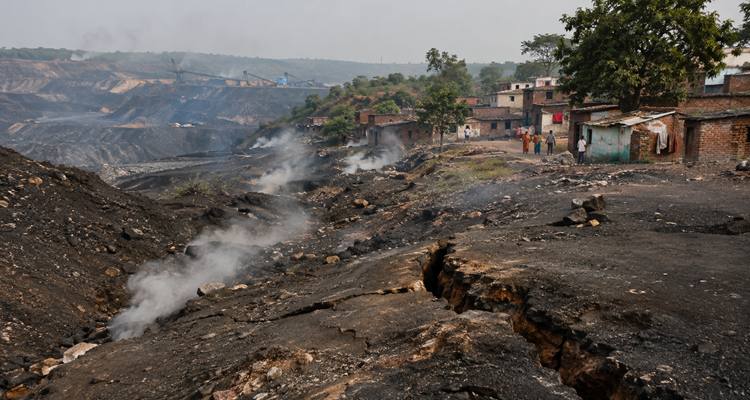
In India’s Jharia coalfield, underground fires have burned since at least 1916. Beneath communities, roads, and mining areas, an extraordinary environmental disaster continues to threaten the land and the people who depend on it.
In parts of eastern India, the greatest danger is not always something people can see. It lies beneath their feet.
The ground can crack without warning. Smoke and gases can escape through openings in the earth. Heat from burning coal can make land unstable, threatening homes, roads, and entire neighborhoods.
This is the reality of the Jharia coalfield, where underground coal fires have persisted for more than a century.
The first documented fire in the region dates to 1916. More than 100 years later, fires remain a serious problem, despite decades of engineering work, scientific monitoring, and government intervention.
Jharia’s story is not simply about an unusually long-lasting fire. It is about what happens when an industrial disaster becomes part of everyday life and why stopping a fire underground can be far more complicated than extinguishing one on the surface.
Where Is the Ground Burning?
Jharia is located in the Dhanbad district of Jharkhand, a state in eastern India. The region contains valuable coal deposits, particularly coking coal used in steel production.
Coal mining began there in the late nineteenth century, and the industry helped shape the surrounding settlements, employment, and local economy.
But mining also transformed the land beneath those communities.
As coal was extracted, underground galleries, exposed coal seams, and disturbed rock created conditions in which fires could begin and spread.
According to India’s Ministry of Coal, the first recorded coalfield fire occurred in 1916. A 2026 scientific study identifies an early fire at the Bhowrah colliery, followed by its spread toward the nearby Sendra colliery in 1917.
The important distinction is that Jharia is not one enormous flame burning beneath a single village. It is a coalfield containing multiple fire-affected locations, some beneath or near inhabited areas.
That makes the disaster geographically complex and exceptionally difficult to manage.
How Can a Fire Burn Underground for Over 100 Years?
A normal surface fire usually ends when its fuel runs out, its oxygen supply is cut off, or its temperature falls below the level needed to sustain combustion.
Underground coal fires operate according to the same basic principles, but their surroundings make those conditions difficult to control.
Coal itself is the fuel. In a coalfield, large deposits can extend underground across substantial distances. Once part of a coal seam ignites, the fire may continue consuming nearby coal if sufficient oxygen reaches it.
Air can enter through fractures, abandoned mining tunnels, and other connected spaces.
As the coal burns, heat can spread through surrounding rock, while changes in underground pressure and airflow can influence the direction of combustion.
Why doesn’t the fire run out of oxygen?
An underground fire is not necessarily sealed off from the atmosphere.
Old mine workings and cracks can create pathways connecting deep coal seams to the surface. Heated gases may rise through some openings while fresh air enters through others.
This circulation can sustain combustion even when no visible flames appear aboveground.
Can coal catch fire without an external flame?
Yes. Under certain conditions, coal can undergo spontaneous combustion.
Coal slowly reacts with oxygen, producing heat. If that heat accumulates faster than it can escape, the temperature can rise until ignition becomes possible.
This process is one recognized cause of coal mine fires, although the exact ignition circumstances of Jharia’s earliest fires are not conclusively established.
Researchers from the University of Texas at Dallas have noted that the precise origins of the fires first reported in 1916 remain uncertain.
What Happens When the Earth Burns From Below?
The most frightening feature of an underground coal fire is that its effects may appear far from the original ignition point.
A fire can consume coal that once helped support the layers of earth above it. As underground spaces weaken or collapse, the surface may sink, fracture, or develop dangerous openings.
This process is called land subsidence.
A 2021 study published in the journal Remote Sensing used satellite radar observations to investigate ground deformation associated with fires in the Jharia coalfield. The research highlighted the importance of monitoring subsidence to understand threats to public safety and infrastructure.
The consequences can include several overlapping hazards:
-
Unstable ground: Subsidence and sudden collapse can threaten buildings, roads, and people.
-
Dangerous gases: Coal combustion can release carbon monoxide and other harmful pollutants.
-
Persistent heat: Burning seams can produce high temperatures underground and around surface vents.
-
Environmental damage: Coal fires can contaminate the surrounding environment and degrade land.
-
Disrupted livelihoods: Fire-affected land can make homes, infrastructure, and working areas unsafe.
These hazards are not evenly distributed. Conditions differ depending on the depth of the fire, the geology, the ventilation pathways, and the stability of the surrounding land.
The Human Cost of Living Above a Fire
For residents of Jharia’s affected communities, the disaster is not merely a geological curiosity.
It is tied to housing, employment, family history, and the difficult question of whether remaining in a familiar place is worth the risk.
Mining has supported livelihoods in the region for generations. At the same time, the industry has contributed to the conditions that make certain areas dangerous.
Relocation can therefore involve more than moving from one building to another. It may mean losing access to established work, neighborhood relationships, local services, and community networks.
Historical World Bank documentation described the Jharia fires as a serious threat to living conditions, including exposure to fumes and the possibility of building collapse. It also highlighted the enormous financial and social challenges associated with relocating affected populations.
The central dilemma is clear: people need protection from dangerous ground conditions, but a successful relocation effort must also consider how they will rebuild their lives.
Simply moving residents away from a fire does not automatically resolve their economic or social difficulties.
Why Haven’t Authorities Extinguished the Fires?
Putting out a coal fire sounds straightforward until the scale of the problem becomes apparent.
A fire burning deep underground cannot always be reached directly. Its exact boundaries may be uncertain, and the tunnels or fractures carrying oxygen can be difficult to identify.
Engineers may attempt to isolate burning coal, restrict oxygen, excavate affected material, or seal underground openings.
Each method has limitations.
Excavation may be expensive and dangerous. Sealing one air pathway may not eliminate others. Water-based approaches can be complicated by underground conditions and the difficulty of reaching the combustion zone.
In Jharia, decades of mining have also left a complicated network of disturbed ground and coal deposits.
A 2026 study published in Communications Earth & Environment examined how intense heat and collapsing rock structures interact in the coalfield. The research emphasized the extraordinary physical complexity of these long-running fires.
The challenge is not simply finding enough water to extinguish a flame. It is identifying where combustion is occurring, controlling its access to oxygen, and preventing it from spreading through a vast underground fuel source.
Has Anything Improved After a Century?
Despite the scale of the problem, it would be inaccurate to suggest that nothing has changed.
In September 2023, India’s Ministry of Coal reported progress under the Jharia Master Plan, an initiative addressing coal fires, land instability, and rehabilitation.
Government-reported progress, September 2023
Identified surface-fire sites
77
27
Reported surface-fire area
17.32
1.80
Square kilometres
Source: India’s Ministry of Coal, September 25, 2023. These figures describe reported progress at that time, not a verified measurement of conditions in November 2026.
Press Information Bureau
These figures indicate substantial progress in reducing identified surface-fire activity.
However, the reduction of visible or mapped surface fires does not necessarily mean every underground combustion zone has been extinguished.
That distinction matters because a coalfield can contain hidden burning material even when surface conditions appear less dramatic.
Long-term monitoring, ground stabilization, fire management, and safe rehabilitation remain important parts of addressing the problem.
How Scientists Monitor Fires Hidden Beneath the Surface
Because underground fires are difficult to observe directly, researchers increasingly rely on technologies that reveal changes in temperature and ground movement.
Satellite thermal imaging can help identify unusually warm areas. Radar measurements can detect subtle changes in ground elevation, including subsidence that may be associated with underground combustion.
Researchers also use field observations, gas measurements, geological investigations, and computer models to understand how fires behave.
These methods are complementary rather than interchangeable. A thermal anomaly alone does not prove that coal is burning, while subsidence can occur for reasons other than fire.
In Jharia, satellite-based studies have demonstrated how repeated observations can help scientists identify changing conditions across large areas without relying exclusively on dangerous ground inspections.
Monitoring cannot extinguish the fires by itself. But it can help authorities identify risks, prioritize intervention, and assess whether fire-control measures are working.
Is Jharia the Only Place Where the Ground Burns?
No. Underground coal fires occur in other parts of the world, including the United States and China.
One of the best-known examples is Centralia, Pennsylvania.
Centralia’s underground mine fire began in May 1962, decades after Jharia’s earliest documented fires.
The fire eventually created serious concerns about dangerous gases and ground collapse. Government authorities began acquiring properties and relocating residents, and much of the community was abandoned.
According to the Pennsylvania Department of Environmental Protection, 545 residences and businesses were acquired between 1985 and 1991 as part of the relocation process.
The comparison reveals two different dimensions of the same problem.
Centralia illustrates how a persistent mine fire can contribute to the near-total disappearance of a town.
Jharia illustrates the difficulty of managing multiple long-running coal fires across a much larger mining region where communities, infrastructure, and economic activity remain closely connected to the affected land.
Both demonstrate that an underground fire can become a social and environmental problem lasting for generations.
Could Jharia’s Fires Continue for Another Century?
It is possible that some underground coal fires could persist for many more decades, particularly where substantial fuel remains and oxygen continues to reach the combustion zones.
However, predicting the lifespan of an individual fire is difficult.
Its future depends on the available coal, underground airflow, geological conditions, mining activity, and the effectiveness of fire-control measures.
Scientific estimates of long-term coal-fire persistence should not be interpreted as a precise countdown for Jharia.
Nor should the existence of a century-old fire be taken to mean that every currently affected location has been burning continuously since 1916.
The coalfield contains multiple fires with different histories, and their boundaries and intensity can change over time.
What Jharia Teaches Us About Environmental Disasters
Jharia challenges the familiar idea that a disaster has a clear beginning, a brief period of destruction, and an identifiable end.
Some disasters unfold slowly.
They alter the landscape over decades, create recurring dangers, and force successive generations to live with consequences they did not create.
The fires beneath Jharia also reveal the long-term costs that can accompany valuable natural resources. Coal has supported industrial development and employment, but extracting it without sufficient attention to geological stability, fire prevention, and environmental protection can create liabilities that outlast individual mines.
The most important question is therefore not only how to extinguish the remaining fires.
It is how to protect communities while addressing the damage already done and how to prevent similar problems in other mining regions.
A Century Later, the Ground Is Still Burning
More than 110 years after the first recorded fire in 1916, Jharia remains an extraordinary example of the persistence of underground coal combustion.
There has been measurable progress in managing some fire-affected areas, but the problem has not disappeared.
Beneath parts of this coalfield, the landscape continues to carry the consequences of its mining history.
For scientists, Jharia is a place to study underground combustion, geological instability, and environmental change.
For the people who live in and around the affected communities, the stakes are more immediate: safe homes, reliable livelihoods, and a future that is not defined by dangerous ground.
The most remarkable part of Jharia’s story is not simply that coal has been burning for more than a century.
It is that the consequences of those fires remain a human challenge today.
This content is published for informational or entertainment purposes. Facts, opinions, or references may evolve over time, and readers are encouraged to verify details from reliable sources.