

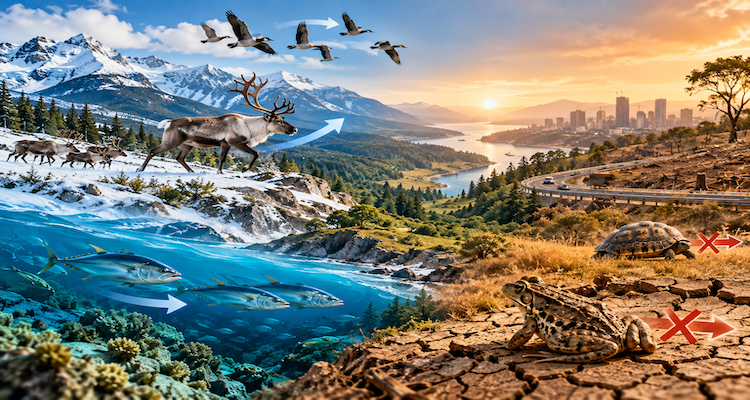







The Environmental Changes Happening One Degree at a Time
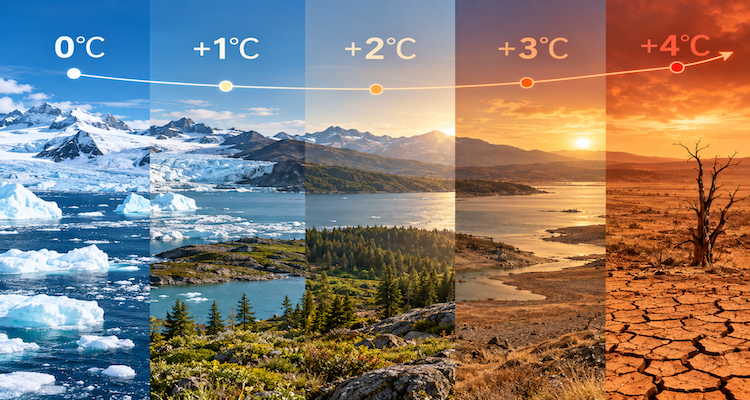
A single degree sounds too small to reshape a planet. For a person deciding whether a day feels warm or cool, one degree may barely register. Earth’s climate system is different. A change in the global average temperature of even a fraction of a degree alters the balance between oceans, ice, atmosphere, ecosystems and living organisms.
That distinction matters because global warming is not simply about hotter days. It changes the conditions under which glaciers form and melt, oceans absorb heat, forests store carbon, species find food and shelter, and coastal communities manage rising seas.
The latest observations make the issue increasingly concrete. Copernicus estimates that human-caused global warming reached about 1.37°C in 2025 relative to 1850–1900. The World Meteorological Organization independently assessed 2025 at about 1.44°C above the same pre-industrial reference period, while noting uncertainty between datasets. Copernicus also reported that the three years from 2023 through 2025 averaged more than 1.5°C above the pre-industrial level. That does not mean the Paris Agreement’s long-term 1.5°C threshold has been permanently crossed, but it shows how close the climate system has moved to that level.
Key Takeaways
- Global warming is already changing oceans, ice, ecosystems, water systems and extreme-weather risks.
- Each additional increment of warming increases the likelihood of multiple climate hazards occurring together.
- A global average temperature increase does not mean every location warms by exactly the same amount.
- Coral reefs, Arctic ecosystems, glaciers and coastal environments are particularly sensitive to additional warming.
- The difference between 1.5°C and 2°C is scientifically meaningful, not simply another half-degree on a thermometer.
- Limiting additional warming reduces risks even when some climate impacts can no longer be avoided.
One Degree Is a Global Average, Not a Global Thermometer
The first important distinction is what scientists mean by global warming.
A rise of 1°C refers to a change in the Earth’s average surface temperature relative to a defined reference period. It does not mean every place on Earth becomes exactly 1°C warmer.
Land generally warms faster than the ocean, and high northern latitudes can warm much faster than the global average. Individual regions can therefore experience temperature changes substantially different from the global figure.
Climate change is also much broader than temperature. NASA identifies changes in sea level, glaciers, polar ice, extreme weather, vegetation and seasonal biological cycles among the observable indicators of a changing climate.
That is why the phrase “one degree” can be misleading. The number describes the average shift in a highly interconnected system. The consequences appear in many different forms.
The Ocean Is Absorbing the Extra Heat
The ocean is one of the clearest places to see why small changes in the global average matter.
Water absorbs enormous quantities of heat, and the ocean has continued warming as greenhouse gases accumulate in the atmosphere. Warming oceans contribute to marine heatwaves, alter habitats and put additional stress on species that already live close to their thermal limits.
The consequences are particularly significant for coral reefs.
The IPCC estimates that warm-water coral reefs would decline by roughly 70–90% under 1.5°C of global warming, with losses exceeding 99% at 2°C. These projections illustrate an important principle: environmental responses are not always proportional to the temperature number.
A seemingly modest additional increase can push ecosystems closer to conditions they cannot tolerate.
Marine ecosystems are also affected by ocean acidification and declining oxygen in some regions. Higher warming increases these pressures, while changes in ocean temperature can shift the geographic ranges of marine species.
For communities dependent on fisheries, the environmental change can therefore become an economic and food-security issue.
Ice Changes Become Water Changes
Ice responds strongly to warming because many frozen systems exist close to physical thresholds.
Mountain glaciers are retreating in many parts of the world, while Greenland and Antarctica are losing ice. The loss of land-based ice contributes to rising sea levels, while changes in snow and glacier storage can affect the timing and availability of freshwater downstream.
The IPCC has found that sea-level rise continues even if warming is limited to 1.5°C. It also estimates that global mean sea level by 2100 would be around 0.1 metre lower under 1.5°C of warming than under 2°C, although the exact future level depends on emissions and other factors.
That difference may sound small.
For a low-lying coastal community, however, additional centimetres of sea level can increase the frequency of flooding, saltwater intrusion, erosion and damage during storms.
The longer-term concern is even larger. Ice-sheet processes can continue for centuries or millennia, meaning that temperature decisions made today influence environmental conditions far beyond a single human lifetime.
Ecosystems Do Not Experience Warming Alone
A forest, wetland, grassland or marine ecosystem does not respond to temperature in isolation.
Species are simultaneously dealing with habitat loss, pollution, invasive species, land-use change, water stress and other pressures. Climate warming can add another stressor or amplify existing ones.
The IPCC’s assessments show that biodiversity risks increase with every additional increment of warming. At higher temperatures, more species are exposed to climatic conditions outside the ranges in which they historically evolved.
Some organisms can migrate. Others cannot.
Plants rooted in place, species restricted to isolated mountain environments, organisms dependent on seasonal ice, and specialized species living within narrow temperature ranges can have fewer options.
This is one reason climate change cannot be understood simply as an average-temperature problem. The average is a useful measurement of planetary change, but ecological consequences occur locally.
Extreme Events Can Become More Difficult to Manage
One of the most important findings from climate research is that additional warming can increase not only individual hazards but also combinations of hazards.
The IPCC reports that every increment of global warming intensifies multiple and concurrent climate hazards. Higher warming can increase the probability of compound events such as heatwaves occurring alongside drought, or heavy rainfall interacting with already saturated conditions.
That creates a management problem.
A city can prepare for extreme heat. A farming region can prepare for drought. A coastal community can prepare for flooding. But when several stresses occur together, the pressure on infrastructure, food systems, water supplies and emergency services can become considerably more complicated.
The distinction matters because climate risk is not simply a matter of counting hotter days. It is also about how different environmental changes interact.
Why 1.5°C and 2°C Are Not Interchangeable
The debate over 1.5°C and 2°C can sometimes sound like a political argument over an arbitrary number.
The scientific basis is different.
The IPCC’s assessments show that climate risks increase as warming rises from 1.5°C toward 2°C and beyond. At 1.5°C, significant impacts remain. At 2°C, many risks become greater, including risks to biodiversity, water systems, ecosystems, coral reefs and coastal environments.
For example, the IPCC projects substantially greater coral-reef losses at 2°C than at 1.5°C. It also projects greater sea-level rise, greater risks to ecosystems and greater exposure to some climate hazards.
The important lesson is not that 1.5°C represents a safe line and 2°C represents a catastrophe.
There is no single temperature at which climate change suddenly begins.
Instead, risk generally increases across a range. The closer warming moves toward higher levels, the more difficult adaptation becomes and the greater the possibility of irreversible environmental damage.
The First 1.5°C Is Not the Whole Story
There is another important measurement issue.
A single exceptionally warm year above 1.5°C does not by itself mean that the Paris Agreement’s long-term temperature goal has been permanently exceeded. Scientists distinguish short-term annual variability from the longer-term warming level used to assess climate targets.
This distinction is particularly important after the extraordinary temperatures recorded in recent years.
Copernicus reported that 2024 was the warmest year in its record, at approximately 1.60°C above the 1850–1900 reference period, while 2025 was about 1.47°C. Its analysis estimated the longer-term level of human-caused warming at around 1.4°C.
The WMO’s consolidated assessment similarly placed 2025 at approximately 1.44°C above the pre-industrial reference period.
Those numbers should not be treated as competing answers. Different datasets, methods and definitions produce slightly different estimates. Together, they show a climate system operating at historically high temperatures.
The Direction Matters as Much as the Number
The most useful way to think about warming is not as a finish line but as a trajectory.
The IPCC concludes that climate risks and losses increase with every increment of global warming. That means reducing warming from 3°C to 2.5°C matters. Reducing it from 2°C to 1.5°C matters. And avoiding another fraction of a degree matters as well.
This also changes how climate action should be understood.
The choice is not between “solving climate change” and “doing nothing.” Some warming and some associated impacts are already unavoidable. But the amount of additional warming remains strongly influenced by future emissions.
The UNEP Emissions Gap Report 2025 estimated that current policies could put the world on a pathway toward about 2.8°C of warming this century, while full implementation of countries’ then-current climate pledges would imply approximately 2.3–2.5°C.
These are projections, not predictions of an inevitable future. They describe what different policy and emissions pathways could produce.
That distinction is crucial because it means the temperature curve is not predetermined.
What One Degree Really Represents
The deeper lesson behind “one degree at a time” is that climate change is not one environmental problem.
It is a collection of interacting changes.
A warmer atmosphere can hold more moisture. A warmer ocean can intensify marine heat stress. Melting land ice contributes to sea-level rise. Changing precipitation affects water availability. Heat and drought can place additional pressure on vegetation. Ecosystem disruption can weaken services on which people depend.
The individual changes may appear gradual when measured year by year.
Together, they can transform landscapes and ecological relationships.
That is why scientists focus so closely on fractions of a degree. The difference between 1.4°C and 1.5°C is only 0.1°C numerically, but it represents additional heat entering an already altered climate system. The difference between 1.5°C and 2°C is larger still, and the evidence shows that many risks increase across that range.
Conclusion
Earth does not experience climate change as a number printed on a global temperature chart.
It experiences it through warmer oceans, retreating ice, rising seas, shifting ecosystems, altered water cycles and increasingly complicated combinations of climate hazards.
That is what makes every fraction of a degree consequential.
The current evidence does not support the idea that there is a single temperature at which the planet suddenly becomes unsafe. Instead, it shows a continuous rise in risk as warming increases. Some environmental losses can be reduced, some can be adapted to, and some may become difficult or impossible to reverse on human timescales.
The significance of one degree, therefore, is not that one degree changes everything.
It is that every additional degree changes more and makes the environmental choices that follow increasingly difficult.
This content is published for informational or entertainment purposes. Facts, opinions, or references may evolve over time, and readers are encouraged to verify details from reliable sources.