









The Batteries That Get Stronger When You Replace Their Metal With Ordinary Rust
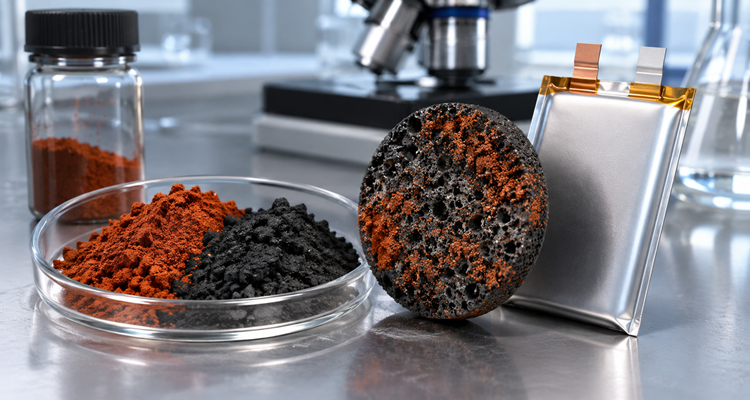
Scientists have developed an experimental lithium-ion battery electrode that gains storage capacity as iron transforms into rust-like compounds. The discovery could help make future energy storage more affordable and sustainable—but important challenges remain.
Rust is usually a warning sign. On a bicycle, a bridge or a piece of machinery, it suggests that metal is deteriorating. Inside a new experimental battery material, however, a carefully controlled form of the same chemistry may actually improve performance.
Researchers in Germany and Austria have developed a lithium-ion battery electrode that combines iron nanoparticles with microscopic, porous carbon spheres. Rather than simply losing capacity as it undergoes repeated charging and discharging, the material can gradually store more electrical charge as its iron becomes electrochemically activated.
The findings were published on January 29, 2026, in the peer-reviewed journal Chemistry of Materials. The researchers reported specific storage capacities reaching 1,190 milliampere-hours per gram (mAh/g), with high charge efficiency during testing over 300 cycles.
The discovery raises an intriguing possibility: Could abundant iron and iron oxide help replace some of the more resource-intensive materials used in battery technology?
The answer is promising, although more complicated than simply putting rust inside a battery.
Why scientists are turning to rust for better batteries
Modern rechargeable batteries depend on materials that can repeatedly store and release electrical energy. Lithium-ion batteries have become essential to smartphones, laptops, electric vehicles and renewable-energy storage.
But the materials used in some battery designs introduce economic and environmental challenges.
Many lithium-ion cathodes contain nickel or cobalt, while their manufacturing processes can involve energy-intensive production and specialized chemicals. These factors have encouraged researchers to investigate alternatives that are abundant, affordable and potentially easier to recycle.
Iron is an attractive candidate.
It is widely available, already produced on an enormous industrial scale and capable of participating in electrochemical reactions that store energy.
Iron oxide, the family of compounds commonly associated with rust, is especially interesting because it can undergo reactions with lithium that provide substantial theoretical charge-storage capacity.
The difficulty is that iron oxide is not automatically a good battery electrode. It has relatively poor electrical conductivity, and repeated reactions can cause significant changes in its physical structure.
Those changes can damage electrodes, interrupt electrical connections and reduce performance.
The research team’s solution was to give iron a carefully engineered home.
Tiny carbon spheres make the difference
The researchers used structures called carbon spherogels: highly porous networks built from tiny carbon spheres.
According to Saarland University, the individual spherical units are approximately 250 nanometers across. That is roughly 400 times smaller than the width of a typical human hair.
These structures offer three particularly useful properties.
First, their large internal surface area provides many locations where electrochemical reactions can occur.
Second, the conductive carbon framework helps electrons move through the electrode.
Third, the porous structure provides space for the iron-containing material to undergo physical changes during battery operation.
Researchers from the University of Salzburg developed the carbon structures, while scientists working with Saarland University and collaborating institutions investigated their performance as energy-storage materials.
Using a synthesis method involving iron lactate, the team incorporated finely distributed iron nanoparticles into the carbon framework.
The published study examined iron contents ranging from approximately 15% to 40% by mass. The formulation containing about 27% iron provided the most favorable balance between capacity and durability among the tested compositions.
The carbon framework was therefore more than a passive container. It helped make a chemically active but mechanically challenging material useful for repeated charge storage.
The surprising discovery: Capacity increased with use
Rechargeable batteries are generally expected to lose some storage capacity as they age.
Repeated charging can cause unwanted chemical reactions, mechanical damage and gradual loss of usable electrode material.
The experimental iron-carbon electrodes showed a different behavior during their initial cycling period.
Their charge-storage capacity increased as the material underwent electrochemical activation.
The researchers associated this improvement with the progressive transformation of embedded metallic iron into electrochemically active iron oxide.
As the electrode was repeatedly charged and discharged, more of the iron-containing material became available for reversible energy-storage reactions.
Saarland University reported that this activation process took approximately 300 charge-discharge cycles to reach its maximum capacity under the studied conditions.
This is the central finding behind the attention-grabbing idea of batteries that become stronger with use.
Importantly, the result does not mean the battery gains unlimited energy-storage capacity or will continue improving throughout its entire lifetime.
It describes an initial activation process observed in a particular experimental electrode material.
Once activation is complete, ordinary aging and degradation mechanisms may still affect performance.
How can rust store electrical energy?
The explanation lies in a class of electrochemical reactions known as conversion reactions.
In a conventional graphite anode, lithium ions are primarily stored by entering spaces within the graphite structure.
Iron oxide behaves differently.
During lithiation, iron oxide can react with lithium to form metallic iron and lithium oxide. During the reverse process, iron can be oxidized again as lithium is removed.
For example, an idealized reaction involving iron(III) oxide can be written as:
This reversible chemistry allows several electrons to participate per formula unit of iron oxide, providing a high theoretical storage capacity.
However, conversion reactions also introduce complications.
The material can expand and contract as its chemical composition changes. If these transformations repeatedly fracture the electrode or separate active particles from conductive pathways, the battery loses useful capacity.
That is where the porous carbon architecture becomes important.
It provides a conductive network and space that can accommodate some of the structural changes associated with iron-based conversion reactions.
The design does not eliminate every source of degradation, but it helps address two major limitations: poor conductivity and mechanical instability.
There is also an important distinction between laboratory iron oxide and the rust found on a neglected steel surface.
Everyday rust can contain mixtures of iron oxides, hydroxides, water and contaminants. The experimental electrodes instead use precisely prepared iron-containing nanostructures.
The discovery is not that ordinary rust scraped from metal can be placed directly into a battery. It is that engineered iron-based materials can exploit chemistry closely related to rust formation to store electrical energy.
What the laboratory results actually show
REPORTED EXPERIMENTAL RESULTS · 2026 STUDY
1,190
mAh/g maximum reported specific capacity
300
Charge-discharge cycles investigated
99%+
Reported Coulombic efficiency during cycling
27%
Iron content in the best-balanced formulation
Values refer to experimental electrode-material testing, not the performance of a complete commercial battery. Source: Borhani et al., Chemistry of Materials (2026).
The researchers reported that their iron-loaded carbon spherogels could achieve specific capacities as high as 1,190 mAh/g.
Specific capacity describes how much electrical charge a material can store relative to its mass.
For context, graphite, the widely used anode material in conventional lithium-ion batteries, has a theoretical specific capacity of approximately 372 mAh/g.
That comparison is encouraging, but it requires care.
A high capacity measured in an experimental electrode does not automatically translate into a battery with three times the driving range or three times the operating time.
A complete battery includes a cathode, anode, electrolyte, separator, current collectors, packaging and other components. Its usable energy depends on both capacity and operating voltage, as well as the mass and behavior of the complete cell.
The study also reported Coulombic efficiency exceeding 99% during cycling. This measures the relationship between charge extracted and charge supplied during a cycle.
It is a useful indicator of electrochemical reversibility, but it is not the same as round-trip energy efficiency, nor does it prove that the material can survive thousands of cycles in a practical battery.
The results establish the potential of the electrode chemistry—not a finished commercial product.
Could rust-based batteries be cheaper and more sustainable?
One of the strongest arguments for iron-based electrode materials is their potential to reduce dependence on certain critical raw materials.
Iron is comparatively abundant and supported by an established global supply chain. It also has well-understood recycling pathways.
These advantages could matter as electricity systems increasingly rely on batteries to store energy from solar panels and wind turbines.
Unlike a smartphone battery, which must fit into a small, lightweight device, a stationary energy-storage system may be able to tolerate additional weight if it delivers sufficiently low cost, long service life and dependable performance.
That makes iron-based chemistry an interesting research direction.
However, environmental benefits cannot be established from raw-material abundance alone.
The complete manufacturing process must also be considered, including the chemicals, energy and equipment required to produce the carbon spherogels and incorporate iron nanoparticles.
The experimental material also remains part of a lithium-ion battery system. It does not eliminate the need for lithium, and it does not establish that every component of a future battery would be free from nickel or cobalt.
Those materials are commonly associated with certain cathode chemistries, while the new research primarily concerns an alternative anode.
A full environmental assessment would need to compare complete battery designs, their manufacturing emissions, operating lifetimes and recycling processes.
Why these batteries are not ready for your phone or electric car
The experimental results are encouraging, but several technical challenges separate a promising electrode from a commercially useful battery.
1. The activation process takes too long
An electrode that requires roughly 300 cycles to achieve its highest storage capacity presents a practical challenge.
Consumers and energy-storage operators generally expect a battery to deliver predictable performance from the beginning of its service life.
Researchers will therefore need to determine whether the activation process can be accelerated, completed during manufacturing or otherwise managed without sacrificing durability.
2. A complete battery still needs to be demonstrated
The reported research focused on anode materials.
A commercially viable battery requires a compatible cathode and a complete cell design with acceptable voltage, energy density, charging behavior and safety characteristics.
A material that performs well in controlled electrode testing may behave differently when paired with a practical cathode.
3. Long-term durability remains uncertain
Three hundred charge-discharge cycles provide useful information about initial electrochemical behavior, but many practical applications require substantially longer service lives.
Researchers must investigate whether the material maintains its advantages over extended cycling and storage periods.
They must also examine possible degradation mechanisms, including continued structural changes, unwanted side reactions and loss of active lithium.
4. Large-scale manufacturing must be economical
The study describes a synthesis approach with potential for scaling, but laboratory feasibility does not establish industrial affordability.
Manufacturers would need to demonstrate consistent production, controlled material quality, competitive costs and compatibility with existing or adapted battery-production equipment.
These questions are especially important for grid-scale storage, where economics can determine whether a promising technology becomes commercially useful.
Does rust make a battery safer?
Not necessarily.
Iron and iron oxide may offer advantages related to material availability and certain environmental considerations, but the presence of iron oxide does not automatically make a complete lithium-ion battery safer.
Battery safety depends on several interacting factors, including electrolyte composition, electrode stability, thermal behavior, cell construction and charging controls.
The 2026 research did not establish that a complete battery using this material is immune to overheating, thermal runaway or other failure mechanisms.
Broader research also shows that uncontrolled corrosion can seriously damage battery performance and introduce safety problems.
A 2025 review in Energy & Environmental Science, for example, examined how corrosion in aqueous metal batteries can contribute to capacity loss, reduced cycle life and undesirable chemical reactions.
The distinction is important: controlled electrochemical conversion inside an engineered electrode is not equivalent to uncontrolled corrosion.
What this discovery means for the future of energy storage
The most important contribution of this research may be a new way of thinking about battery materials.
Engineers often try to prevent chemical and structural transformations that damage electrodes. The iron-carbon system demonstrates how some transformations can instead become part of a useful activation process.
The porous carbon structure does not merely hold iron in place. It helps create conditions in which the iron-containing material can participate in reversible reactions while retaining useful electrical connections.
That principle could inform further research into conversion-type electrodes, including designs based on other abundant metal compounds.
It also highlights why battery innovation is not simply a competition to discover a single superior chemical ingredient.
A material’s performance depends on its architecture, particle size, conductivity, mechanical behavior and interaction with the rest of the cell.
Iron oxide has been investigated as a battery material before. The notable development here is the engineered combination of iron nanoparticles and porous carbon, together with the experimentally observed capacity increase during activation.
The bottom line
Rust is usually associated with deterioration, but the chemistry behind iron oxidation can also participate in reversible energy storage.
Researchers from Saarland University, the University of Salzburg and collaborating institutions have demonstrated that carefully engineered iron-carbon electrodes can achieve high charge-storage capacity, with performance improving during an initial activation period.
The results are scientifically meaningful, but they do not establish that rust can simply replace the metals inside existing batteries, or that commercial batteries will become stronger indefinitely as they age.
What the study does show is that abundant iron, combined with sophisticated carbon nanostructures, deserves serious consideration as a future battery-electrode material.
If researchers can shorten activation time, demonstrate durable full cells and establish cost-effective manufacturing, this approach could eventually contribute to more sustainable energy-storage technology.
The larger lesson is that a substance commonly regarded as a sign of material failure can, under carefully controlled conditions, become part of an energy-storage solution.
The information presented in this article is based on publicly available sources, reports, and factual material available at the time of publication. While efforts are made to ensure accuracy, details may change as new information emerges. The content is provided for general informational purposes only, and readers are advised to verify facts independently where necessary.