










The Energy Storage Race Is Moving Beyond Lithium-Ion Batteries
For more than a decade, lithium-ion batteries have defined the global energy storage race. They power electric vehicles, smartphones, laptops, and increasingly large-scale renewable energy projects. Their falling costs and improving performance helped accelerate the transition toward cleaner electricity.
But the next phase of energy storage is becoming more complicated. The challenge is no longer simply producing batteries with higher energy density. The world needs storage technologies that can operate safely for longer periods, use more abundant materials, reduce supply-chain risks, and serve applications where lithium-ion technology is not always the best fit.
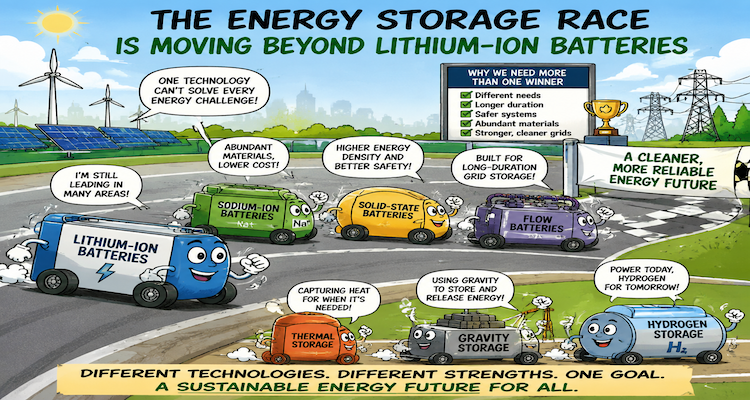
The result is a shift from a single-battery race into a broader competition among multiple storage technologies. Lithium-ion is not disappearing, but researchers, governments, and companies are investing heavily in alternatives designed for specific needs from storing solar power overnight to balancing national electricity grids for days or even weeks.
Key Takeaways
- Lithium-ion batteries remain dominant, but new storage technologies are targeting applications where they face limitations.
- Sodium-ion batteries could reduce dependence on critical minerals such as lithium and cobalt.
- Long-duration energy storage requires technologies designed beyond traditional battery chemistry.
- Grid operators increasingly need storage systems that can deliver energy for many hours, not just minutes.
- The future energy system is likely to rely on multiple storage technologies rather than one universal solution.
Why Lithium-Ion Became the Energy Storage Standard
Lithium-ion batteries succeeded because they offered a rare combination of advantages: high energy density, fast charging capability, efficiency, and a rapidly expanding manufacturing ecosystem.
The technology became central to electric vehicles because lighter batteries allow vehicles to travel farther on a single charge. The same advantages helped lithium-ion batteries expand into home energy storage systems and utility-scale projects.
According to the International Energy Agency (IEA), battery storage deployment has grown rapidly alongside renewable energy expansion, with battery storage becoming an increasingly important tool for integrating solar and wind power into electricity systems.
However, the same characteristics that made lithium-ion successful also reveal its limitations.
Lithium-ion batteries rely on minerals including lithium, nickel, manganese, graphite, and cobalt. Mining and processing these materials create environmental, geopolitical, and supply-chain challenges. Demand growth from electric vehicles and energy storage has increased pressure on global mineral supply chains.
Safety is another consideration. Although modern lithium-ion systems include sophisticated management and cooling systems, battery thermal runaway events can cause fires under certain failure conditions.
The question facing the energy industry is not whether lithium-ion works. It clearly does. The question is whether one technology can meet every future energy storage requirement.
The New Challenge: Storing Renewable Energy for Longer
Solar and wind power have transformed electricity generation, but they introduce a fundamental challenge: they do not always produce electricity when demand is highest.
Solar panels generate electricity during daylight hours, while demand often rises in the evening. Wind production can fluctuate depending on weather conditions.
Short-duration lithium-ion storage can help shift electricity by several hours, but future renewable-heavy grids may require storage capable of delivering power for much longer periods.
The U.S. Department of Energy has identified long-duration energy storage as a critical area of research because future electricity systems may need storage capable of supporting reliability over extended periods.
This is where alternative technologies are gaining attention.
Sodium-Ion Batteries: A Lithium Alternative Using More Abundant Materials
One of the most closely watched alternatives is sodium-ion battery technology.
Sodium-ion batteries work using sodium ions instead of lithium ions. Sodium is significantly more abundant and widely available than lithium, potentially reducing dependence on concentrated mineral supply chains.
The technology has historically offered lower energy density compared with lithium-ion, which limits its use in some electric vehicles. However, for stationary storage applications where weight is less important, sodium-ion batteries could become competitive.
Several companies and battery manufacturers are developing sodium-ion systems for grid storage and electric mobility.
China-based battery manufacturers have been among the most active in commercializing the technology, with companies such as CATL announcing sodium-ion battery development programs.
The likely role of sodium-ion is not replacing lithium-ion everywhere but expanding the range of storage options.
Solid-State Batteries: Improving Energy Density and Safety
Solid-state batteries represent another major research direction.
Traditional lithium-ion batteries use liquid electrolytes that allow ions to move between electrodes. Solid-state batteries replace this liquid material with a solid electrolyte.
Potential advantages include:
- Higher energy density
- Improved safety characteristics
- Faster charging possibilities
- Reduced dependence on certain battery materials
However, large-scale commercialization remains challenging. Manufacturing complexity, cost, durability, and production scalability are still major obstacles.
Many companies are investing in solid-state technology, particularly for electric vehicles, but widespread commercial adoption will depend on whether manufacturers can produce them reliably and affordably at industrial scale.
Flow Batteries: Designed for Large-Scale Grid Storage
While lithium-ion batteries are optimized for compact energy storage, flow batteries take a different approach.
Flow batteries store energy in liquid electrolytes contained in external tanks. Their capacity can be increased by simply enlarging the storage tanks, making them attractive for stationary applications.
One advantage is durability. Some flow battery designs can operate for many years with less degradation compared with conventional batteries.
They are unlikely to replace lithium-ion batteries in vehicles because of their size and weight. Instead, they are designed for large-scale electricity storage where space is available.
Utilities looking to store renewable energy for many hours may find these systems useful.
Other Technologies Competing in the Storage Race
The future storage landscape is expanding beyond chemical batteries.
Thermal Energy Storage
Thermal storage captures energy as heat or cold and releases it when needed. These systems can support industrial processes, buildings, and electricity systems.
For example, concentrated solar power plants can store heat in materials such as molten salt, allowing electricity generation after sunlight disappears.
Gravity-Based Storage
Gravity storage systems store energy by lifting heavy materials and releasing them to generate electricity when needed.
The concept is similar to pumped hydro storage, which remains one of the world’s largest forms of energy storage. However, gravity-based systems are being explored for locations where traditional hydro projects are not practical.
Hydrogen Storage
Hydrogen can act as a form of long-duration energy storage by converting electricity into hydrogen through electrolysis and later converting it back into electricity.
The technology has potential for seasonal storage and industrial applications, although efficiency losses and infrastructure requirements remain significant challenges.
The Business Implications: A More Diverse Energy Storage Market
The move beyond lithium-ion is creating opportunities across the energy industry.
Battery manufacturers are investing in different chemistries because no single technology perfectly satisfies every requirement.
Automakers may prioritize energy density and fast charging. Grid operators may prioritize lifetime, cost, and reliability. Industrial users may prioritize storage duration and safety.
This means the future battery market may look less like a winner-takes-all competition and more like the semiconductor industry, where different technologies serve different purposes.
Companies that successfully match technology to application could gain advantages, while businesses dependent on a single supply chain may face greater risks.
The Limits of the “Post-Lithium” Narrative
Despite growing interest in alternatives, lithium-ion batteries will likely remain central for many years.
The technology benefits from enormous manufacturing investment, established supply chains, and continuous improvement.
Replacing an entire battery ecosystem requires more than proving that another chemistry works in a laboratory. It requires reliable manufacturing, lower costs, customer confidence, recycling systems, and global production capacity.
The energy transition will not be powered by one perfect battery. It will likely depend on a combination of technologies optimized for different challenges.
Conclusion
The energy storage race is entering a new era where the question is no longer simply “What comes after lithium-ion?”
The more important question is: Which storage technology is best suited for each energy challenge?
Lithium-ion batteries will continue playing a major role, especially in electric vehicles and many short-duration storage applications. But the growing demand for cleaner electricity, stronger grids, and more resilient energy systems is creating space for sodium-ion, solid-state, flow batteries, thermal storage, and other emerging technologies.
The future of energy storage will not be defined by one winner. It will be built through a diverse portfolio of solutions designed for a world that needs electricity to be available whenever and wherever it is required.
The information presented in this article is based on publicly available sources, reports, and factual material available at the time of publication. While efforts are made to ensure accuracy, details may change as new information emerges. The content is provided for general informational purposes only, and readers are advised to verify facts independently where necessary.
Related News
- The Energy Paradox of Efficiency: Why Using Less Electricity Does Not Always Mean Using Less Energy
- Why Extreme Weather Is Turning Electricity Resilience Into an Everyday Consumer Issue
- Why Energy Independence Is Becoming a Household Decision, Not Just a National Strategy
- The Hidden Energy Cost of Keeping Everything Available Instantly