










The Battery Problem After the Battery Boom: How the World Will Handle Millions of Aging Energy-Storage Systems
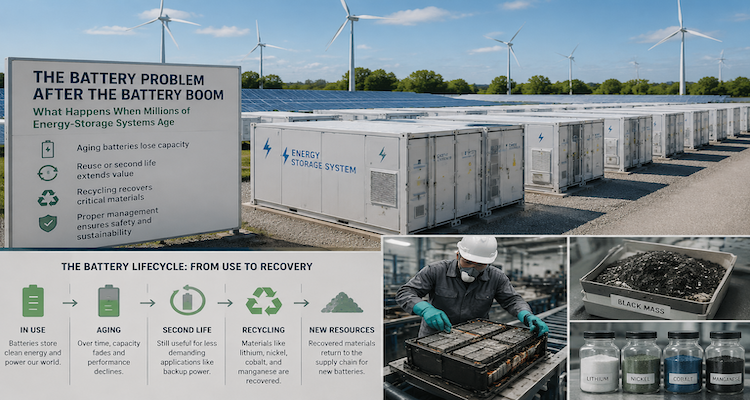
The global push toward battery-powered energy systems has solved one major challenge: storing electricity when renewable energy is available and using it when demand rises. But a second challenge is emerging quietly behind the expansion of lithium-ion batteries what happens when those systems become old.
Large-scale batteries installed alongside solar farms, wind projects, homes, businesses, and electric grids are designed to operate for years, not forever. As early generations of energy-storage systems begin to age, operators, recyclers, manufacturers, and governments face a new question: can the world build a circular battery economy fast enough to manage the coming wave of retired batteries?
The issue is not that batteries suddenly become useless. Many aging batteries can still provide valuable service through repair, reuse, or “second-life” applications. But eventually, millions of cells will need careful handling because they contain valuable materials and because damaged or improperly managed lithium-ion batteries can create safety risks.
The battery transition was built around deployment. The next phase will be built around durability, recovery, and responsible end-of-life management.
Key Takeaways
- Battery growth is creating a future challenge: managing aging energy-storage systems safely and economically.
- Older batteries may still have value through repair, reuse, or second-life applications before recycling.
- Recycling can recover important materials such as lithium, nickel, cobalt, and manganese from retired batteries.
- Battery chemistry, design, and condition will determine the best end-of-life pathway.
- The energy-storage industry must develop recycling infrastructure alongside new battery production.
The Next Phase of the Battery Industry Is Not Just Manufacturing
For more than a decade, the battery industry has focused on improving energy density, reducing costs, and increasing production capacity. Batteries have become central to electric vehicles, renewable energy integration, and grid reliability.
Energy storage has grown rapidly as utilities use batteries to balance electricity supply from variable renewable sources. The International Energy Agency reported that battery storage deployment in the power sector was the fastest-growing commercially available energy technology in 2023, with global battery storage capacity additions more than doubling year over year.
But every battery installed today represents a future management responsibility.
A battery does not simply “die” at a fixed moment. Over time, chemical reactions inside lithium-ion cells reduce their ability to store and deliver energy. Factors such as temperature, charging patterns, operating conditions, and usage cycles influence degradation. Battery researchers and modeling tools account for both calendar aging deterioration over time and cycle aging caused by repeated charging and discharging.
For grid operators, an aging battery may still be useful even after it no longer meets its original performance target.
A battery that is no longer ideal for a high-demand application may still work for less intensive energy-storage tasks.
Why Aging Batteries Are Different From Ordinary Waste
A retired battery system is not simply electronic waste.
Large energy-storage installations contain thousands of individual battery cells, along with electronics, cooling systems, safety equipment, and structural components. The challenge is identifying what can be reused, what can be repaired, and what must be recycled.
Lithium-ion batteries contain valuable materials including lithium, cobalt, nickel, manganese, and graphite. Recovering these materials can reduce demand for newly mined resources and support more circular supply chains.
However, recycling is technically complex.
Batteries come in different chemistries and designs. Two battery packs may look similar externally while having different internal materials and different recycling requirements. The U.S. Environmental Protection Agency notes that lithium batteries vary widely in chemistry and that this variation affects their properties and end-of-life management.
This means the future battery economy will require better tracking, identification, and collection systems.
The “Second Life” Question: Can Old Batteries Get Another Job?
One of the most important ideas in battery sustainability is extending useful life before recycling.
A battery removed from an electric vehicle, for example, may no longer provide enough range for a driver but could still store electricity for stationary applications. Similar approaches are being explored for retired energy-storage modules.
The advantage is straightforward: using a battery longer reduces the need to manufacture a replacement immediately.
The challenge is economic and technical. Companies must determine whether testing, transporting, modifying, and redeploying an old battery costs less than replacing it with a new one.
The National Renewable Energy Laboratory has examined circular-economy approaches for lithium-ion batteries used in mobile and stationary applications, highlighting reuse, repurposing, and recycling as possible pathways as battery volumes increase.
A successful second-life market would require reliable information about battery health. Without accurate data about a battery’s previous use and remaining capacity, companies may struggle to evaluate whether reuse is practical.
Recycling Infrastructure Must Catch Up With Battery Production
Battery manufacturing has expanded faster than recycling infrastructure.
The International Energy Agency reported that global battery recycling capacity exceeded 300 GWh per year in 2023, with the majority located in China, while Europe and the United States represented much smaller shares at that time. The agency expects recycling capacity to expand significantly if announced projects are completed.
The challenge is timing.
A battery industry needs recycling facilities before large numbers of batteries retire. But recycling companies need enough retired batteries to operate efficiently. This creates a common industrial problem: building infrastructure ahead of demand.
The solution may involve closer cooperation between battery manufacturers, energy companies, recyclers, and policymakers.
Future battery systems may increasingly be designed with recycling in mind, including easier disassembly, better labeling, and improved tracking of materials throughout their lifecycle.
Safety Is a Growing Concern During the End-of-Life Stage
Lithium-ion batteries are generally safe when properly designed, manufactured, and used. The risks increase when batteries are damaged, poorly stored, transported incorrectly, or handled without appropriate equipment.
The EPA warns that lithium-ion batteries should not be placed in household trash or regular recycling streams because they can become damaged during collection and processing, creating fire hazards.
For large energy-storage systems, end-of-life management requires specialized processes. Batteries may need controlled discharge, inspection, transportation procedures, and professional recycling methods.
The industry challenge is not only recovering materials it is doing so safely.
The Battery Industry’s New Test: Designing for the Entire Lifecycle
The first era of batteries focused on making energy storage cheaper and more powerful.
The next era will likely focus on making batteries easier to manage from beginning to end.
That could influence future battery design decisions:
- Manufacturers may prioritize materials that are easier to recover.
- Energy companies may demand clearer information about battery health.
- Regulators may develop stronger collection and recycling requirements.
- Recycling companies may become a more important part of the energy supply chain.
A battery is no longer just a product sold and replaced. It is part of a longer industrial cycle involving mining, manufacturing, operation, reuse, and recovery.
The environmental benefits of renewable energy storage depend partly on whether this entire cycle can be managed responsibly.
Conclusion
The battery boom created the foundation for a cleaner and more flexible energy system. But the success of that transition will not be measured only by how many batteries are installed.
It will also depend on what happens when those batteries age.
The coming challenge is not a shortage of battery technology. It is building the systems needed to repair, reuse, recycle, and safely manage millions of energy-storage units throughout their full lifecycle.
The future of batteries will not be defined only by how much energy they can store but by how responsibly society handles them when they no longer store enough.
The information presented in this article is based on publicly available sources, reports, and factual material available at the time of publication. While efforts are made to ensure accuracy, details may change as new information emerges. The content is provided for general informational purposes only, and readers are advised to verify facts independently where necessary.
Related News
- The Energy Paradox of Efficiency: Why Using Less Electricity Does Not Always Mean Using Less Energy
- Why Extreme Weather Is Turning Electricity Resilience Into an Everyday Consumer Issue
- Why Energy Independence Is Becoming a Household Decision, Not Just a National Strategy
- The Hidden Energy Cost of Keeping Everything Available Instantly