










Why Data Centers Are Changing Where New Power Infrastructure Gets Built
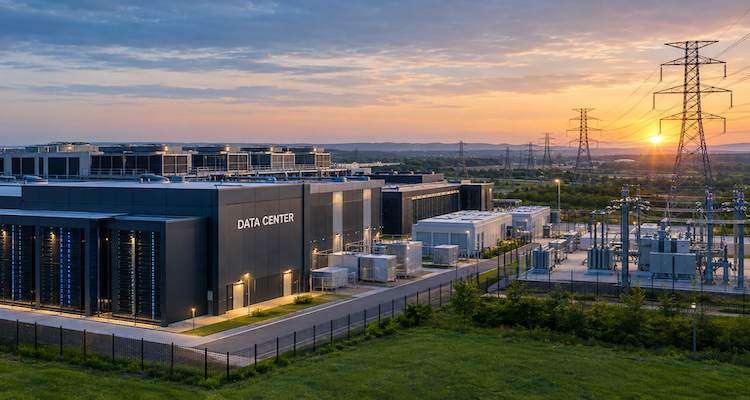
The next generation of data centers is creating a new constraint in the digital economy: power availability is becoming a location decision.
For years, data-center development was largely discussed in terms of fiber connectivity, land, taxes, cooling, labor and proximity to users. Those factors still matter, but the rapid expansion of AI computing is putting electricity much closer to the center of the site-selection equation. In the United States, data centers consumed about 4.4% of electricity in 2023, and a 2026 Lawrence Berkeley National Laboratory update estimates that they could account for 9.5% to 15.3% of U.S. electricity consumption by 2030, with a central estimate of 11.8%.
That scale changes the infrastructure problem. A data center is no longer simply another customer connecting to an existing grid. In some regions, a large computing campus can be large enough to influence forecasts for generation, transmission, substations, procurement and even the economics of building power plants.
The result is a subtle but important shift: the electricity system increasingly has to be planned around where large computing loads can realistically be served and where new power can be delivered to them.
Key Takeaways
- Data-center growth is making available grid capacity a major factor in deciding where new computing facilities can be built.
- Transmission constraints can matter as much as generation capacity because electricity must reach concentrated new loads.
- Utilities and grid operators are increasingly planning around large-load forecasts rather than treating data centers as ordinary incremental demand.
- New generation, batteries, transmission upgrades and onsite power can all become part of a data center’s infrastructure strategy.
- PJM’s 2026 reforms illustrate how large loads are beginning to influence the way electricity supply is procured.
- The long-term issue is not simply producing more electricity, but coordinating computing demand with the physical limits of the power system.
The Power Problem Starts With Concentration
Electricity demand from data centers is different from many traditional forms of load growth because enormous amounts of consumption can be concentrated in a relatively small geographic area.
A new residential development may add thousands of customers gradually. A hyperscale computing campus can add a very large electrical load to one location or cluster of locations.
That creates a geographic problem.
The United States can have sufficient electricity-generating capacity in aggregate while still having difficulty serving a particular data center because the transmission and distribution network around that location cannot deliver the required power.
The U.S. Department of Energy’s draft 2026 National Transmission Needs Study explicitly identifies data centers, domestic manufacturing and other large industrial loads as drivers of increased transmission needs. The study says the existing grid must accommodate rapidly growing loads while integrating additional generation and maintaining reliability.
This distinction is crucial.
Power generation answers how much electricity exists. Transmission determines where much of that electricity can actually be used.
Transmission Is Becoming a Data-Center Site-Selection Issue
A useful way to understand the changing geography is to imagine two locations with equally attractive land and tax incentives.
One has a nearby high-voltage transmission network with available capacity and a realistic path to interconnection.
The other has abundant land but limited transmission and a long queue of projects waiting for upgrades.
The first location may now be considerably more valuable to a data-center developer.
A recent U.S. Geological Survey analysis examining AI data centers and energy infrastructure found that proximity to a power plant is not necessarily the decisive factor. Its spatial analysis found that high-voltage transmission access can be more important for delivering sufficient power to large AI data centers than simply being close to a generating facility.
That helps explain why the traditional question Where is electricity generated? is becoming less useful than a broader one:
Where can large amounts of reliable electricity be delivered, and how quickly can that connection be built?
The answer can move investment toward areas with transmission capacity, substations, existing generation infrastructure or a combination of those assets.
Data Centers Are Changing Generation Planning Too
The second change is happening upstream.
If existing generation cannot satisfy the projected demand in a region, developers and utilities need additional resources. Those can include natural-gas generation, renewables, batteries, nuclear resources, geothermal projects, demand flexibility and other technologies.
The mix will vary by region and by the reliability requirements of the system.
The International Energy Agency estimates that global data-center electricity consumption rose about 17% in 2025. Its updated outlook projects global data-center electricity use to roughly double from 485 TWh in 2025 to about 950 TWh in 2030.
The U.S. picture is particularly significant. The IEA says data centers accounted for around half of the country’s total electricity-demand growth in 2025.
That does not mean every new power plant is being built specifically for AI. Electricity systems serve many customers simultaneously, and attributing an individual generation project to one data center can be misleading.
But the aggregate effect is increasingly difficult for planners to ignore.
Large computing loads are changing the forecasts on which decisions about generation and transmission are based.
The New Infrastructure Equation
The traditional infrastructure sequence was relatively straightforward:
Customers → electricity demand → grid expansion
Large AI data centers complicate that sequence:
Expected computing demand → location choice → grid capacity assessment → generation and transmission requirements → financing and procurement → data-center construction
That reversal matters because a data-center developer cannot necessarily wait for the power system to catch up.
Lawrence Berkeley National Laboratory’s 2026 Speed to Power report identifies more than 40 potential approaches for accelerating connections of large loads. The report groups them into areas including load forecasting, interconnection, resource planning and procurement, electricity markets and cost allocation.
In other words, the problem is not one missing technology.
It is a coordination problem involving utilities, regulators, grid operators, generators, transmission owners, large-load customers and investors.
Why Onsite Power Is Becoming More Attractive
One response is to reduce dependence on the conventional grid connection or supplement it.
The Department of Energy has highlighted microgrids and other onsite arrangements as potential ways to support large loads with shorter timelines than some major transmission or distribution expansions.
The regulatory landscape is also evolving. In July 2026, the U.S. Environmental Protection Agency issued guidance concerning so-called islanded generation facilities power generation that is not connected to the public electricity grid. The guidance could give developers greater flexibility in how and where certain data-center power systems are developed.
But onsite generation is not a universal replacement for the grid.
Large computing facilities still require reliability, fuel or energy resources, equipment, cooling and other supporting infrastructure. And depending on the technology, onsite generation can introduce emissions, permitting, fuel-supply or operating challenges of its own.
The important shift is that power supply is increasingly becoming part of the data-center project itself rather than something developers can always assume the utility will provide later.
PJM Shows How the Relationship Is Changing
The PJM electricity market provides one of the clearest examples of this transition.
PJM, which operates the largest regional transmission organization in the United States, has been redesigning parts of its capacity process in response to rapidly growing demand and anticipated resource shortfalls.
In July 2026, PJM said its recent capacity auction produced a 6,831 MW shortfall for the 2028/2029 delivery year and proposed a Reliability Backstop Procurement to secure additional resources.
The proposal goes beyond simply asking generators to build more capacity. PJM’s process includes bilateral contracting involving large loads, hyperscalers and generation developers, alongside a central procurement mechanism.
That is significant because it moves the relationship between electricity buyers and power producers closer together.
A large computing customer can become part of the mechanism through which new supply is identified, contracted and financed.
PJM’s May 2026 materials also showed the scale of interest: its request for information received nearly 450 responses representing more than 130 GW of potential supply and more than 30 GW of demand. Those figures represent responses and expressed interest, not committed projects, so they should not be interpreted as guaranteed future capacity.
Still, the process illustrates the changing economics of large-load development.
The Geography of Cheap Power May Become Less Important Than the Geography of Buildable Power
There is an important distinction between cheap electricity and available electricity.
A region can have inexpensive generation but insufficient transmission capacity to connect a new hyperscale campus.
Another region may have more expensive electricity but enough transmission, generation and industrial infrastructure to energize a project sooner.
For developers operating on aggressive construction schedules, that difference can materially affect project economics.
This is one reason data-center geography may increasingly follow infrastructure rather than simply real-estate opportunity.
The LBNL research on large-load connections identifies forecasting and interconnection as major bottlenecks. Its work also points to the importance of planning mechanisms that allow utilities and regulators to distinguish credible future demand from uncertain or speculative projects.
That distinction matters because building infrastructure for a project that never materializes can leave other electricity customers carrying unnecessary costs.
The Grid Is Becoming Part of the AI Supply Chain
AI infrastructure is usually described as a stack of chips, servers, networking equipment, software and data.
Increasingly, that description is incomplete.
The physical supply chain also includes substations, transformers, transmission lines, generation equipment, batteries, cooling systems and fuel or energy resources.
The IEA has identified energy infrastructure and equipment including transformers and gas turbines as bottlenecks that can constrain the expansion of data centers.
That creates a second-order effect.
Even when a company has secured land, financing, chips and construction contractors, the project can still be constrained by the time required to obtain and build its power connection.
The limiting resource may therefore shift from compute hardware to infrastructure coordination.
Efficiency Helps but Does Not Eliminate the Siting Problem
There is an important counterargument to the idea that rising AI demand automatically requires proportionally more power infrastructure.
Computing efficiency is improving.
The IEA says electricity consumption per AI task is declining rapidly, even as overall demand grows because AI usage is expanding and more energy-intensive applications are emerging.
That means better chips, software optimization, cooling improvements and workload efficiency can reduce the electricity required for individual computations.
But infrastructure planners care about the aggregate load at a location.
If efficiency improves while the amount of computing grows even faster, the local electrical demand can still increase substantially.
The 2026 LBNL update reflects this uncertainty by providing a range rather than a single deterministic forecast: data centers could represent between 9.5% and 15.3% of U.S. electricity consumption in 2030, with 11.8% as the report’s central estimate.
That range is itself an important finding.
The exact future load is uncertain, but the infrastructure planning problem is already real.
What This Means for Communities and Businesses
The consequences extend beyond technology companies.
For communities, large data-center projects can create investment and employment while also raising questions about grid upgrades, electricity rates, land use, water, emissions and local infrastructure.
For utilities, the challenge is determining how much infrastructure should be built ahead of confirmed demand and how the associated costs should be allocated.
For data-center developers, power availability increasingly belongs near the beginning of the site-selection process rather than near the end.
For investors, the value of a site may increasingly depend on something invisible in a conventional real-estate analysis: its ability to obtain reliable power within the project’s required timeframe.
And for policymakers, the central question is becoming more complicated than whether to permit new data centers.
It is whether energy infrastructure, markets and regulation can expand quickly enough while maintaining reliability and allocating costs fairly.
The Bigger Shift Is From Data-Center Siting to Energy-System Siting
The most important change may be conceptual.
Data centers are still choosing locations. But increasingly, their locations are constrained by the physical architecture of the electricity system.
That means future development could involve more than selecting a favorable site and then requesting a grid connection. Developers may increasingly evaluate transmission corridors, substations, generation resources, interconnection timelines, onsite generation options and regional power-market conditions as a single package.
The relationship can work in the other direction as well.
A region with new transmission capacity, surplus generation potential or favorable conditions for additional power resources may become more attractive precisely because it can support large computing loads.
In that sense, AI is beginning to influence not only where servers are installed, but where electricity infrastructure is economically justified.
Conclusion
The emerging data-center power story is not simply about whether the world has enough electricity.
It is about where that electricity is available, how quickly it can be delivered, what infrastructure must be built to deliver it, and who pays for that infrastructure.
The scale of AI-driven computing is making those questions harder to separate from data-center development itself. U.S. federal agencies and grid researchers are already treating large computing loads as a significant factor in transmission planning, generation procurement and grid modernization.
The practical consequence is straightforward: power infrastructure is becoming a competitive asset in the geography of computing.
For the next generation of data centers, the best site may not simply be where land is available or electricity is inexpensive. It may be where the grid, generation and development timelines can all meet at the same place.
The information presented in this article is based on publicly available sources, reports, and factual material available at the time of publication. While efforts are made to ensure accuracy, details may change as new information emerges. The content is provided for general informational purposes only, and readers are advised to verify facts independently where necessary.
Related News
- The Energy Paradox of Efficiency: Why Using Less Electricity Does Not Always Mean Using Less Energy
- Why Extreme Weather Is Turning Electricity Resilience Into an Everyday Consumer Issue
- Why Energy Independence Is Becoming a Household Decision, Not Just a National Strategy
- The Hidden Energy Cost of Keeping Everything Available Instantly