



Why More People Are Choosing Experiences They Won’t Post Online
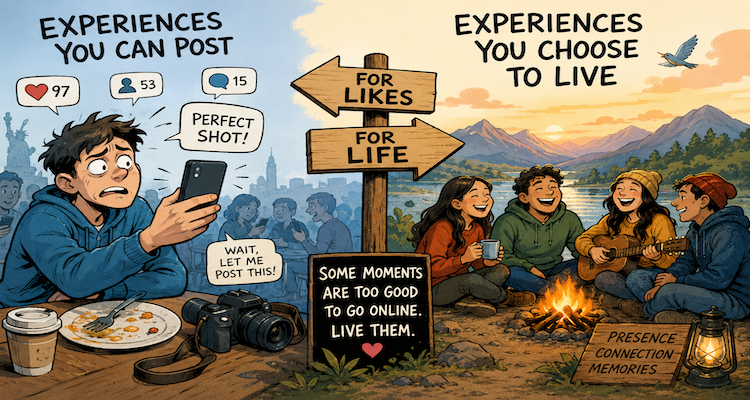
A concert with phones locked away. A dinner where nobody reaches for a camera. A weekend trip remembered through conversation rather than a carousel of carefully selected photographs. These experiences are becoming easier to find and increasingly, people are choosing them deliberately.
Eventbrite reported in 2026 that phone-free experiences listed on its platform grew 567% globally between 2024 and 2025, while attendance increased 121%. Its data also found that 49% of surveyed consumers wanted live experiences to feel less curated and more real. The figures describe Eventbrite’s platform rather than society as a whole, but they offer a useful signal: the appeal of being temporarily invisible online is becoming commercially visible.
At the same time, other evidence suggests people are becoming more selective about what they publish. Ofcom’s 2025 research on UK adults found that 49% of social-media users actively posted, shared or commented, down from 61% in 2024. Its qualitative research also found people becoming more cautious about their digital footprints, with some stopping posting altogether.
The interesting part is what sits behind those numbers. The attraction of an offline experience is not necessarily that people dislike technology. It may be that some experiences feel different when they are not being prepared for an audience.
The experience changes when there is no audience
Posting an experience online creates a second task alongside having the experience itself.
A person taking photographs at a restaurant is not necessarily distracted. A traveler recording a sunset is not necessarily enjoying it less. Social media can help people preserve memories, communicate with friends and discover places.
Research actually shows that active social-media use can have positive aspects. A 2024 experience-sampling study published in the Journal of Computer-Mediated Communication followed 74 adults six times a day for five days. Within individuals, moments of posting were associated with greater feelings of connectedness, while social-media-induced upward comparison was associated with lower momentary self-esteem.
That distinction matters.
The issue is not simply “screen versus no screen.” It is what the person is doing with the screen and what psychological role the audience plays.
When an experience is being photographed for later memory, the camera may be useful. When it is being photographed because the moment feels incomplete until other people see it, the experience can acquire a different objective.
The dinner becomes content.
The vacation becomes a sequence of publishable locations.
The concert becomes footage.
The private celebration becomes an update.
Choosing not to post can therefore be less about rejecting technology and more about removing the second layer of performance.
Social media has made sharing normal but not everyone wants to be a creator
There is another reason the “offline experience” trend can be misunderstood: most social-media users are not prolific publishers in the first place.
Pew Research Center’s study of U.S. adult TikTok users found that around half had never posted a video, while the most active 25% of users by posting volume produced 98% of publicly accessible videos from the users studied. The typical user was therefore much more of a consumer than a creator.
That finding challenges the idea that everyone is constantly turning life into content.
The culture may look highly performative because the most visible users produce enormous amounts of material. But visibility is not the same thing as participation.
For many people, the choice may be much simpler: they enjoy seeing other people’s lives but have little desire to publish their own.
The growing popularity of deliberately private experiences may be an extension of that behavior. Instead of asking, “How do I make this worth posting?” people can ask, “Was this worth experiencing?”
The pressure to document can become part of the experience
Travel provides one of the clearest examples.
Social media can influence where people go, what attractions they notice and how they imagine a destination before arriving. Research published in the Journal of Destination Marketing & Management in 2024 analyzed more than 139,000 Instagram photographs associated with a tourism destination and found that posts featuring points of interest received more engagement than posts focused on hospitality services. Posts featuring people and those posted by tourists also attracted more engagement.
Another 2024 study found that social-media exposure can narrow tourists’ experiences by repeatedly directing attention toward similar places and visual patterns. The researchers argued that algorithms, cognitive biases and social connections can contribute to self-reinforcing tourism behavior.
This creates an unusual paradox.
Social media can help people discover a destination, but the same visual culture can influence what they believe they are supposed to see once they arrive.
The result can be a trip designed partly for the camera: recognizable landmark, photograph, caption, upload, reaction.
Choosing not to post breaks that sequence.
A traveler can still take a photograph. They can still visit the famous viewpoint. But the experience no longer needs to justify itself through public visibility.
There is also a privacy calculation
The decision not to share is not always philosophical.
Sometimes it is practical.
Once an experience is posted publicly, control over it becomes more complicated. Images can be copied. Locations can be identified. Personal routines can become visible. A post intended for friends can potentially reach a much wider audience depending on platform settings and sharing behavior.
Ofcom’s 2025 behavioral audit of major social and video-sharing platforms found that services do not always draw users’ attention to important privacy choices or explain how personal information will be used before consent is provided.
That helps explain why digital restraint can feel attractive even to people who enjoy social platforms.
Not every moment needs an audience.
Not every location needs to become searchable.
Not every relationship needs to be publicly documented.
And not every memory needs a permanent digital record.
The science does not support a simple “social media is bad” story
This is where the trend deserves more nuance.
A 2024 meta-analysis covering 78 studies found that the relationship between social-media use and well-being depends substantially on the type of activity. Social communication and positive online experiences showed positive associations with some forms of well-being, while problematic use and social comparison showed negative associations. The overall effects were not uniform.
A 2025 systematic review and meta-analysis of social-media abstinence likewise found that evidence about whether temporarily stopping social media improves well-being is inconsistent. The researchers included 10 studies involving 4,674 participants and examined outcomes including positive affect, negative affect and life satisfaction.
That matters because the emerging preference for offline experiences should not be turned into another simplistic lifestyle rule.
People do not necessarily need to delete Instagram, abandon TikTok or spend every weekend without a phone.
The more useful lesson is that different forms of digital participation produce different experiences.
Sometimes sharing creates connection.
Sometimes comparison creates pressure.
Sometimes a phone preserves a memory.
Sometimes it interrupts the moment that would have become the memory.
Why phone-free experiences are becoming attractive
Eventbrite’s 2026 data provides perhaps the clearest commercial signal of this changing preference. The company says phone-free events on its platform increased 567% globally between 2024 and 2025, with attendance up 121%. It also reported particularly strong growth in the UK and United States.
The methodology is important: these numbers come from Eventbrite listings containing “Phone-Free” terminology and therefore should not be interpreted as a representative survey of everyone.
But the underlying idea is broader than the numbers.
Phone-free concerts, locked-phone parties, analog game nights and screen-free social gatherings create something that ordinary digital-detox advice often cannot: a social environment where everyone is participating in the same absence.
That distinction is important.
Putting your phone away alone requires self-control.
Entering a room where everyone has agreed to put their phones away removes much of the social pressure to keep checking them.
The absence becomes collective rather than individual.
That can make conversation, attention and participation feel easier not because phones are inherently harmful, but because everyone has temporarily agreed that the audience outside the room does not matter.
The most valuable experiences may become the least visible
There is an irony here.
For years, digital culture rewarded visibility. The places people photographed, the restaurants they reviewed, the destinations they posted and the events they documented gained additional cultural momentum.
Now the opposite signal is beginning to emerge.
An experience that cannot easily be posted can acquire a different kind of value.
A conversation that stays between two people cannot be measured in likes.
A concert remembered rather than recorded does not need to compete with someone else’s version of the same performance.
A holiday without constant documentation can be experienced without repeatedly asking how it looks from the outside.
That does not make private experiences automatically better. Nor does it mean people are abandoning social media. The evidence does not support either conclusion.
What appears to be changing is the relationship between experiencing something and proving that it happened.
People can still share the spectacular moments. They can still photograph friends, recommend restaurants and post travel memories.
But there is growing appeal in having some experiences that exist only for the people who were there.
What this means for everyday life
The practical lesson is not to turn every outing into a digital detox.
Instead, people can deliberately decide which experiences deserve documentation and which deserve attention.
A useful test is simple:
- Am I recording this because I want the memory, or because I want the reaction?
- Would I still take the photograph if nobody could see it?
- Is posting helping me connect with people who matter, or pulling me toward an imagined audience?
- Would this experience feel different if I knew I could never share it?
There is no universally correct answer.
Sometimes the photograph is the memory.
Sometimes the photograph gets in the way of the memory.
Knowing the difference may become a more valuable digital skill than simply knowing how to use another platform.
Conclusion
The appeal of experiences that cannot be posted online is not necessarily a rebellion against social media. It is a response to something subtler: the realization that visibility can change the way an experience is experienced.
Research shows that social media can create connection as well as comparison, and that temporary abstinence does not produce universally predictable benefits. At the same time, recent behavioral and event-platform data suggest growing interest in more selective sharing and phone-free environments.
The emerging choice, then, may not be between an online life and an offline one.
It may be between living everything for an audience and deciding that some moments are valuable precisely because there is no audience at all.
This content is published for informational or entertainment purposes. Facts, opinions, or references may evolve over time, and readers are encouraged to verify details from reliable sources.