









Earth, Energy, and Everything in Between: How One Energy System Connects the Planet, Economy and Digital Age
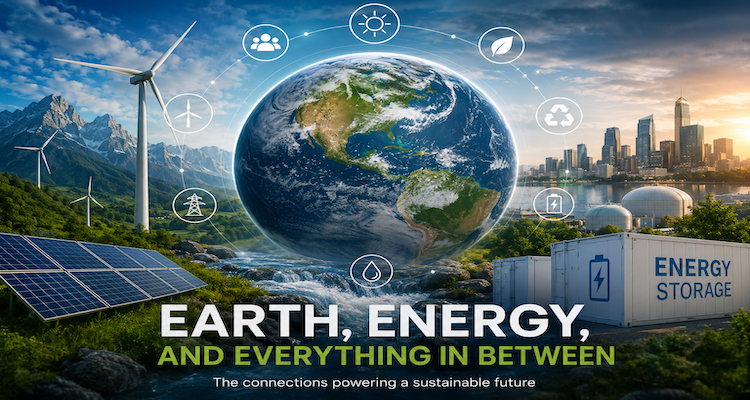
Earth’s energy story begins far beyond power plants and electricity grids. Every ecosystem, weather system and human energy system ultimately operates within a larger flow of energy, much of it originating with the Sun. Solar radiation heats the planet, drives evaporation and atmospheric circulation, supports photosynthesis and sets the basic conditions under which life can exist.
Human civilization has built its own energy system on top of that natural foundation. Coal, oil and gas powered industrialization; electricity transformed how energy could be delivered; and wind, solar, nuclear, hydropower and other technologies are now reshaping the supply system. At the same time, electricity demand is accelerating because buildings, transport, industry, digital infrastructure and artificial intelligence increasingly depend on it.
That creates an important tension: the world is deploying low-carbon energy at extraordinary speed, yet total energy demand continues to rise and fossil fuels remain deeply embedded in the global system. Understanding that tension is more useful than treating the energy transition as a simple switch from one technology to another.
Key Takeaways
- Earth’s climate is governed by a continuous balance between incoming solar energy and energy leaving the planet.
- Human energy consumption has become a major force shaping economies, infrastructure and environmental conditions.
- Electricity is growing faster than overall energy demand as transport, buildings, industry and computing become increasingly electrified.
- Renewable power is expanding rapidly, but rising energy demand means fossil fuels have not disappeared from the system.
- Artificial intelligence adds a new electricity demand challenge while simultaneously creating incentives for greater energy efficiency.
- The energy transition is increasingly a question of grids, storage, reliability and affordability not simply generation capacity.
Earth Runs on an Energy Budget
The simplest way to understand Earth’s energy system is to think of the planet as continuously receiving and releasing energy.
The primary external source is sunlight. NASA estimates that Earth receives an average of about 340 watts of solar power per square metre at the top of the atmosphere. Roughly 29% is reflected back into space, while the remainder is absorbed by the atmosphere and surface.
That absorbed energy does far more than warm the ground.
It drives evaporation and the water cycle. It powers atmospheric circulation and ocean processes. Plants capture part of it through photosynthesis, converting solar energy into chemical energy that supports food webs and, over geological timescales, contributed to the formation of fossil fuels.
The planet then releases energy back into space, largely as thermal infrared radiation. When incoming and outgoing energy are balanced over long periods, Earth’s climate remains relatively stable. When the balance changes, the climate system responds.
This is the deeper meaning behind the phrase “energy system.” It is not simply a collection of power stations and fuel supplies. It is a chain connecting sunlight, atmosphere, oceans, ecosystems, agriculture, industry, transportation and digital infrastructure.
From Sunlight to Civilization
Humanity learned to exploit energy sources that could provide more controllable and concentrated power than direct sunlight.
Wood supplied early societies with heat. Agriculture converted solar energy into food and animal power. Coal then provided an energy source capable of supporting steam engines and industrial production on a vastly larger scale.
Oil and natural gas extended that transformation into transportation, chemicals, electricity generation, heating and manufacturing.
The result was an economy increasingly organized around abundant, portable and controllable energy.
But this system created another connection: much of the carbon released by extracting and burning fossil fuels eventually interacts with Earth’s climate system.
The natural greenhouse effect itself is essential to a habitable planet. Greenhouse gases absorb some outgoing infrared radiation and help keep Earth’s surface substantially warmer than it would otherwise be. The problem arises when human activities increase greenhouse-gas concentrations and alter the planet’s energy balance.
That distinction matters. The issue is not that greenhouse gases exist. Earth depends on them. The issue is how human activity has changed their concentration and therefore the flow of energy through the climate system.
The Energy System Is Growing, Not Simply Changing
One of the easiest mistakes in discussions about the energy transition is to assume that replacing fossil fuels automatically means total energy consumption will fall.
The data tell a more complicated story.
The International Energy Agency reported that global energy demand increased 2.2% in 2024, faster than its average annual growth rate during 2013–2023. Electricity demand grew even faster, increasing 4.3%. Emerging and developing economies accounted for more than 80% of global energy-demand growth.
The Energy Institute’s 2026 review of 2025 data similarly found that total energy supply increased 1.7%, with major energy sources reaching new highs. Renewables were the largest contributor to growth in total energy supply for the first time outside a recession.
This produces an important distinction between energy addition and energy substitution.
Renewable energy can grow extremely quickly without immediately eliminating fossil-fuel consumption if total demand is also expanding.
That is one reason the transition can look contradictory: solar and wind can be breaking deployment records while coal, oil or gas consumption remains significant.
The Energy Institute’s transition data show that global fossil-fuel consumption increased between 2017 and 2024 even as renewable consumption more than doubled.
The transition is therefore better understood as a restructuring of a growing energy system than as a simple replacement exercise.
Electricity Is Becoming the Bridge Between Energy and Technology
Electricity occupies a special position because it can connect very different energy sources to very different uses.
A solar panel produces electricity. A battery stores electricity. An electric vehicle converts electricity into motion. A heat pump uses electricity to move heat. A data centre converts electricity into computing capacity.
That flexibility is helping electricity become increasingly important across the economy.
The IEA describes this shift as a “new Age of Electricity.” Global electricity consumption increased 4.3% in 2024, and the agency projected continued growth of close to 4% through 2027 in its 2025 electricity outlook.
The drivers are diverse:
- electric vehicles;
- air conditioning and other appliances;
- heat pumps;
- industrial electrification;
- semiconductor and battery manufacturing;
- data centres;
- artificial intelligence infrastructure.
This changes the central energy question.
It is no longer enough to ask how much energy the world produces.
Increasingly, the questions are:
Where is electricity produced? How reliably can it reach users? How much does it cost? Can the grid absorb new demand? And what happens when renewable generation varies with weather?
Solar and Wind Are Growing Fast But the Grid Matters
Renewable electricity is expanding rapidly.
The IEA’s Renewables 2025 forecast projects almost 4,600 gigawatts of additional renewable power capacity between 2025 and 2030, with solar photovoltaics expected to account for nearly 80% of worldwide renewable-capacity expansion.
But generating electricity and delivering electricity are different problems.
Solar production changes with daylight and weather. Wind generation varies with atmospheric conditions. Electricity demand does not necessarily follow either pattern.
That makes transmission networks, flexible generation, energy storage, demand management and grid planning increasingly important.
The Energy Institute reported that global battery-storage capacity more than doubled in 2024, reaching 126 GW, with China accounting for much of the increase.
Storage does not eliminate every challenge, but it changes what electricity systems can do with variable generation. A system with substantial storage and flexible demand can make better use of electricity when renewable output is high and reduce dependence on more carbon-intensive generation during other periods.
The practical lesson is straightforward: building generation is only one part of building an energy transition.
AI Adds a New Layer to the Energy Story
The connection between energy and technology is becoming particularly visible through artificial intelligence.
AI models run primarily in data centres, and those facilities require substantial electricity. The IEA estimates that data centres accounted for about 1.5% of global electricity consumption in 2025, while their electricity use increased 17% that year.
At the same time, AI creates an unusual efficiency paradox.
The amount of electricity required for an individual AI task can fall as hardware and software become more efficient. But if AI becomes cheaper and more widely used, the number of tasks can increase dramatically.
The IEA’s recent analysis therefore points to both forces operating simultaneously: improving efficiency per task and rapidly expanding overall use.
This matters beyond technology companies.
Large computing facilities can affect local electricity demand, grid connections, infrastructure investment and power-generation decisions. In the United States, the IEA estimates that data centres accounted for around half of total electricity-demand growth in 2025.
AI therefore illustrates a broader principle: digital progress still has a physical energy footprint.
The cloud is ultimately connected to power lines, transformers, cooling systems, buildings and generation assets.
The Hardest Part May Be Matching Supply With Demand
Energy discussions often focus on generation technologies because they are visible and easy to compare.
But energy security depends on something more fundamental: whether supply can meet demand when and where people need it.
A country can have enormous renewable potential and still experience grid congestion. A region can have abundant electricity generation but insufficient transmission. A city can attract data centres faster than its power infrastructure can accommodate them.
These constraints are increasingly important as electrification accelerates.
The IEA expects renewable sources to meet more than 90% of global electricity-demand growth between 2025 and 2030, according to its Renewables 2025 outlook.
That is significant but it should not be interpreted as meaning the energy system has already become predominantly renewable.
Electricity demand is growing rapidly, and different regions have very different starting points, resources, grids, policies and economic priorities.
The transition will therefore look different in India, China, Europe, the United States, Africa and other regions.
What the Energy Transition Really Means
The phrase “energy transition” can make the process sound linear: old fuels go down, new fuels go up, and the job is finished.
Reality is messier.
The Energy Institute’s 2025 review noted that renewable deployment has been growing substantially faster than total energy demand, yet fossil fuels have continued to expand as global energy demand rises.
This is why the transition should be judged across several dimensions:
Carbon intensity: How much greenhouse gas is associated with each unit of useful energy?
Reliability: Can energy be supplied when demand peaks?
Affordability: Can households and businesses access energy at sustainable prices?
Infrastructure: Can grids, pipelines, storage systems and transmission networks handle changing patterns of demand?
Resource availability: Are the minerals, equipment and manufacturing capacity required for new technologies available at sufficient scale?
Access: Can developing economies expand energy consumption without reproducing the most carbon-intensive pathways of earlier industrialization?
These questions are connected. Improving one part of the system can create pressure elsewhere.
The Planetary and Human Systems Are Becoming More Closely Linked
Earth’s natural energy system and humanity’s industrial energy system were never truly separate. Human civilization has always depended on climate, water, agriculture and ecological productivity.
What has changed is the scale.
Energy consumption now determines not only how homes are heated or vehicles are moved, but also how factories operate, how food is produced, how information is processed and how rapidly new technologies can be deployed.
At the same time, the energy system is increasingly influenced by climate itself. Heatwaves can increase cooling demand. Water availability can affect hydropower and thermal power operations. Extreme weather can damage infrastructure. Changing conditions can alter both supply and demand.
Energy policy is therefore becoming increasingly inseparable from climate resilience, industrial policy, technology strategy and economic planning.
Conclusion
“Earth, Energy, and Everything in Between” is ultimately a story about connections.
The sunlight reaching Earth becomes the foundation for climate and life. Human societies capture energy through increasingly sophisticated technologies. Electricity connects renewable generation to factories, homes, vehicles and computers. Artificial intelligence adds another layer of demand while pushing engineers toward greater efficiency.
The most important shift is therefore not simply from coal and oil toward solar and wind.
It is toward a world in which energy, technology, infrastructure and the environment increasingly operate as one interconnected system.
The success of that system will depend less on finding a single perfect energy source than on building an energy network that is cleaner, reliable, affordable, resilient and capable of supporting rising human demand.
That is the real challenge between Earth and everything in between.
This content is published for informational or entertainment purposes. Facts, opinions, or references may evolve over time, and readers are encouraged to verify details from reliable sources.