







What Happens If the World’s Glaciers Disappear?
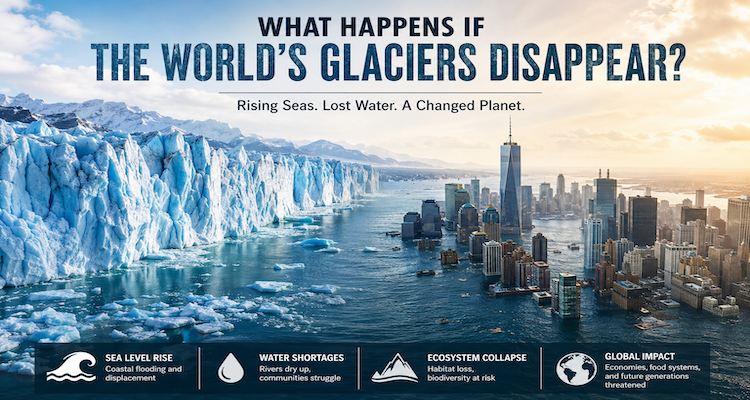
Glaciers are often described as frozen archives of Earth’s climate. But they are also active parts of the modern world: they feed rivers, support ecosystems, influence sea level and shape the economies and communities built around mountain landscapes.
Their disappearance would not produce one single, simultaneous catastrophe. The consequences would unfold differently across regions and over decades or centuries. Coastal cities would face rising seas. Some mountain communities would first experience more meltwater and flooding, then less reliable water as shrinking glaciers pass a critical threshold known as “peak water.” Ecosystems adapted to cold, glacier-fed environments would be transformed. Entire landscapes and some of the tourism, agriculture and infrastructure built around them would have to adapt.
The world is not currently on the verge of losing every glacier overnight. Yet glacier loss is already widespread. The World Meteorological Organization reported that 2024 marked the third consecutive year in which all glacier regions experienced losses, while the IPCC concludes with very high confidence that glaciers will continue losing mass for at least several decades even if global temperatures stabilize.
The more useful question, then, is not simply what a glacier-free world would look like. It is what disappears with the ice and which consequences begin long before the last glacier is gone.
Key Takeaways
- Glacier loss raises sea levels, but melting mountain glaciers alone would not produce the same outcome as the loss of Greenland or Antarctica.
- Many glacier-fed regions can experience increased runoff before eventually facing declining and less reliable water supplies.
- The disappearance of glaciers would transform ecosystems, landscapes, tourism and infrastructure in mountain regions.
- Recent global glacier losses show that this is not a distant hypothetical; important consequences are already emerging.
- Reducing warming can still limit how much glacier ice is lost, even though some continued loss is already unavoidable.
First, What Does “All Glaciers” Actually Mean?
A common misconception is to place all of Earth’s land ice into a single category. In reality, glaciers and ice sheets are not interchangeable.
For this discussion, glaciers generally means the flowing bodies of land ice found in mountain ranges and polar regions outside the great Greenland and Antarctic ice sheets. Those two ice sheets contain vastly larger stores of freshwater and represent a separate, much larger long-term sea-level risk. NASA notes that Greenland and Antarctica together store about two-thirds of Earth’s freshwater.
That distinction matters because the disappearance of every mountain glacier would be globally consequential, but it would not mean instant disappearance of Greenland and Antarctica.
The IPCC estimated that glaciers lost about 6,200 gigatonnes of mass between 1993 and 2019, contributing roughly 17 millimetres to global mean sea-level rise. During 2010–2019, glacier mass loss was greater than in any previous decade of the observational record.
So a glacier-free future is not a binary switch. It is a long process in which the consequences change as the remaining ice shrinks.
Sea Levels Would Continue to Rise
When land-based glacier ice melts and the water eventually reaches the ocean, it contributes to sea-level rise.
The IPCC found that glacier mass loss was responsible for about 22% of observed global mean sea-level rise between 1971 and 2018. Together, glaciers and ice sheets became the dominant contributors to sea-level rise during 2006–2018.
But the consequences would not be distributed evenly.
A few additional centimetres of global mean sea-level rise can substantially increase coastal flooding risks in low-lying areas because it raises the baseline from which storm surges and high tides operate. The exact local impact depends on land subsidence or uplift, tides, storms, coastal defenses and regional ocean dynamics.
There is another important point: sea-level rise does not stop when a glacier disappears. Oceans also rise because warmer seawater expands, and the response of large ice sheets can continue for centuries or longer.
NASA’s current ice-sheet observations underline the scale of that broader problem. Greenland and Antarctica are already losing ice mass, adding another major source of sea-level rise beyond mountain glaciers.
The disappearance of glaciers, therefore, should not be viewed as the end of the sea-level story. It would be part of a larger transformation of Earth’s cryosphere.
The Water Paradox: More Melt Before Less Water
One of the most important and often overlooked consequences of glacier loss concerns freshwater.
At first, warming can increase glacier melt. In some regions, that means rivers receive more water from shrinking ice. But this increase cannot continue indefinitely. A glacier is effectively drawing down a finite store of frozen water.
Eventually, a region can reach peak water: the point at which annual glacier meltwater reaches its maximum. After that, runoff from the glacier begins to decline because there is simply less ice left to melt.
The WMO highlighted this transition in its 2025 assessment of global water resources, noting that many small-glacier regions have already reached, or are approaching, peak water.
This creates a two-stage risk:
- During rapid retreat: increased meltwater can contribute to unstable river flows and, in some locations, hazards associated with changing mountain environments.
- After substantial ice loss: dry-season and drought-period water supplies may become less reliable where glacier melt previously provided an important buffer.
The scale of the problem varies enormously. Not every river is glacier-dependent, and the consequences depend on rainfall patterns, seasonal snow, groundwater, reservoirs and water management.
But for communities that rely heavily on glacier-fed water systems, the disappearance of glaciers would mean losing a natural storage mechanism that releases water during warmer and drier periods.
That is the central water paradox: the first sign of glacier decline can be too much meltwater; the later consequence can be too little dependable meltwater.
Mountain Ecosystems Would Be Rewritten
Glacier retreat does more than remove ice. It exposes new land, changes river temperatures and alters sediment flows.
As ice retreats, landscapes that may have been covered for centuries or millennia become available for colonization by plants and animals. New lakes can form, river channels can shift and cold-adapted habitats can shrink.
These changes create ecological opportunities as well as losses. New ecosystems may emerge on newly exposed terrain, but species adapted specifically to cold, glacier-fed environments can lose habitat.
The transformation can also be rapid from a human perspective. A valley mapped, farmed, visited or developed around a stable glacier landscape may become a fundamentally different environment within a few generations.
The disappearance of glaciers would therefore not simply leave behind “empty mountains.” It would begin a prolonged ecological reorganization whose winners and losers would vary from place to place.
The Geography of Risk Would Change
Glacier loss does not affect every region equally.
The IPCC projects large regional differences in how much glacier mass may be lost, depending on future emissions and local geography. Under high-emissions pathways, several regions with relatively small glacier coverage are projected to lose nearly all of their glacier mass by 2100, while larger Arctic glacier regions can contribute more substantially to sea-level rise because they contain far greater volumes of ice.
This creates an important mismatch between where glaciers disappear first and where the largest global sea-level contribution comes from.
Small tropical or mid-latitude glaciers may be locally crucial despite contributing relatively little to global sea-level rise. Their disappearance can have outsized regional consequences for water, ecosystems, cultural identity and tourism.
Meanwhile, large glacier regions in Alaska, the Canadian Arctic, Greenland’s peripheral glaciers and other polar areas matter more to the global sea-level budget because of the enormous amount of ice involved.
A disappearing glacier is therefore both a local and global story but the two scales do not always align.
Infrastructure Built for an Icy World Would Have to Adapt
Many mountain roads, bridges, hydropower systems and settlements were designed around environmental conditions that assumed glaciers and frozen ground would remain relatively stable.
As glaciers retreat, slopes can change, new lakes may develop and river systems can be reorganized. The exact hazards vary by location, but glacier loss can force expensive reassessments of infrastructure and disaster planning.
Hydropower illustrates the broader challenge. More meltwater does not automatically mean permanently greater electricity generation. Once glaciers shrink beyond their period of peak runoff, the long-term water supply to some glacier-fed systems may decline.
The same principle applies to water infrastructure more broadly. Reservoirs, irrigation systems and municipal water networks are often designed around historical patterns. If the seasonal timing and volume of river flow change, past assumptions may become less useful.
The disappearance of glaciers would therefore create a planning problem as much as a physical one: societies would have to redesign systems built for a climate that no longer exists.
Tourism Would Lose More Than a View
Glaciers are economic assets as well as physical features.
They attract visitors, support mountaineering and skiing economies, shape national parks and contribute to the identity of mountain regions. Their disappearance would alter what tourists see and what local communities can offer.
The impact would not necessarily mean the end of mountain tourism. Landscapes adapt, and tourism industries can adapt with them. But destinations built specifically around glacier access or glacier scenery could face a fundamental change in their appeal and infrastructure needs.
There is also a cultural dimension that cannot be measured easily in economic statistics. In many regions, glaciers are embedded in local history, spiritual traditions, scientific heritage and collective memory.
A glacier can disappear before the communities around it have fully adapted to what its absence means.
A Glacier-Free World Would Not Arrive All at Once
The phrase “all glaciers disappear” can create the impression of a single global tipping point. The evidence points instead to a highly uneven process.
Some glaciers and regions are much more vulnerable than others. The IPCC’s assessments show that future glacier loss depends strongly on future warming and emissions, while also emphasizing that glaciers will continue responding to past and present warming for decades because of the inertia of the climate and glacier systems.
This distinction is essential.
Some ice loss is already committed. That does not mean the amount of future loss is fixed.
Lower warming limits the amount of ice exposed to conditions that drive long-term melting. Higher warming increases the likelihood that more regions lose a much larger share of their glacier mass.
The difference between climate pathways is therefore not merely academic. It can determine whether future generations inherit diminished glaciers or lose many of them almost entirely.
What the Disappearance of Glaciers Would Really Mean
The most profound consequence may be the loss of a stabilizing system.
Glaciers store water across seasons and years. They influence rivers, ecosystems and landscapes. Their disappearance would remove that frozen reservoir and replace a relatively familiar system with one increasingly shaped by rainfall, snow variability and warmer conditions.
The transition would also reveal a broader truth about climate change: environmental change often arrives in stages.
First comes retreat. Then comes increased melt. Then, in some regions, peak water. Later comes declining runoff, a transformed landscape and the need to redesign systems built around the old climate.
By the time the last ice disappears from a particular valley, the transformation has already been underway for decades.
Conclusion
If the world’s glaciers disappeared, the consequences would extend far beyond dramatic photographs of bare mountain peaks. Sea levels would rise further, glacier-dependent water systems would be altered, ecosystems would reorganize and communities would face new challenges in managing rivers, infrastructure and local economies.
But the most important lesson is that glacier loss is not an all-or-nothing future event. The process is already underway, and its effects emerge long before a glacier vanishes completely.
The scientific evidence also leaves room for meaningful choice. Continued glacier loss is expected because of warming already experienced, but the scale of future loss depends strongly on how much additional warming occurs. The question is no longer whether every glacier can be preserved exactly as it is. It is how much of Earth’s remaining ice and the water, ecosystems and protection it provides can still be retained.
This content is published for informational or entertainment purposes. Facts, opinions, or references may evolve over time, and readers are encouraged to verify details from reliable sources.