







The Sixth Mass Extinction: Are Humans Changing Life on Earth Forever?
Earth has experienced catastrophic biological upheavals before. The fossil record identifies five major mass extinctions, including the event 66 million years ago that ended the age of non-avian dinosaurs. The unsettling difference today is that the dominant disruptive force is not an asteroid or a vast volcanic episode. It is human activity.
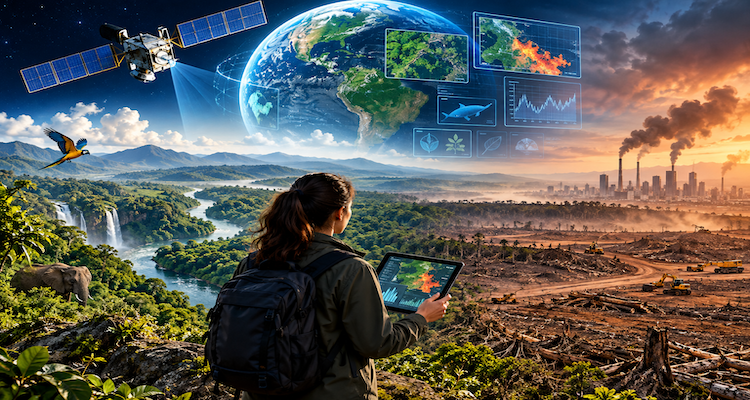
Habitat conversion, overexploitation, invasive species, pollution and climate change are reshaping ecosystems at extraordinary speed. Hundreds of species have already been documented as extinct in recent centuries, while many thousands more face elevated extinction risk. Yet one of the most important scientific questions is also more complicated than popular headlines suggest: does the evidence prove that Earth is already experiencing a sixth mass extinction, or are we witnessing an exceptionally severe biodiversity crisis whose ultimate scale has not yet been determined?
That distinction matters. The science does not support complacency, but neither does it require pretending that every uncertainty has been resolved. The strongest evidence points to a profound human-driven disruption of life on Earth. Whether scientists eventually classify the episode as the sixth mass extinction may depend partly on how the crisis unfolds and on what humanity does next.
Key Takeaways
- Human activity is driving unusually rapid biodiversity loss, although the exact current extinction rate remains difficult to measure.
- Influential research finds modern vertebrate extinction rates far above estimated natural background rates.
- Scientists still debate whether the current crisis has yet reached the scale required to classify it as a true mass extinction.
- Habitat loss, overexploitation, climate change, invasive species and pollution are acting simultaneously rather than as isolated threats.
- The most important question may be less about the label “sixth mass extinction” than about how much biodiversity can still be protected.
What Does “Mass Extinction” Actually Mean?
A mass extinction is not simply a period in which species disappear. Extinction is a normal part of evolution. Most species that have ever existed are extinct.
What makes a mass extinction different is its scale and speed relative to the longer history of life.
The five major mass extinctions recognized in Earth’s history occurred over very different geological circumstances. The end-Cretaceous extinction, associated with the Chicxulub asteroid impact and other environmental stresses, is perhaps the best known. But the largest of the five, at the end of the Permian roughly 252 million years ago, was far more devastating.
The problem is that translating this deep-time concept into the present is not straightforward.
A 2025 paper in Trends in Ecology & Evolution argued that the phrase “sixth mass extinction” remains scientifically debatable because there is no universally accepted quantitative threshold for deciding when an ongoing extinction crisis becomes a mass extinction. The authors did not dispute that humans have caused extinctions or that many species face serious threats. Their argument was that the magnitude of currently documented species loss has not yet reached the scale often associated with the great mass extinctions of the geological past.
That debate is important because two statements can both be true:
- Earth is undergoing a serious, human-driven biodiversity crisis.
- Scientists can still disagree about whether the term “mass extinction” precisely describes its current stage.
The uncertainty is about classification and magnitude—not about whether human activity is placing enormous pressure on biodiversity.
The Evidence for an Accelerating Extinction Crisis
One of the most influential modern analyses came from a 2015 study published in Science Advances. Researchers compared recent vertebrate extinctions with estimated background extinction rates derived from the fossil record.
Using deliberately conservative assumptions, the study concluded that modern vertebrate extinction rates were substantially higher than the estimated natural background rate. It estimated that the vertebrate species losses observed over the previous century would have taken hundreds to thousands of years longer under the assumed background rate. The authors argued that the pattern was consistent with the beginning of a sixth mass extinction.
The exact multiplier matters less than the underlying difficulty: measuring extinction is inherently challenging.
Scientists do not know precisely how many species exist on Earth. Many organisms, particularly insects, fungi and other invertebrates, remain undescribed or poorly assessed. A species can also disappear before scientists have formally documented its existence.
This creates what might be called an extinction measurement problem. Documented extinctions provide a minimum count, but estimating unseen losses introduces uncertainty.
That uncertainty has produced genuine scientific disagreement. A 2022 review argued that focusing only on officially documented extinctions can underestimate biodiversity loss because many invertebrate groups have not been assessed as comprehensively as birds or mammals.
The disagreement, therefore, is partly about evidence thresholds and partly about what data gaps mean.
Why “One Million Species” Needs Context
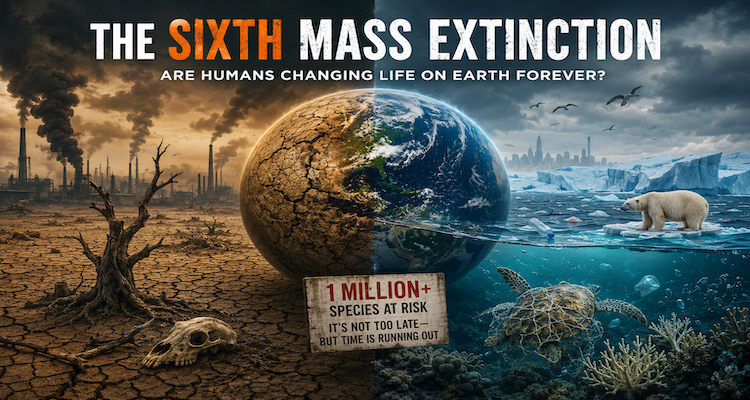
The often-cited figure that up to one million species are threatened with extinction comes from the 2019 Global Assessment of the Intergovernmental Science-Policy Platform on Biodiversity and Ecosystem Services, commonly known as IPBES.
The figure is not a count of one million confirmed extinctions. It is an estimate of how many species could face extinction risk based on available assessments and broader extrapolations.
This distinction is crucial.
“Threatened with extinction” does not mean “already extinct.” Nor does it mean every threatened species will inevitably disappear. Conservation action can change outcomes.
IUCN has continued to document threats across a growing range of organisms. Its recent assessments also show why biodiversity cannot be understood only through charismatic animals such as tigers, elephants or whales. In 2025, the IUCN highlighted that the number of fungi species assessed on its Red List had surpassed 1,000, with deforestation, agricultural expansion and urban development among the pressures affecting threatened fungi.
The broader lesson is easy to miss: extinction is only one measure of ecological decline.
A species can remain technically alive while losing most of its population, disappearing from large parts of its historical range or becoming too rare to play its previous ecological role.
This means a planet can undergo major biological simplification long before every affected species appears on an extinction list.
The Overlooked Crisis: Ecosystems Can Change Before Species Vanish
The extinction debate can sometimes obscure a more immediate problem: ecological systems do not need to lose every species before they begin to function differently.
Pollinators can decline without becoming globally extinct. Large predators can disappear from much of their historical range while surviving elsewhere. Forests can lose particular insects, fungi or plant species without disappearing from a map.
The consequences can accumulate.
Biodiversity supports processes that humans often take for granted, including pollination, nutrient cycling, soil formation, water regulation and food systems. The precise contribution of any individual species varies by ecosystem, and biodiversity cannot be reduced to a single economic number. But ecological networks become more vulnerable when populations decline and functional diversity is lost.
This is one reason the debate over terminology should not become a distraction.
If a forest retains many species but loses the organisms that regulate pests, disperse seeds or maintain soil processes, the ecosystem has already changed in ways that may be difficult to reverse.
The important question is therefore not only, “How many species have gone extinct?”
It is also, “How much ecological resilience are we losing before extinction becomes permanent?”
Humans Are Not Creating One Threat They Are Creating Interacting Pressures
The drivers of biodiversity loss rarely operate independently.
A forest may first be fragmented by roads and agriculture. The remaining habitat may then experience higher temperatures, altered rainfall, invasive species and pollution. Hunting or harvesting can further reduce already isolated populations.
These pressures can interact.
Climate change, for example, does not replace habitat destruction as a biodiversity threat; it can intensify existing pressures. The IUCN states that climate change is already affecting thousands of species assessed on its Red List and can reduce the ability of organisms to adapt as environmental conditions change rapidly.
This interaction makes simple predictions difficult.
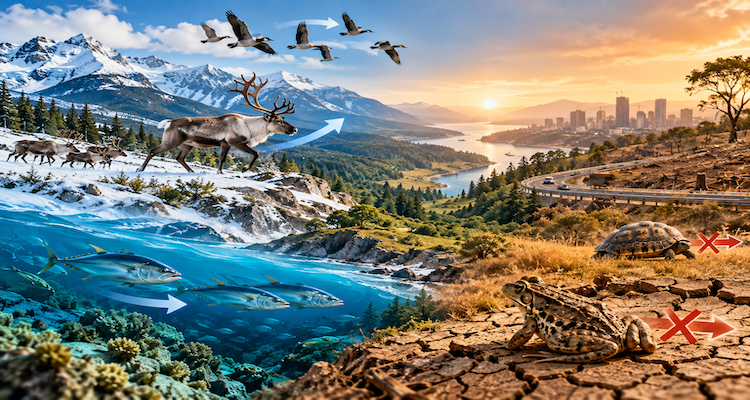
Some species may shift their geographic ranges. Others may adapt. Some may decline slowly before reaching a critical threshold. Conservation success can also prevent predicted losses.
The future is therefore not predetermined.
The Scientific Debate Is Not a Reason for Inaction
A common mistake is to interpret scientific disagreement as evidence that there is no crisis.
That is not what the research says.
The 2025 critique of the sixth mass extinction concept explicitly acknowledges that humans have caused hundreds of extinctions and threaten thousands of species. Its argument concerns whether current evidence meets a particular definition of a mass extinction.
Similarly, research supporting the sixth mass extinction framework acknowledges substantial uncertainty in estimating global extinction rates.
This is how science should work. Researchers can agree on the seriousness of biodiversity loss while disagreeing about measurements, terminology, extrapolations and thresholds.
For readers, the useful distinction is between uncertainty about the final scale of the crisis and uncertainty about whether human activity is causing major ecological damage.
The first remains scientifically contested.
The second is supported by extensive conservation and ecological evidence.
What Makes This Crisis Different From the Past?
The geological record contains disasters caused by forces beyond the control of any species: asteroid impacts, immense volcanic activity and dramatic climate shifts.
The modern crisis has a different feature.
Humans are both the principal driver of many current pressures and potentially the only species capable of deliberately reducing them at a global scale.
That creates an unusual relationship between cause and outcome.
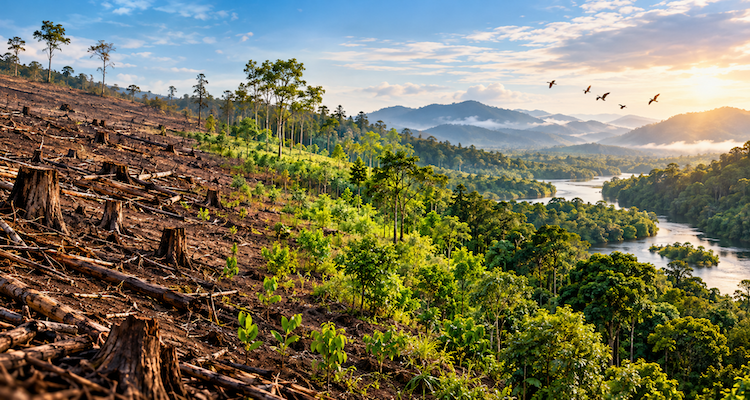
Land-use decisions, fishing practices, wildlife protection, pollution controls, energy systems and climate policy can influence how ecosystems change over coming decades. Conservation is not simply an attempt to preserve a static version of nature. In a rapidly changing climate, it increasingly involves maintaining ecological connectivity, protecting habitat diversity and giving species better chances to adapt.
There is also evidence that conservation can matter.
The existence of threatened species does not mean protection efforts are futile. Species recovery programs, habitat protection, invasive species management and changes in exploitation can alter extinction trajectories.
That may be the most consequential difference between today’s biodiversity crisis and a prehistoric catastrophe.
An asteroid could not change course.
Human societies can.
Are Humans Changing Life on Earth Forever?
In many cases, the answer is already yes.
Extinction is irreversible on human timescales. A species that disappears takes with it a unique evolutionary history that cannot simply be reconstructed by restoring habitat decades later.
But “forever” does not mean every current ecological change is fixed.
Some populations can recover. Degraded habitats can be restored. Species can be reintroduced. Protected areas and better management can reduce pressure.
The central danger is that ecological damage often becomes harder and more expensive to reverse as populations shrink and habitats become fragmented.
A 2025 review of anthropogenic extinctions concluded that the present extinction episode remains far below the devastation of the end-Cretaceous event, while also suggesting that available evidence places the ongoing crisis among the more significant extinction episodes of the last 66 million years. Its authors emphasized that the eventual magnitude will depend heavily on how humanity interacts with the biosphere over long timescales.
That conclusion offers a more useful framework than either extreme.
It is not scientifically necessary to claim that the sixth mass extinction is already complete or inevitable to recognize that humanity is changing the evolutionary future of Earth.
Conclusion
The question of whether Earth has formally entered a sixth mass extinction remains scientifically contested, largely because extinction rates, total species numbers and the definition of a “mass extinction” are difficult to measure with precision.
But the uncertainty around the label should not obscure the larger reality.
Human activity is already altering habitats, populations and ecological relationships on a global scale. Species are disappearing, many more face elevated risk, and ecosystems can lose resilience long before every decline becomes a confirmed extinction.
The most important lesson is therefore not that humanity is doomed to repeat the catastrophes of deep geological time. It is that biological loss is not simply a historical record waiting to be measured after the damage is done.
The scale of the final outcome remains, to a meaningful degree, a human choice.
This content is published for informational or entertainment purposes. Facts, opinions, or references may evolve over time, and readers are encouraged to verify details from reliable sources.