









Why Is the Earth Getting Hotter? Understanding Climate Change Beyond the Headlines
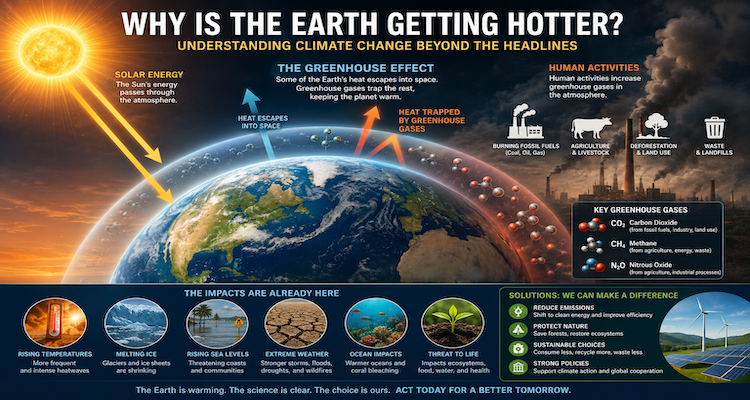
Earth is warming for a reason that is both scientifically established and often oversimplified in public discussion: human activity has changed the atmosphere’s energy balance. The strongest evidence points to the buildup of heat-trapping greenhouse gases, especially carbon dioxide from fossil fuels, alongside methane, nitrous oxide and changes in land use. The IPCC concludes that human activities have unequivocally caused global warming, while observations from satellites, oceans, ice, atmospheric measurements and historical climate records show the consequences across the climate system.
The important question, then, is not simply whether Earth is getting hotter. It is why the warming continues, where the extra heat goes, why individual cold days do not contradict a long-term warming trend, and why a change in the global average can produce very different consequences from one place to another. Understanding those connections makes climate change less of a distant headline and more of a measurable physical process with consequences for weather, oceans, food systems, infrastructure and daily life.
Key Takeaways
- Human activities, primarily greenhouse gas emissions, are the dominant cause of the long-term warming observed since the industrial era.
- Carbon dioxide is the largest contributor to human-caused warming, while methane and nitrous oxide add significant heat-trapping effects.
- The greenhouse effect itself is natural and necessary for life; the problem is the human-driven increase in heat-trapping gases.
- Most of the excess heat accumulating in the climate system is absorbed by the oceans, not just the atmosphere.
- A cold day or season can still occur in a warming climate because weather varies naturally while climate reflects long-term patterns.
- Climate change does not make every event identical; it shifts the conditions in which heatwaves, rainfall, drought and other extremes occur.
The Basic Physics: Earth Is Taking In More Energy Than It Can Easily Lose
Climate change begins with an energy imbalance.
Earth receives energy from the Sun, absorbs part of it and eventually releases energy back toward space in the form of infrared radiation. Greenhouse gases in the atmosphere absorb and re-emit some of that outgoing infrared energy. This natural greenhouse effect keeps the planet warm enough for life.
The problem is not the existence of greenhouse gases. Without them, Earth would be far colder. The problem is that human activity has increased the concentration of several of these gases, strengthening the heat-trapping effect and slowing the loss of energy to space.
That distinction matters because climate change is sometimes described as if humans had “created” the greenhouse effect. They did not. Humans have altered the concentration of gases that regulate how efficiently Earth loses heat.
The largest source of the additional carbon dioxide is the burning of coal, oil and natural gas. Land-use changes, including deforestation, also affect the carbon cycle. Agriculture, energy production, waste and other activities contribute methane and nitrous oxide.
NASA notes that industrial activity has raised atmospheric carbon dioxide concentrations by nearly 50% since 1750, while the IPCC concludes that the observed rise in well-mixed greenhouse gas concentrations since that period is unequivocally caused by human activities.
Why Carbon Dioxide Matters So Much
Carbon dioxide is not the only greenhouse gas, and molecule for molecule it is not the most powerful heat-trapping gas. Its importance comes from a combination of scale, persistence and the enormous quantities released by human activity.
Modern economies have been built around processes that release carbon dioxide: generating electricity with fossil fuels, manufacturing cement, heating buildings, transporting people and goods, and powering much of industry.
Once emitted, a portion of that carbon dioxide remains in the atmosphere for a very long time. Natural systems help absorb some emissions, but they do not remove all of them immediately. The result is accumulation.
Recent observations illustrate the continuing trend. NASA’s Earth Indicator listed atmospheric carbon dioxide at 429 parts per million in July 2026, based on measurements linked to the long-running Mauna Loa record.
That number alone does not explain the climate system. What matters is the physical consequence: more atmospheric carbon dioxide changes the way infrared energy moves through the atmosphere.
The scientific case is also not based on a single thermometer, one climate model or one unusually hot year. Evidence comes from multiple, independent lines of observation, including atmospheric measurements, satellite data, ocean heat, ice loss and paleoclimate records.
The Overlooked Part of Global Warming: Most of the Heat Is Going Into the Ocean
One reason climate change can be misunderstood is that people experience temperature through the air around them. But the atmosphere is only one part of Earth’s climate system.
The oceans absorb the overwhelming majority of the excess heat accumulating in the system. The IPCC has assessed that ocean warming accounted for about 91% of the heating accumulated in the climate system, with smaller shares associated with warming land, melting ice and warming the atmosphere.
This is one of the most important ways to look beyond daily weather headlines.
A temporary pause or slowdown in atmospheric surface warming does not mean the planetary energy imbalance has disappeared. Heat can be distributed differently within the ocean-atmosphere system from year to year. Meanwhile, the long-term accumulation of energy continues to affect ocean temperatures, sea level and marine conditions.
The World Meteorological Organization reported that ocean heat content reached a record level in 2025, based on the observational records assessed in its global climate reporting.
The practical implication is straightforward: global warming is not simply a story about hotter afternoons. It is a story about an Earth system retaining more energy.
Why a Few Cold Days Do Not Disprove Climate Change
Weather and climate are related, but they are not the same thing.
Weather describes conditions over hours, days or weeks. Climate describes longer-term patterns, usually measured over decades. A warming climate does not eliminate natural variability.
A city can experience an unusually cold day, a cold winter or a regional cold spell while the planet as a whole continues to warm. Local conditions are influenced by atmospheric circulation, geography, ocean patterns and other short-term factors.
The more useful comparison is therefore not:
Was today warmer or colder than yesterday?
It is:
How are temperatures changing across large areas and over long periods?
The IPCC found that each of the last four decades has been successively warmer than any preceding decade since 1850. NOAA reported that 2025 was the third-warmest year in its global record and that the 10 warmest years in that record have all occurred since 2015.
Short-term variability still matters. It can temporarily amplify or reduce global temperatures. But variability operates around a long-term warming trend; it does not erase the trend.
What About the Sun, Volcanoes and Natural Climate Cycles?
Earth’s climate has always changed naturally. Changes in Earth’s orbit, volcanic eruptions, solar variations and internal climate cycles have influenced temperatures throughout the planet’s history.
Recognizing those natural influences is not a challenge to climate science. It is part of climate science.
The crucial question is whether those factors explain the current long-term warming.
The IPCC’s assessment is that natural drivers and internal climate variability cannot account for the magnitude of observed human-caused warming since the industrial era. Its analysis estimates that human-caused warming from 1850–1900 to 2010–2019 was likely between 0.8°C and 1.3°C, with a best estimate of 1.07°C.
NASA similarly states that current warming cannot be explained by changes in the Sun and identifies human expansion of the greenhouse effect as the cause of the warming trend observed since the mid-20th century.
Volcanic eruptions can affect climate, but major eruptions generally produce temporary cooling by placing particles in the atmosphere that reflect sunlight. Natural cycles can also shift heat between the ocean and atmosphere and influence individual years.
These factors help explain fluctuations. They do not provide the dominant explanation for the persistent warming trend.
Why a Small Global Temperature Increase Can Produce Major Consequences
A global temperature increase of around one degree can sound modest because people routinely experience temperature changes of 10 or 20 degrees in a single day.
But those are different measurements.
A daily temperature swing describes local weather. A change in global average surface temperature represents an enormous amount of additional energy distributed across the atmosphere, oceans and land.
This is where climate change becomes less intuitive.
A warmer baseline changes the starting conditions from which weather develops. It does not mean every day will be hotter than the corresponding day in the past, nor does it mean every flood, drought or storm has a single cause.
Instead, warming can change the probability and intensity of certain events. The IPCC concludes that human-caused climate change is already affecting many weather and climate extremes in every region of the world.
The effects are not uniform. One region may experience greater heat stress, while another faces changes in rainfall patterns, drought risk or coastal impacts. Vulnerability also depends on housing, infrastructure, income, geography, public health systems and the ability to adapt.
That unevenness is often lost in global discussions. Climate change is global in cause, but its consequences are intensely local.
The Role of Methane, Nitrous Oxide and Aerosols
Carbon dioxide receives the most attention, but it is not acting alone.
Methane is a powerful greenhouse gas and is emitted from sources including fossil fuel systems, agriculture, wetlands and waste. Nitrous oxide is associated with natural processes as well as human activities, particularly agriculture and industrial activity.
Then there are aerosols: tiny particles produced by some human activities. Their climate effects are complex, but certain aerosols have an overall cooling influence because they can reflect sunlight or alter clouds.
This creates an important, often overlooked point. Some forms of air pollution have partially masked a portion of greenhouse-gas warming. The IPCC’s assessment shows that greenhouse gases have produced more warming than the observed net temperature rise alone might suggest, while other human influences, principally aerosols, have exerted a cooling effect.
That does not mean air pollution is a climate solution. Aerosols have serious health and environmental consequences, and reducing pollution without simultaneously reducing greenhouse gas emissions would not solve the underlying accumulation of heat-trapping gases.
The climate system responds to the combined effect of multiple human and natural influences. Carbon dioxide is central, but understanding the full picture requires looking at the entire energy balance.
What Recent Temperature Records Actually Tell Us
Recent record-breaking years are important, but they should not be interpreted as proof that climate change suddenly began in one particular year.
The long-term trend is the central evidence.
The World Meteorological Organization reported that 2025 was among the two or three warmest years on record, depending on the dataset used, with a global average temperature of approximately 1.43°C above the 1850–1900 average in its assessment. NOAA’s analysis ranked 2025 as the third-warmest year in its record.
Different institutions can produce slightly different rankings because they use different datasets and methodologies. That is not necessarily a scientific contradiction. What is more significant is the broad agreement that recent years belong to a period of exceptional global warmth.
There is another reason to avoid treating one year as the entire climate story: short-term factors can temporarily push global temperatures higher or lower. Ocean-atmosphere patterns such as El Niño can influence annual temperatures.
The stronger conclusion comes from the persistence of the underlying trend across decades.
The Real Challenge Is Cumulative, Not Just Annual
Perhaps the most useful way to understand climate change is to think less about whether one particular year is a record and more about accumulation.
Carbon dioxide emissions accumulate in the atmosphere. Excess energy accumulates in the climate system. Ocean heat accumulates over time. Some consequences, including sea-level rise, can continue long after an individual year has passed.
This means the climate question is fundamentally cumulative.
Every additional quantity of greenhouse gas added to the atmosphere affects the energy balance. At the same time, the future scale of warming is not fixed in advance. The IPCC’s assessments make clear that future climate outcomes depend significantly on future greenhouse gas emissions and the choices societies make about energy, land use and adaptation.
That is why climate action is often discussed in terms of both mitigation and adaptation.
- Mitigation aims to limit further warming by reducing greenhouse gas emissions and increasing carbon removal where appropriate.
- Adaptation aims to reduce harm from climate impacts that are already occurring or cannot now be completely avoided.
One cannot fully substitute for the other. Adaptation can reduce vulnerability, but it becomes increasingly difficult as warming intensifies. Emissions reductions address the underlying driver of further long-term warming.
Beyond the Headlines: What Readers Should Actually Watch
Climate headlines often focus on a single extreme event or the latest annual temperature ranking. Those developments can be important, but a clearer understanding comes from watching several connected indicators.
These include:
- Long-term global surface temperature trends.
- Atmospheric concentrations of carbon dioxide, methane and nitrous oxide.
- Ocean heat content.
- Sea-level change.
- Changes in glaciers and ice sheets.
- The frequency and intensity of climate extremes, interpreted through careful attribution science.
No single indicator tells the whole story. Together, they show whether Earth’s climate system is gaining or losing energy and how that energy is changing the planet.
The strongest scientific conclusion is therefore broader than the phrase “the weather is getting hotter.” Human activities have altered the composition of the atmosphere, changing Earth’s energy balance. The warming atmosphere is one visible result, while ocean heating, ice loss, sea-level rise and changing extremes are interconnected parts of the same system.
Conclusion
Earth is getting hotter because human activity, above all the emission of greenhouse gases, has strengthened the atmosphere’s ability to retain heat. The basic mechanism is well understood, and the evidence does not depend on a single temperature record, computer model or recent heatwave.
What is easier to miss is where the warming is expressed. Much of the excess energy enters the oceans. Natural variability still produces cold spells and year-to-year fluctuations. Different regions experience different consequences. And the most meaningful measure is not a single hot day, but the long-term direction of the entire climate system.
That perspective changes the question from “Was this year unusually hot?” to “What is happening to Earth’s energy balance over time?” The answer to that question is why climate change remains a defining scientific and societal issue: the warming is measurable, human influence is established, and future outcomes still depend substantially on decisions that affect greenhouse gas emissions and resilience.
This content is published for informational or entertainment purposes. Facts, opinions, or references may evolve over time, and readers are encouraged to verify details from reliable sources.