







The Hidden World Beneath Our Feet: Why Soil May Be One of Earth’s Most Important Ecosystems
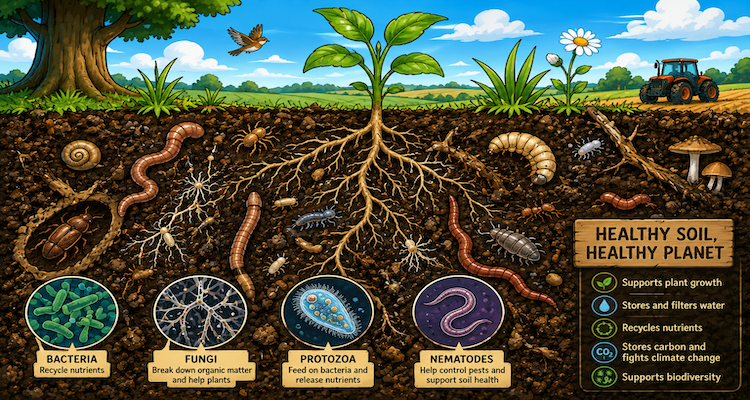
A handful of healthy soil can contain an extraordinary variety of living organisms, yet soil is still easy to treat as little more than dirt beneath roads, farms and buildings. That view misses one of the planet’s most consequential ecosystems.
Soil supports much of the food system, regulates water, cycles nutrients, stores enormous quantities of carbon and provides habitat for a vast community of organisms. Its importance also extends beyond agriculture. When soil is degraded, the effects can reach rivers, groundwater, biodiversity, climate systems and the resilience of communities facing droughts or heavy rainfall.
The deeper lesson is that soil is not simply a material to be used. It is a living system whose condition can determine how well landscapes function. Understanding that system matters at a time when land degradation, intensive land use, erosion and climate pressures are forcing governments and researchers to pay closer attention to what is happening beneath the surface.
Key Takeaways
- Soil is a living ecosystem that supports food production, biodiversity, water regulation and nutrient cycling.
- A substantial share of Earth’s biodiversity is associated with life in soils, much of which remains poorly understood.
- Healthy soils can help landscapes absorb and retain water, reducing vulnerability to drought and runoff.
- Soil contains major stores of organic carbon, linking land management with climate change mitigation and adaptation.
- Soil degradation can undermine ecosystem services long before damage becomes obvious above ground.
- Protecting soil requires managing it as a functioning ecosystem, not merely as a surface for agriculture or construction.
Soil Is More Than a Growing Medium
A functioning soil contains minerals, organic matter, water, air and a complex community of living organisms. Bacteria, fungi, archaea, protozoa, nematodes, insects, earthworms and plant roots interact in ways that influence the movement of nutrients, the formation of soil structure and the health of ecosystems above ground.
The Food and Agriculture Organization of the United Nations describes soil biodiversity as a major component of terrestrial biodiversity and notes that soils are home to a large share of the world’s biological diversity. Yet much of this underground life remains less visible and less thoroughly studied than plants and animals above the surface.
That invisibility has consequences. A forest can lose trees visibly. A wetland can shrink on a map. Soil degradation, by contrast, can develop gradually through erosion, loss of organic matter, compaction, contamination or disruption of biological activity.
By the time the consequences become obvious—falling productivity, muddy waterways, increased runoff or greater vulnerability to drought the underlying ecosystem may already have been significantly altered.
The Underground Food Web Helps Keep Landscapes Functioning
One reason soil deserves to be understood as an ecosystem is that its inhabitants perform functions rather than merely occupy space.
Microorganisms help decompose organic material and transform nutrients into forms that plants can use. Fungi can form close associations with plant roots, while larger organisms such as earthworms and insects can influence soil structure and the movement of organic matter.
These relationships are not always simple. The effects of individual organisms depend on soil type, climate, vegetation, land management and countless interactions among species. But the broader scientific understanding is clear: biological activity is central to how many soils function.
This is where a common misunderstanding becomes important. Soil fertility is not simply a matter of adding nutrients.
A soil may contain nutrients but still function poorly if its structure is damaged, organic matter is depleted, biological communities are disrupted or water and air cannot move effectively through it. Productive land depends on a combination of chemical, physical and biological processes.
That distinction has practical implications for agriculture. Managing soil solely as a chemical input-output system can overlook processes that influence resilience over time.
Soil and Food Security Are Closely Connected
The connection between soil and food is obvious at one level: crops grow in soil. But the relationship is more complex than that.
Healthy soils can contribute to nutrient cycling, root growth and water availability. Degraded soils can become more vulnerable to erosion and less capable of supporting productive agriculture, depending on local conditions and management practices.
The United Nations has repeatedly identified soil degradation as a major challenge for food security and sustainable land management. FAO’s Global Soil Partnership emphasizes that soil is a limited resource that can be degraded far more quickly than many soils can form.
This creates an important mismatch between economic and ecological time.
A field can be cultivated repeatedly within a few years. Severe erosion can occur during a relatively short period of intense rainfall. Rebuilding some soil properties, however, may take much longer.
That does not mean every soil-management problem has a single solution. Practices that work in one region may not work in another because soil types, rainfall, crops, topography and farming systems differ. The principle is broader: soil management must account for local ecological conditions rather than assuming that land behaves like a uniform production platform.
The Overlooked Link Between Soil and Water
One of soil’s most important roles receives far less public attention than its connection to farming: water regulation.
Soil can absorb, store and transmit water. Its structure, organic matter and vegetation cover can influence how rainfall moves across and through a landscape. When soils are compacted, bare, severely eroded or otherwise degraded, rainfall may be more likely to become surface runoff rather than infiltrating the ground.
The consequences can extend well beyond individual farms.
Runoff can contribute to erosion and carry sediment or pollutants into waterways. Reduced infiltration can also limit the amount of water retained within the soil for plants and ecosystems.
This makes soil health relevant to climate adaptation. As many regions face greater concern about drought, intense rainfall and changing precipitation patterns, landscapes that can retain and manage water effectively may become increasingly valuable.
The important caveat is that soil alone does not determine flood or drought risk. Climate, terrain, drainage systems, vegetation and land use all matter. Still, soil condition is one part of the environmental infrastructure that often remains hidden until it fails.
A Major Carbon Reservoir Beneath the Surface
Soil also matters to the climate system.
According to major scientific assessments, soils contain substantial quantities of organic carbon. Plants capture carbon dioxide through photosynthesis, and some of that carbon enters the soil through roots, plant residues and other biological processes. Soil organisms then help transform and cycle that organic material.
Whether a particular soil gains or loses carbon depends on many factors, including climate, vegetation, soil type and land management. This complexity is important because soil carbon is sometimes discussed as though it were a simple, permanent storage mechanism.
It is not.
Increasing soil carbon can be difficult to measure accurately, storage may not continue indefinitely, and carbon can be lost again if land management changes or soils are disturbed. Scientific and policy discussions therefore increasingly emphasize the need for credible measurement, realistic expectations and long-term management.
The significance of soil carbon lies partly in this dual role: healthy soil can support agricultural and ecological resilience while also participating in the global carbon cycle. But soil restoration should not be presented as a substitute for reducing greenhouse-gas emissions from fossil fuels. It is one component of a much broader climate response.
Why Soil Biodiversity May Be One of Science’s Biggest Blind Spots
Above-ground biodiversity is easier to see, photograph and count. Soil life is harder to observe.
Many organisms are microscopic, difficult to identify or embedded in highly complex ecological relationships. Advances in genetics, microscopy and environmental monitoring are expanding scientific understanding, but researchers still face major knowledge gaps about the diversity and functions of life beneath the surface.
This creates an unusual problem for conservation.
It is difficult to protect what has not been adequately measured. A landscape may appear healthy above ground while important changes are occurring in its underground ecosystem.
The emerging field of soil biodiversity research therefore raises a broader question: should environmental monitoring focus more on whether ecosystems look healthy, or on whether the underlying processes that sustain them are still functioning?
The answer is likely both. Visible indicators remain important, but soil reminds us that ecosystem decline can begin in places people rarely examine.
Soil Degradation Is an Environmental Problem With Delayed Consequences
Soil degradation can take several forms, including erosion, salinization, contamination, compaction, sealing by infrastructure and declines in organic matter or biological function.
Not all degraded soils behave the same way, and not every change is irreversible. Restoration and improved management can produce meaningful improvements. But prevention is often easier than rebuilding lost ecological function.
This is particularly important in rapidly changing landscapes.
Urban expansion can cover soil with buildings and roads. Intensive land use can alter soil structure and nutrient cycles. Deforestation and vegetation loss can expose soil to erosion. Industrial pollution can introduce contaminants that persist for long periods.
The consequences are often distributed across sectors. Agriculture may experience lower resilience. Water managers may face more sediment or runoff. Conservation efforts may focus on species above ground while underground habitat changes. Cities may lose some of the cooling, drainage and ecosystem benefits associated with living soils.
This is why soil policy cannot be treated solely as an agricultural issue.
The Bigger Shift: From Treating Soil as Material to Managing It as Infrastructure
The most useful way to rethink soil may be to see it as biological infrastructure.
Unlike concrete infrastructure, healthy soil is not simply installed and left alone. Its functions depend on ecological processes. Its performance can improve or decline depending on how land is managed.
That perspective changes the questions policymakers, businesses and communities may need to ask.
Instead of asking only how much land can produce, they may also need to consider:
- How resilient is the soil to drought and heavy rainfall?
- Is erosion reducing the long-term value of the land?
- Are land-use decisions disrupting biodiversity that supports ecosystem functions?
- Can restoration improve water retention or reduce sediment loss?
- Are soil-related environmental risks being recognized before they become visible crises?
These questions are relevant not only to farmers. They also matter to urban planners, infrastructure developers, food companies, conservation organizations and governments.
The challenge is measurement. Soil health is not captured by a single universal number. A useful assessment depends on context and may include physical, chemical and biological indicators. What counts as healthy for one soil ecosystem may differ from another.
That complexity makes simplistic solutions risky but it also explains why soil management increasingly requires local knowledge, monitoring and long-term thinking.
Conclusion
The hidden nature of soil has encouraged a persistent mistake: treating the ground beneath us as passive.
It is not passive. Soil is a dynamic ecosystem where biological, chemical and physical processes interact to support food production, biodiversity, water cycles and climate regulation. When those processes are damaged, the consequences may emerge slowly and spread far beyond the land where the damage began.
The growing attention to soil is therefore about more than protecting farmland. It reflects a broader recognition that some of Earth’s most important infrastructure is alive, largely invisible and difficult to replace once seriously degraded.
Protecting it begins with a simple shift in perspective: beneath our feet is not merely dirt. It is an ecosystem that helps make the world above it possible.
This content is published for informational or entertainment purposes. Facts, opinions, or references may evolve over time, and readers are encouraged to verify details from reliable sources.