










From Side Hustle to Startup: When Does a Small Idea Become a Real Business?
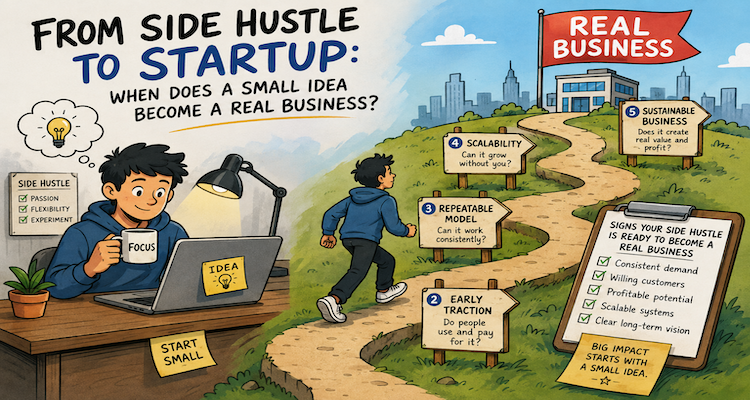
A person sells handmade products on weekends, takes freelance clients after work, or builds a small app that begins attracting paying users. At first, the activity may feel informal: a side project, an experiment, or simply a way to earn extra money.
Then something changes.
Customers start returning. Income becomes predictable enough to plan around. Expenses increase. Deadlines matter. A missed order or unhappy client now has consequences beyond a hobby. The founder begins making decisions not just about the work itself, but about pricing, cash flow, taxes, customer relationships and growth.
That is usually the more important transition: not the moment someone chooses the word startup, and not necessarily the day they register a company.
A small idea becomes a real business when it develops an economic system that must be deliberately managed.
That distinction matters because many people wait for a dramatic milestone before becoming more disciplined. They may assume they need outside funding, employees, an office or a formal corporate structure before taking the venture seriously. In reality, many businesses begin much earlier and many never need to become venture-backed startups at all.
The better question is not, “When does my side hustle look like a company?” It is: “When does this activity require me to operate like a business?”
Key Takeaways
- A side hustle begins functioning as a business when customers, revenue, costs and obligations require deliberate management.
- Revenue alone does not prove that an idea has a sustainable business model; repeatable demand and viable economics matter more.
- A startup is not simply a small business with ambition; the term usually implies a search for a repeatable and scalable model.
- Separating personal and business finances can improve financial visibility and recordkeeping as commercial activity grows.
- Formal registration should follow relevant legal, tax and regulatory requirements rather than an arbitrary revenue milestone.
- The critical transition is often operational: when the founder must build systems instead of relying only on personal effort.
The side hustle is an activity; the business is a system
The phrase side hustle describes how an activity fits into someone’s life. It is usually something done alongside employment, study, caregiving or another primary commitment.
But side hustle is not a formal legal category.
Someone can run a small but genuine business in the evenings. Another person can spend 50 hours a week on a project that has not yet found a viable customer or business model.
The difference is important.
A business, in practical terms, involves an organized effort to provide products or services while managing the economic consequences of doing so. That means tracking what comes in, what goes out, what customers actually want and whether the activity can continue without consuming more resources than it creates.
This is why the transition is rarely defined by a single number.
There is no universal revenue figure at which a hobby suddenly becomes a business, or at which a freelancer becomes a startup. Legal and tax definitions also vary by jurisdiction and business structure.
Instead, the shift is better understood through a set of signals.
Signal one: strangers are willing to pay
The first payment is psychologically important, but it is not the strongest evidence.
A friend buying a product to be supportive is different from an independent customer repeatedly choosing it over alternatives. The more useful signal is whether demand can be reproduced.
Can the founder explain:
- Who the customer is?
- What problem the customer is paying to solve?
- Why the customer chooses this product or service?
- How similar customers can be reached again?
- Whether they are likely to return or recommend it?
A business begins to take shape when demand stops being accidental.
That does not mean every customer relationship must be recurring. A wedding photographer, for example, may not expect the same client to book another wedding. But the photographer can still develop repeatable demand through referrals, reputation, partnerships and a reliable customer acquisition process.
The essential question is whether the next sale depends entirely on luck or whether the founder is beginning to understand how another sale can be created.
Revenue is a milestone, but profit is a different test
One of the most common mistakes in the journey from side hustle to business is confusing sales with sustainability.
A product can generate impressive revenue while losing money. A freelancer can have a full calendar but discover that the effective hourly income is too low to support the workload. A subscription product can attract users while spending more to acquire them than the economics can justify.
This is where a small idea starts requiring business discipline.
The founder needs to know:
Revenue – the direct and indirect costs of producing and delivering the product or service = a clearer picture of whether the activity is economically viable.
The calculation can become more complicated as a company grows, but the underlying discipline should begin early.
The U.S. Internal Revenue Service emphasizes the practical importance of maintaining records that show business income and expenses. Good records can help a business monitor its progress, prepare financial statements, track deductible expenses and support tax reporting.
For an early-stage founder, however, recordkeeping is more than a tax exercise.
It answers basic questions that enthusiasm cannot:
- Which products or services actually make money?
- Which customers are expensive to serve?
- Is growth improving the business or increasing losses?
- How much cash is available?
- Can the activity support the founder’s time and future investment?
The moment these questions become necessary, the venture is already behaving more like a business than a casual experiment.
The real dividing line is repeatability
A useful way to think about the transition is through three stages.
1. The experiment
At this stage, the idea is being tested.
The founder may not yet know whether anyone wants the product, what price works or whether demand exists beyond a small circle. Spending may be exploratory, and processes are often improvised.
The goal is learning.
2. The repeatable business
The next stage begins when the founder can increasingly repeat the process of creating value.
Customers can be identified. A product or service has a clearer proposition. Pricing is becoming more deliberate. There is some understanding of how work is delivered and how customers are acquired.
This does not mean the business is guaranteed to survive. U.S. Bureau of Labor Statistics data illustrate that business survival is difficult and varies across industries and economic conditions. For one cohort of private-sector establishments born in 2013, 34.7% were still operating a decade later, according to BLS data published in 2024.
The lesson is not that every new venture should expect a particular outcome. Survival statistics cannot predict the fate of an individual company.
The more useful lesson is that becoming a business is not the finish line. The harder work is building one that can endure.
3. The scalable startup
This is where another distinction becomes necessary.
Not every real business is a startup.
A local design studio, independent consultancy or profitable online shop may be successful without needing to expand rapidly. Its owner may intentionally prioritize steady income, quality, flexibility or a sustainable team size.
A startup, by contrast, is commonly associated with an organization attempting to discover and develop a repeatable model that can scale. Growth may be central to its strategy, often because technology, capital or network effects create an opportunity to serve a much larger market.
That difference changes the questions the founder must answer.
A small business may ask:
Can we build a stable operation that generates sustainable profit?
A startup may additionally ask:
Can this model grow rapidly without costs increasing at the same rate?
Neither model is inherently superior.
Confusing the two can create unnecessary pressure. A profitable small business does not become less legitimate because it does not seek venture capital. Equally, calling every new project a startup does not create scalability where the underlying economics do not support it.
When personal finances and business activity should stop being mixed
One practical sign of maturity is financial separation.
The IRS notes that keeping business and personal accounts separate can make recordkeeping easier, while its guidance on starting a business emphasizes maintaining records of income and expenses.
The exact legal and banking requirements vary by country and business structure, so founders should not treat U.S. guidance as universal legal advice.
But the underlying management principle travels well.
If business income and expenses are scattered across personal accounts, cards and payment platforms, it becomes harder to answer basic questions about performance.
Financial separation can help distinguish:
- business revenue from personal transfers;
- genuine operating costs from personal spending;
- money available to reinvest from money needed for household expenses;
- business cash flow from the founder’s overall finances.
This is one reason a venture can feel “real” long before it has a large team. Administrative discipline often arrives before organizational size.
Registration does not create the business but ignoring obligations can create problems
There is also an important distinction between operational reality and legal status.
A person may already be carrying on commercial activity before they feel emotionally ready to call themselves an entrepreneur. At the same time, the legal, tax, licensing and reporting obligations attached to that activity depend heavily on jurisdiction, business type and structure.
In the United States, for example, the Small Business Administration provides guidance on registration, tax identification and licenses, while the IRS provides guidance on business structures, income, expenses and recordkeeping.
The correct timing for formal registration is therefore not determined by a universal internet rule such as “register after your first $10,000” or “wait until you quit your job.”
Founders should instead determine what applies where they operate.
That may depend on factors including:
- the nature of the activity;
- the legal structure chosen;
- tax obligations;
- local or industry-specific licensing;
- whether employees are being hired;
- contractual or liability considerations;
- applicable thresholds and reporting rules.
A useful rule is simple: do not wait for the business to “feel official” before checking whether it already has official obligations.
The founder’s job changes when systems become necessary
Perhaps the clearest sign that a side hustle is becoming a real business has little to do with paperwork.
It happens when the founder can no longer run everything from memory.
At first, personal effort may be enough. The founder answers every email, creates every product, delivers every service and remembers every customer.
Eventually, growth creates friction.
The same questions appear repeatedly. Orders need tracking. Customer communication becomes inconsistent. Delivery depends on the founder being available. Mistakes become expensive.
This is when systems begin to matter.
A simple system might be:
- a documented process for handling orders;
- a standard proposal or contract;
- a reliable invoicing process;
- a customer support workflow;
- regular financial reviews;
- a calendar for tax and compliance deadlines.
These systems do not make a company less entrepreneurial. They make it less dependent on improvisation.
That may be the most overlooked transition in the entire side-hustle journey: the founder stops merely doing the work and begins designing how the work gets done.
A practical test: ask five questions
A founder wondering whether an idea has crossed the line into a business can ask:
Do customers exist beyond my immediate network?
Independent demand is stronger evidence than encouragement from friends and family.
Can I explain how the next customer might arrive?
The answer does not need to be perfectly predictable. But there should be more than hope.
Do I know whether the economics work?
Revenue without an understanding of costs, time and cash flow is incomplete information.
Would the activity continue if I became temporarily unavailable?
If every sale and delivery depends entirely on one person’s constant involvement, the venture may still be viable but it has limited operational resilience.
Have I checked the legal and tax rules that apply to me?
This question is especially important once money is being earned, contracts are being signed or obligations to customers and authorities begin to accumulate.
If the answer to several of these questions is yes, the idea may already deserve to be managed as a business even if the founder still works another job and has no employees.
Why the distinction matters more now
The modern tools available to independent creators and founders have made it easier to start selling without first building a conventional company.
A single person can reach customers through online marketplaces, social platforms, freelance platforms, payment systems, no-code software and cloud-based tools. This lowers some barriers to experimentation.
But lower barriers to starting do not eliminate the challenge of building something durable.
In fact, easy access to tools may make one skill more important: judgment.
Founders must decide when to keep experimenting, when to invest, when to formalize, when to stop an unprofitable activity and when to build systems around something that is working.
The U.S. Census Bureau’s Nonemployer Statistics also reflect the importance of businesses operating without paid employees, tracking businesses with no paid employees that are subject to federal income tax.
That is a useful reminder that a business does not need an office, payroll department or large organizational chart to be economically real.
Sometimes it is one person, one useful service and a disciplined system for delivering it.
The goal is not to look bigger than you are
The pressure to “level up” can lead founders toward unnecessary complexity.
They may rush to adopt elaborate software, create a corporate identity that exceeds their actual operations or pursue investment before understanding whether customers genuinely want what they are selling.
The opposite mistake is also common: remaining informal after the activity has developed real customers, financial obligations and operational risk.
The smarter transition is selective.
Formalize what needs to be formalized. Measure what needs to be measured. Build systems where repeated work creates friction. Keep experimenting where uncertainty remains.
A founder does not become a serious business owner by collecting business cards, registering an impressive domain name or using startup vocabulary.
The venture becomes more serious when its decisions become evidence-based.
Conclusion
A small idea does not become a real business because it reaches a fashionable revenue target or because its founder finally feels ready to call themselves an entrepreneur.
The transition is more practical.
It happens when customer demand becomes something that can be understood and repeated; when income must be compared with costs; when financial records and legal obligations require attention; and when the work begins to depend on systems rather than memory and improvisation.
The next step is not necessarily to become a startup.
For many founders, the better goal is simpler and more durable: build a business model that customers value, whose economics can be understood, and whose growth does not create more confusion than opportunity.
A side hustle can remain small and still be a real business. A startup can be ambitious and still be searching for a workable model.
The important milestone is not the label.
It is the moment the idea stops being merely something you do and becomes something you can deliberately manage, measure and sustain.
The information presented in this article is based on publicly available sources, reports, and factual material available at the time of publication. While efforts are made to ensure accuracy, details may change as new information emerges. The content is provided for general informational purposes only, and readers are advised to verify facts independently where necessary.