










Why Some Companies Are Replacing Managers With AI Tools
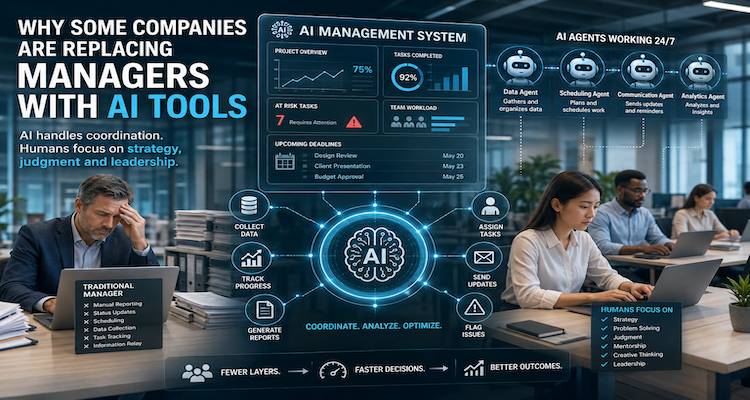
The corporate use of artificial intelligence is moving beyond chatbots that draft emails or summarize meetings. In some organizations, AI systems are beginning to take on parts of the coordination work traditionally handled by managers: routing information, tracking projects, generating reports, allocating work, monitoring workflows and, increasingly, supervising fleets of other AI agents.
The important distinction is that most companies are not yet replacing the full human role of a manager with a machine. What is changing is the economic logic behind layers of management. If software can coordinate routine work across a larger team, executives may conclude that fewer people are needed to relay information, compile status updates or oversee standardized processes. That can flatten an organization but it also raises a harder question: when companies remove managers, are they eliminating bureaucracy or quietly removing mentorship, judgment and accountability along with it?
The evidence so far suggests both outcomes are possible. AI can reduce coordination work, but replacing managerial judgment is a far more difficult proposition. The companies most likely to benefit may therefore be those that redesign management rather than simply subtract managers.
Key Takeaways
- AI is primarily absorbing coordination and administrative work, not the full range of human managerial responsibilities.
- Flatter organizations can increase speed, but removing management layers can also weaken mentoring, accountability and leadership development.
- AI agents may reduce the cost of coordinating work, allowing remaining managers to oversee broader spans of activity.
- The emerging role is often not “manager replaced by AI,” but “manager of humans and AI agents.”
- Employment decisions made with automated systems require careful governance, transparency and meaningful human oversight.
What Companies Are Actually Replacing
The phrase “AI replacing managers” can be misleading if it suggests that companies are installing a chatbot in the corner office and dismissing every human supervisor.
A more significant change is happening lower down the organizational chart.
Much of middle management involves coordination: collecting updates, assigning follow-up work, monitoring deadlines, preparing reports, passing information between teams and maintaining a shared view of what is happening. AI systems can increasingly perform portions of these tasks quickly and continuously.
An AI agent can, for example, pull information from multiple systems, summarize project status, flag a delayed task, draft a follow-up message and route the issue to the appropriate person. Previously, that workflow might have required several people and multiple management layers.
That does not mean the AI has acquired judgment in the broader sense. It means that a company may no longer need as many people to perform the information-routing and administrative components of management.
This distinction matters because the organizational consequences can be substantial even when AI does not fully “replace” a manager.
Microsoft’s 2025 Work Trend Index found that 46% of surveyed leaders said their organizations were already using agents to fully automate workstreams or business processes. The report also described a shift toward more flexible “human-agent” teams and found that leaders expected activities such as training and managing agents to become part of teams’ work.
Microsoft’s 2026 report pushed the argument further, examining how management itself may evolve as AI agents take on more execution. Its central premise is not that leadership disappears, but that organizations must redesign work and clarify how humans direct and remain accountable for increasingly capable digital systems.
Why Middle Management Is Under Pressure
AI is arriving at a time when many companies were already questioning organizational complexity.
As businesses grow, management layers often multiply. Information moves upward for approval and downward for execution. Meetings are held partly to establish what has already happened elsewhere. Status reports are created so that other people can understand work they did not directly observe.
This creates what might be called a coordination tax.
AI’s potential business value lies partly in reducing that tax. A system connected to project-management, communication and business platforms may be able to maintain a continuously updated picture of work rather than requiring employees to repeatedly explain that work to different layers of management.
That can change a fundamental management calculation:
If technology makes coordination cheaper, how many coordinators does the organization still need?
This is one reason AI could lead to flatter companies even when the technology does not directly replace employees one-for-one.
A recent organizational theory paper describes this as AI reducing the cost of coordination and potentially expanding managers’ spans of control. That research is theoretical rather than evidence that a universal restructuring pattern has already been established, but it highlights an important mechanism: organizational structure itself can change when coordination becomes cheaper.
The practical implication is more immediate. A manager who once needed several supervisors beneath them to collect information may be able to use AI-generated dashboards, summaries and automated workflows to oversee a larger operation.
The technology is therefore putting pressure on management tasks, and management positions may be affected when companies decide that those tasks no longer justify the same organizational structure.
The New Job May Be Managing AI
There is an irony in the prediction that AI will eliminate managers: AI itself may create more management work.
As companies deploy multiple AI agents, someone must decide:
- What each agent is allowed to do.
- Which data and systems it can access.
- When a human must approve an action.
- How errors are detected and corrected.
- How performance is measured.
- Who is responsible when the system causes harm.
Harvard Business Review has described the emergence of “agent managers,” using examples of organizations overseeing fleets of AI agents rather than treating them as completely autonomous employees. The work involves monitoring performance, examining data and intervening when systems fail or require adjustment.
Microsoft’s research uses a related idea: the “agent boss.” In this model, employees and managers increasingly delegate tasks to AI systems, assess the output and retain responsibility for the outcome.
That suggests a more complicated future than the simple “AI versus manager” narrative.
Some traditional management work may disappear. But companies may simultaneously need people with the ability to:
- redesign workflows;
- set rules and permissions for AI systems;
- evaluate unreliable or conflicting outputs;
- resolve exceptions;
- coordinate human and AI work;
- and make decisions that cannot safely be reduced to a standardized rule.
The hierarchy may shrink without eliminating management as a function.
The Overlooked Risk: Companies May Remove a Leadership Pipeline
The strongest argument against treating middle managers as expendable is that management does more than transmit information.
Middle managers often develop future leaders. They give feedback, interpret strategy, recognize interpersonal problems, coach inexperienced employees and make contextual judgments that may never appear in a project-management dashboard.
If companies automate routine managerial tasks and eliminate too many management positions at the same time, they could create a longer-term talent problem.
Where will employees learn to lead if the traditional pathway into management disappears?
The World Economic Forum has highlighted this tension, arguing that automation may remove tasks that were inefficient but also provided opportunities for employees to build judgment and progress toward leadership. Its analysis also notes that HR leaders see middle managers as important to AI adoption and the redesign of changing roles.
This is an important distinction for executives. A management layer can be bureaucratic without every function performed by the people in that layer being bureaucratic.
Removing repetitive reporting may be beneficial. Removing coaching may not be.
The danger is that companies measure the first outcome immediately fewer meetings, lower costs, faster reporting while the consequences of weaker mentoring or leadership development appear years later.
AI Management Can Also Create a New Accountability Problem
The more consequential the AI decision, the weaker the case for treating automation as a substitute for accountable human judgment.
AI systems can make recommendations based on incomplete data, reproduce patterns embedded in historical information or generate plausible explanations that do not accurately describe what happened. A human supervisor who simply approves an AI recommendation without understanding it may provide the appearance of oversight rather than meaningful oversight.
The National Institute of Standards and Technology’s AI Risk Management Framework emphasizes characteristics including accountability, transparency, explainability and ongoing monitoring. Its discussion of human oversight also warns that organizations need to define what people responsible for oversight can actually do and whether they are empowered to challenge AI outputs.
That principle becomes especially important when AI influences workplace decisions.
Scheduling, productivity analysis and task allocation may be increasingly automatable. Disciplinary action, promotion and dismissal introduce much greater consequences.
A company may discover that replacing a manager with software does not eliminate responsibility. It simply moves responsibility to the people who designed, configured, approved or deployed the system.
In other words, automation can remove a managerial role without removing the need for management accountability.
Why the “AI Replaces Managers” Story Is Still Incomplete
The current trend should not be confused with proof that AI-managed companies consistently perform better.
Many claims about organizational transformation remain early, company-specific or based on surveys of executive expectations. Surveys can show what leaders plan to do, but they do not prove that every restructuring will improve productivity.
Even the most ambitious models of AI-enabled work require reliable data, clear workflows and governance. Microsoft’s own guidance on agent adoption stresses the need to map workflows, unify data and establish governance rather than simply deploying agents into an unprepared organization.
There is another practical limitation: management often involves ambiguity.
A project may be technically on schedule but heading toward failure because two teams do not trust each other. An employee’s falling productivity may reflect a skills problem, an unclear assignment or a personal issue. A customer may need an exception that makes no sense according to a standardized policy.
These situations are difficult to reduce to a dashboard.
AI can provide information about such problems. It may even suggest actions. But deciding what should happen can require contextual knowledge, ethical judgment and accountability that organizations may be reluctant or legally unable to delegate completely.
That is why the more credible near-term scenario is managerial unbundling.
The role of a manager is being separated into components. Administrative coordination is increasingly automatable. Workflow monitoring can be augmented. Reporting can be generated. Routine decisions can sometimes be standardized.
But coaching, conflict resolution, strategic judgment and accountability remain much harder to automate responsibly.
What This Means for Workers and Companies
For workers, the safest assumption is not that every manager will disappear. It is that jobs built primarily around routine coordination may change faster than jobs requiring judgment, domain knowledge and responsibility for difficult outcomes.
For managers, this creates a different challenge. The valuable manager may increasingly be the person who can improve a system rather than merely operate inside it.
That means asking:
- Which tasks should be delegated to AI?
- Which decisions require human review?
- How do we detect when an AI system is wrong?
- Are employees able to challenge automated recommendations?
- Are we measuring productivity without destroying the human work that produces long-term value?
For companies, the central strategic question is also more sophisticated than “How many managers can AI replace?”
A better question is: Which parts of management are genuine friction, and which parts are the infrastructure of a healthy organization?
The first category may be a strong candidate for automation. The second can be expensive to lose.
Conclusion
Companies are experimenting with AI because it can reduce one of the hidden costs of large organizations: the effort required to coordinate people, information and decisions.
That creates real pressure on management layers, particularly where a role is dominated by reporting, routing information and supervising standardized workflows. But replacing those tasks is not the same as replacing leadership.
The deeper transformation may be a redistribution of managerial responsibility. Fewer people may spend their days collecting updates and forwarding instructions. More workers may instead find themselves directing AI agents, reviewing automated decisions and taking responsibility for systems they did not personally execute.
The companies most likely to benefit will not necessarily be those that remove the most managers. They may be the ones that distinguish between bureaucracy and management—and understand that AI can reduce the first while making the second more important.
The information presented in this article is based on publicly available sources, reports, and factual material available at the time of publication. While efforts are made to ensure accuracy, details may change as new information emerges. The content is provided for general informational purposes only, and readers are advised to verify facts independently where necessary.
Related News
- The Great Unbundling: Why Consumers Are Moving Away From All-in-One Platforms
- From Side Hustle to Startup: When Does a Small Idea Become a Real Business?
- Zombie Companies: How Businesses Survive Even When Their Models Stop Working
- Quiet Hiring: Why Companies Are Filling New Roles Without Posting New Jobs