










The Rise of the Creator CEO: How Personal Brands Are Becoming Real Businesses
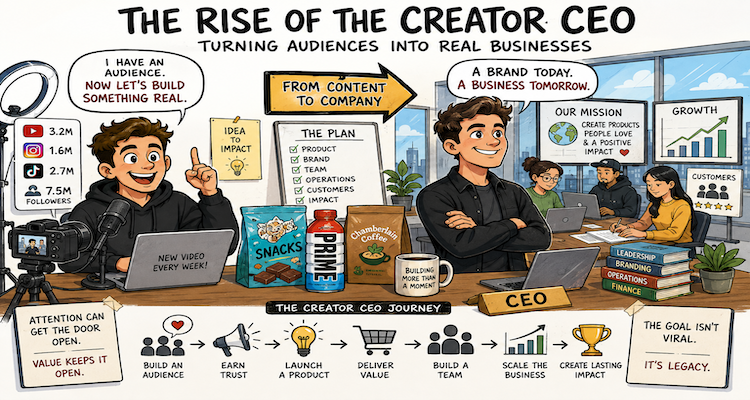
The old creator economy story was built around audience: grow followers, win sponsorships, and turn attention into advertising revenue. That model still exists, but it no longer explains the most ambitious creators.
A growing number are using their audiences as the starting point for companies rather than the final product. They are launching consumer brands, software products, media businesses, education platforms and investment vehicles. In this model, the creator is not simply the marketing department. The personal brand can function as the initial distribution system, customer-acquisition engine and trust layer around a business.
The important shift is not that famous people sell products. Celebrity endorsements are hardly new. What has changed is the infrastructure available to individuals who can build a direct relationship with an audience and then convert that relationship into a company with employees, operations, intellectual property and products that may eventually become larger than the personality that launched them.
That creates a new kind of business challenge. An audience can accelerate a launch, but it cannot automatically create product-market fit. A loyal following can reduce the cost of getting attention, while simultaneously creating dependence on one person’s reputation and on the algorithms that distribute that person’s content. The emerging Creator CEO is therefore less a social-media job title than a business transition: from monetizing attention to building an organization that can survive beyond it.
Key Takeaways
- A large audience can provide distribution and early customer access, but it does not guarantee a durable business.
- The strongest creator-led companies are increasingly investing in products, teams and operations beyond sponsorship income.
- Creator brands can face unusually concentrated reputational risk because the founder and the company are closely connected.
- The next test for the Creator CEO is whether the business can retain customers when the founder is less visible.
- Personal brands may increasingly compete with traditional companies for attention, trust and direct consumer relationships.
When an Audience Becomes a Distribution Network
The creator economy is often discussed as a market for influencers, sponsorships and advertising. That description is increasingly incomplete.
Goldman Sachs estimated in 2023 that the creator economy’s total addressable market could grow from about $250 billion to $480 billion by 2027, although such market-size forecasts should be treated as estimates rather than established facts. Its analysis also highlighted the importance of brand deals, platform revenue sharing and direct audience monetization.
What matters for the Creator CEO is the strategic difference between earning from an audience and building a company through an audience.
A traditional consumer startup may need to spend heavily to establish awareness, educate customers and build a community. A successful creator begins with something many startups spend years trying to acquire: an existing channel of communication with people who have voluntarily chosen to pay attention.
That advantage can take several forms:
- immediate product awareness;
- rapid customer feedback;
- lower dependence on traditional advertising during an initial launch;
- an established voice and brand identity;
- a direct channel for explaining product changes or new launches;
- a community that can amplify a product organically.
But attention is not the same thing as demand. The creator can open the door; the product still has to give customers a reason to stay.
That distinction is becoming more important as creator-led ventures move into categories where operational competence matters as much as personality.
The Creator Is Becoming a Founder With a Built-In Go-to-Market Channel
The most useful way to understand this trend is to think of a creator’s personal brand as an early go-to-market asset.
A creator can demonstrate a product repeatedly, answer questions directly, show how it fits into everyday life and receive immediate feedback from customers. The process can compress the distance between marketing, community management and product development.
The companies themselves illustrate how different this model can look.
Feastables, the snack brand associated with MrBeast, operates as a consumer-products business with a product range, retail distribution and sourcing strategy rather than simply a merchandise store. The company has also made ethical sourcing part of its public brand positioning, stating that its cocoa is sourced on Fairtrade terms and describing its work with child-labor monitoring and remediation systems. Those claims are company statements, but they show how a creator-led business can move from personality-driven marketing into operational and supply-chain commitments.
Chamberlain Coffee provides another version of the model. Emma Chamberlain’s public association with coffee helped establish a natural connection between creator identity and product category, but the company has expanded beyond that original association into coffee, tea, matcha, subscriptions and physical cafés. Its own history describes the business as growing from Chamberlain’s long-standing public relationship with coffee and product experimentation.
PRIME, founded around the partnership of Logan Paul and KSI, demonstrates the power—and complexity—of combining major digital audiences with a conventional consumer-products category. PRIME launched its hydration product in 2022 and has since expanded its product range and retail presence.
These examples should not be treated as identical business stories. Their ownership structures, operations and commercial circumstances differ. The broader lesson is more important: the audience is increasingly becoming the first layer of distribution, while the company underneath must still solve the familiar problems of product, operations, retention and scale.
The Real Business Test Comes After the Launch
A creator can generate enormous launch attention. Sustaining a company is harder.
The early economics of a creator-led business can be unusually attractive because the founder already owns a communication channel. Yet that advantage can become misleading if founders confuse visibility with customer loyalty.
A business becomes more durable when customers buy because the product itself has value not only because the founder mentioned it in a video.
That raises several questions investors, operators and consumers should ask about a creator-led company:
Does the product have a reason to exist without the creator?
The strongest ventures usually have a clear answer: product quality, convenience, price, design, community, distribution or some combination of these factors.
If removing the founder from the marketing equation would immediately eliminate customer demand, the company may still be dependent on celebrity attention rather than building an independent brand.
Can the company build a real operating organization?
A large following cannot manage inventory, negotiate with retailers, maintain quality control, build software, handle customer service or develop new products on its own.
The rise of the Creator CEO therefore also means the rise of the creator team. Editors, producers and social-media managers may be only the beginning. As a creator business expands, it may require product leaders, operators, finance specialists, legal teams, supply-chain expertise and conventional executive management.
YouTube’s own 2025 U.S. impact report, based on research by Oxford Economics and YouTube data, estimated that its creative ecosystem contributed more than $60 billion to U.S. GDP in 2025 and supported more than 540,000 full-time equivalent jobs. The report is platform-sponsored and should be interpreted with that context in mind, but it nevertheless illustrates the growing organizational footprint surrounding successful creators.
Can customers return without a new viral moment?
Virality is useful for acquisition. Repeat behavior is useful for building a business.
This is where creator companies begin to resemble every other company. They need retention, product development, customer satisfaction and reliable economics. A large audience may reduce the difficulty of the first transaction while doing far less to guarantee the second, third or tenth.
Why the Personal Brand Is Both an Asset and a Risk
The Creator CEO model contains a built-in contradiction.
The founder’s identity can create an unusually powerful connection with customers. Research on influencer marketing has found that factors such as perceived trustworthiness and expertise can influence how audiences respond to social-media influencers and purchase intentions, though results vary across contexts and studies.
The same closeness that creates trust can also concentrate risk.
A traditional corporation can often separate a product from an individual executive. A creator-led company may find that separation much harder. Public controversies, shifts in audience sentiment, changing creator relevance or even a founder’s decision to step back can affect the business more directly.
Recent academic work examining influencer-owned businesses has also highlighted this entanglement between personal reputation and commercial trust. The precise business impact will vary from company to company, but the structural risk is clear: when the founder is the brand, reputational diversification is difficult.
This suggests a paradox at the heart of the Creator CEO model:
The personal brand may be the company’s greatest growth asset at the beginning and one of its greatest concentration risks as the company grows.
The long-term challenge is not necessarily to remove the creator. It is to make the relationship between creator and company less fragile.
From Influencer to Institution
The next stage of the creator economy may depend less on how many people can become creators and more on how many creator businesses can become institutions.
There are already signs that platforms are becoming economic infrastructure rather than merely publishing tools. YouTube reported that more than $100 billion had been paid to creators, artists and media companies globally over the preceding four years as of its 2026 CEO update. The platform also continues to expand monetization options including shopping, brand partnerships and fan-funding tools.
This matters because the infrastructure around creators is broadening. A successful creator can now combine advertising revenue with subscriptions, commerce, licensing, partnerships and direct sales. Goldman Sachs identified this diversification of monetization as one of the central forces supporting creator-economy growth.
The business opportunity, however, is becoming more competitive.
As more creators launch products, simply having an audience may become less of a differentiator. Consumers have finite attention and limited willingness to buy products merely because a familiar personality is attached to them.
That could produce a useful sorting mechanism: the creators who can attract attention will continue to launch products, but the companies that survive will increasingly be judged on conventional business fundamentals.
In that sense, the Creator CEO may eventually become less exceptional.
The end point of success is not a company that constantly proves its creator can sell. It is a company whose founder built enough trust, talent, systems and customer value that the organization can keep growing even when every sale is not personally promoted.
The AI Factor: More Content, Lower Barriers, Greater Need for Differentiation
Artificial intelligence could accelerate this transition.
AI tools are reducing the cost of tasks associated with content production, editing, localization and business operations. YouTube has described generative AI as another major inflection point in creative production and has studied how creator businesses are incorporating these technologies.
For emerging creators, that could make it easier to produce and distribute content. But easier production may also mean more competition for attention.
If content becomes cheaper to create, the scarce assets may shift further toward trust, distinctive perspective, community and the ability to turn attention into something customers genuinely value.
That creates another reason for creators to think beyond advertising. Content can bring people in. A product, service or durable media property can potentially create a relationship that is less dependent on the next algorithmic recommendation.
The danger is that AI can also make personal-brand businesses more performative and less differentiated. Scaling content output is not the same as scaling a company. More posts do not automatically create better products, stronger margins or more loyal customers.
What the Creator CEO Means for Traditional Businesses
The trend is also changing the competitive landscape for established companies.
For decades, large brands relied heavily on intermediaries: broadcasters, publishers, retailers, advertising agencies and distribution networks. Creators can now build direct communication channels that bypass some of those layers.
This does not mean traditional companies are about to disappear. Large businesses still possess major advantages in manufacturing, logistics, regulation, capital, distribution and institutional knowledge.
But creator-led companies introduce a different starting point.
Instead of building a product first and then searching for an audience, they may begin with an audience and then search for the right product. That sequence can shorten the path from idea to customer feedback.
For established brands, the implication is straightforward: marketing is becoming less separable from community. Companies increasingly compete not only on advertising budgets but also on their ability to build direct, credible and recurring relationships with customers.
For creators, the implication is tougher: becoming a CEO means accepting that a following is not a substitute for management.
Conclusion
The Creator CEO is not simply an influencer with a new job title. It represents a shift in how modern businesses can begin.
Personal brands now have the potential to function as distribution channels, research communities and launch platforms. That can give creator-founded companies a meaningful early advantage, especially when attention is expensive and traditional customer acquisition is crowded.
But the advantage has an expiration test.
A personal brand can create the first wave of demand. A real business must earn the next one through product quality, operational discipline, customer retention and the ability to build value that does not disappear when the founder stops posting.
That may be the defining challenge of the next creator economy. The winners will not necessarily be the people with the largest audiences. They may be the creators who understand when to stop thinking like influencers and start building companies that can outgrow the influence that created them.
The information presented in this article is based on publicly available sources, reports, and factual material available at the time of publication. While efforts are made to ensure accuracy, details may change as new information emerges. The content is provided for general informational purposes only, and readers are advised to verify facts independently where necessary.