










What Your Food Waste Says About Modern Consumption
The food we throw away is often treated as a household problem: an overripe banana, leftovers forgotten in the refrigerator, a package bought with good intentions and never opened. But food waste is also evidence of something larger. It reveals how modern consumption has become increasingly detached from the limits of planning, storage, production and even attention.
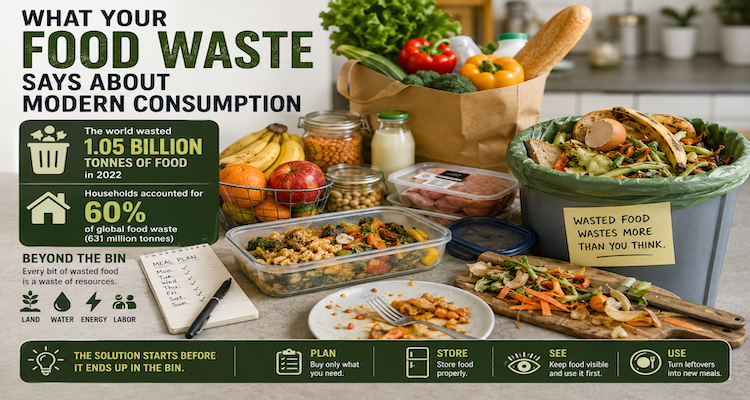
The scale gives that everyday waste a broader significance. The United Nations Environment Programme estimates that 1.05 billion tonnes of food were wasted globally in 2022, with households accounting for the largest share of food waste at the consumption stage. At the same time, food waste represents wasted land, water, energy, labour and other resources used to produce food that ultimately goes uneaten.
Key Takeaways
- Household waste is not only a kitchen issue; it reflects how food is bought, stored, marketed and valued.
- UNEP estimates that households accounted for 60% of the 1.05 billion tonnes of food wasted globally in 2022.
- Food waste often begins before disposal, through overbuying, poor planning, oversized portions and food that is forgotten rather than deliberately rejected.
- The environmental cost includes resources used to grow, process, transport and prepare food that is never eaten.
- Composting is useful, but preventing edible food from becoming waste is generally a higher priority.
Food waste is a record of consumption decisions
A rubbish bin is the end of a story that often began much earlier.
A shopper sees a promotion and buys more than originally planned. A large pack appears better value than a smaller one. Fresh produce is purchased for an imagined week of healthy cooking. Leftovers are stored with the intention of eating them later, then disappear behind newer purchases. Eventually, the food becomes waste.
None of these decisions is necessarily irrational on its own. Modern food systems are designed around convenience, abundance, variety and availability. Supermarkets reward bulk purchasing. Packaging can encourage consumers to buy quantities that do not match household needs. Busy schedules make meal planning unreliable. Refrigerators preserve food, but they can also make it easier to postpone decisions until food is forgotten.
That is why food waste can be read as a form of consumption mismatch: a gap between what people acquire and what they actually use.
The most revealing part is that waste does not always mean people do not value food. Often, it means they value other things at the moment of purchase: convenience, choice, optimism, preparedness or the perceived bargain of buying more.
UNEP’s 2024 Food Waste Index found that 1.05 billion tonnes of food were wasted in 2022 across households, food service and retail. Households accounted for 631 million tonnes, or 60% of the total.
That does not mean households alone are responsible for the global problem. Food loss and waste occur throughout the food system, and FAO distinguishes consumer and retail waste from losses occurring earlier in supply chains. The causes, and therefore the solutions, differ across countries and stages of production.
Still, the household share matters because it shows that a significant part of the problem is connected to everyday consumption.
The paradox of abundance
Modern consumers have access to an extraordinary range of food. In many markets, products are available year-round, often in multiple brands, package sizes and levels of convenience.
Abundance has obvious benefits. It can increase choice, reduce some forms of scarcity and make food more accessible. But abundance also changes the consequences of a small purchasing error.
When food is relatively easy to replace, wasting one item may feel insignificant. The individual loss is a few leftovers or a bag of vegetables. The system-wide result, however, becomes substantial when the same pattern is repeated across millions of households.
This creates a psychological distance between purchase and disposal.
At the supermarket, food is a product selected from a shelf. At home, it becomes inventory. In the bin, it becomes waste. Each stage changes how we think about it.
The original labour, land, water, energy, transport and processing involved in producing the food are largely invisible by the time a consumer throws it away. The U.S. Environmental Protection Agency notes that wasting food also wastes the resources used to grow, process, distribute and prepare it.
The bin therefore hides the full cost of the decision.
Food waste is also an information problem
One underappreciated aspect of household food waste is that it can reveal poor information management.
Many households do not have a clear picture of what they already own. Food is purchased without checking existing supplies. Items are moved to the back of shelves or refrigerators. Dates on packaging may be misunderstood or treated as automatic indicators of safety when they can serve different purposes depending on local labeling systems and products.
The result is not simply “too much food.” It is food that is poorly visible.
This is why waste prevention often resembles inventory management more than environmental activism. The EPA recommends practical measures such as making grocery lists, inventorying supplies and buying only what is needed.
Businesses confront the same problem at a larger scale. The EPA recommends food-waste assessments that identify not only how much food is discarded, but also what is being wasted and why. Over-preparation, poor storage, inaccurate purchasing and uneaten portions can require different responses.
There is a useful lesson here for households: you cannot manage a pattern you never observe.
Tracking discarded food for even a short period can reveal whether the main problem is forgotten produce, excessive leftovers, poor storage or unrealistic shopping habits. The purpose is not guilt. It is diagnosis.
The business model behind “more”
Food waste also exposes a tension within consumer culture.
Consumers are frequently encouraged to interpret quantity as value. Larger packages, multi-buy offers and promotional pricing can make buying more appear economically sensible. But the cheapest price at checkout is not necessarily the lowest cost if part of the purchase is never consumed.
This distinction matters because the traditional idea of a “good deal” usually ends at the cash register. A more complete calculation would ask:
- How much of the purchase will actually be used?
- Can the household store it properly?
- Is the quantity realistic before it spoils?
- Does buying more reduce the unit price but increase the probability of waste?
The same logic applies beyond food. Modern consumption often rewards acquisition because purchasing is easy to measure, while underuse is harder to see.
A cupboard full of unused products, an overflowing wardrobe and a refrigerator containing forgotten food are different expressions of a similar pattern: ownership can expand faster than attention.
Food makes this pattern particularly visible because it has a deadline. A shirt can remain unused for years. Fresh food eventually forces a decision.
Why throwing food away is more than a disposal problem
Food loss and waste have implications for food security, resource use and climate. FAO states that food loss and waste represent inefficient use of resources including labour, water, energy and land, while also contributing to environmental impacts.
FAO also cites estimates that food loss and waste account for roughly 8% to 10% of global greenhouse gas emissions.
But this issue requires some care in interpretation.
Reducing household food waste does not mean that every kilogram saved automatically becomes food available to someone experiencing hunger elsewhere. Food insecurity is shaped by income, access, conflict, infrastructure, distribution and many other factors. Preventing waste and solving hunger are connected challenges, but they are not interchangeable solutions.
The stronger argument is about efficiency and pressure on the food system. When less food is wasted, fewer resources are used to produce food that serves no nutritional purpose.
That is why prevention is generally placed above disposal-based solutions. The European Commission’s food use and waste hierarchy prioritizes prevention before redistribution, recovery and waste treatment. The EPA’s Wasted Food Scale similarly places prevention among the most environmentally preferable approaches.
Composting can have value. So can anaerobic digestion, donation and other forms of recovery. But these approaches address food after it has become surplus or waste. Prevention asks a more fundamental question: why did food that could have been eaten become waste in the first place?
What a lower-waste household actually looks like
Reducing food waste does not require turning every meal into a rigid efficiency exercise. Food involves spontaneity, changing appetites and imperfect planning. Some waste, particularly unavoidable inedible parts, will always exist.
The more realistic goal is to reduce avoidable waste.
A practical approach can include:
- Checking before shopping: Look in the refrigerator, freezer and cupboards before making a list.
- Buying for realistic plans: Shop for the meals you are likely to prepare, not every meal you hope to prepare.
- Making food visible: Move older items to the front so they are used before newer purchases.
- Treating leftovers as ingredients: Plan one flexible meal around food already available.
- Learning storage practices: Different foods have different storage needs, and proper storage can extend usability.
- Measuring the waste occasionally: A short audit can identify recurring problems more effectively than relying on memory.
These practices may sound ordinary because they are. That is partly the point.
Food waste is not likely to be solved by a single dramatic consumer innovation. Much of the opportunity lies in better coordination between what we buy, what we store and what we actually eat.
The deeper question is how much consumption exceeds attention
Food waste is often discussed as a moral failure: people should care more, plan better and throw away less.
That framing is incomplete.
The problem is also structural. Modern consumers operate inside systems that make abundance easy and attention difficult. Food can be purchased in seconds, delivered quickly, stored out of sight and replaced with little immediate friction. Marketing encourages aspiration at the point of purchase, while waste becomes visible only later.
The result is a mismatch between the speed of acquisition and the slower work of using what has been acquired.
That may be the broader lesson hidden in food waste.
The modern economy is exceptionally effective at helping people obtain things. It is less effective at helping them maintain awareness of what they already have.
Food simply makes the consequences harder to ignore.
Conclusion
What ends up in the bin can reveal more than a failure to finish a meal. It can expose the gap between intention and behaviour, between perceived value and actual use, and between a culture built to encourage purchasing and the everyday attention required to consume responsibly.
The global food-waste problem is too large to be solved by household behaviour alone. Governments, producers, retailers, restaurants and food-service businesses all have important roles, while the causes of food loss vary across the supply chain.
But households still matter. The most useful shift may be to stop viewing food waste only as something that happens at disposal. By the time food reaches the bin, the pattern that produced it may have started days earlier.
Waste, in that sense, is not merely what we throw away. It is evidence of how modern consumption works when acquisition becomes easier than attention.
This content is published for informational or entertainment purposes. Facts, opinions, or references may evolve over time, and readers are encouraged to verify details from reliable sources.