










Are We Losing Traditional Recipes? The Race to Preserve Culinary Heritage
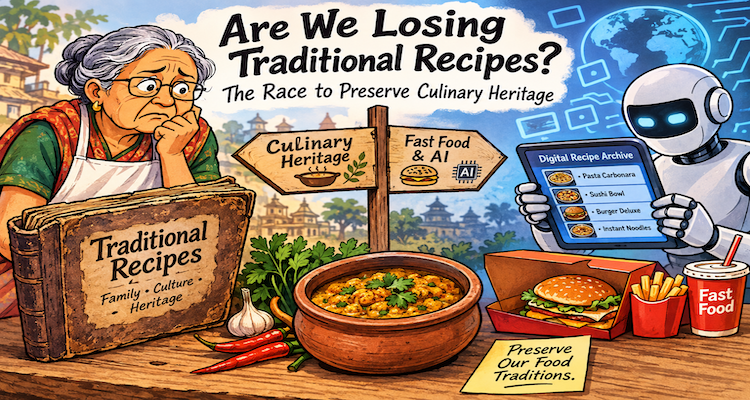
A traditional recipe can disappear long before anyone realizes it is gone.
It may survive in a grandmother’s memory but never be written down. A particular ingredient may become harder to grow or buy. Younger generations may know the dish but not the techniques behind it. Migration can separate families from the places where local food traditions developed. Commercial food systems can make standardized alternatives easier, cheaper, and more visible.
The concern, however, is not simply that old dishes are being replaced by new ones. The deeper risk is the loss of knowledge surrounding food: how ingredients are selected, when they are harvested, how they are preserved, which occasions call for a particular preparation, and how cooking connects families and communities to a landscape and history.
That distinction matters. UNESCO’s approach to food-related intangible cultural heritage does not primarily treat a dish as an object to be frozen in time. It recognizes the skills, knowledge, rituals, social practices and forms of transmission that allow culinary traditions to remain alive.
The race to preserve culinary heritage, then, is not really a race to stop food from changing. Food has always changed. The more difficult challenge is ensuring that communities do not lose the ability to understand, adapt and pass on the knowledge that gives a recipe its cultural meaning.
Key Takeaways
- Traditional recipes carry knowledge about ingredients, landscapes, seasons, techniques and social traditions—not merely instructions for preparing food.
- UNESCO increasingly recognizes food-related heritage as living cultural practices rather than museum pieces or isolated dishes.
- Globalized food markets, environmental change and broken intergenerational transmission can weaken traditional food knowledge.
- Preservation works best when communities continue cooking, teaching, adapting and practicing traditions rather than simply archiving recipes.
- Protecting culinary heritage can also help preserve agricultural biodiversity, local knowledge and cultural identity.
The Real Thing We Risk Losing Is More Than a Recipe
A recipe written on paper can often be reproduced decades later. But a written list of ingredients rarely captures everything required to recreate a food tradition.
How fine should the grain be ground? How does the cook know when a fermented preparation is ready? Which seasonal variation is considered acceptable? Who traditionally prepares the dish, and for what occasion?
Much of this knowledge is transmitted through observation and repetition rather than formal instruction.
UNESCO’s description of the Mediterranean diet illustrates this broader understanding. The heritage element includes skills and knowledge related to cultivation, harvesting, fishing, conservation, processing, cooking and the sharing and consumption of food. UNESCO also emphasizes the role of markets, social exchange and intergenerational transmission.
This provides an important way to think about culinary preservation: a recipe is only one layer of food heritage.
The recipe may survive online while the ecosystem of knowledge around it disappears.
A dish can still carry its original name even when the local ingredient, seasonal practice, technique or social ritual that shaped it has been lost. That does not make the newer version illegitimate culinary traditions have always adapted but it does mean that preserving the written recipe alone may not preserve the heritage.
Why Traditional Food Knowledge Can Become Vulnerable
There is no single global explanation for why culinary traditions weaken. The pressures vary by region, community and food system.
The ingredients themselves can disappear from everyday life
Traditional cooking depends on access to ingredients, including local crop varieties, wild foods, fish and livestock. When those foods become difficult to obtain, expensive, environmentally threatened or commercially marginalized, the associated recipes can become harder to practice.
The Food and Agriculture Organization of the United Nations has documented how Indigenous Peoples’ food systems are closely connected to biodiversity, local ecosystems and accumulated knowledge. It has also identified climate change and the expansion of industrial and commercial activities as significant pressures on some of these systems.
This means culinary loss can begin before a recipe disappears from memory. If the ecological foundation of a food tradition changes, the knowledge built around that food may also become difficult to maintain.
Convenience can change what gets passed on
Modern convenience is not inherently hostile to tradition. Refrigeration, transportation, packaged ingredients and digital communication can all help recipes travel and survive.
But convenience can alter transmission.
A dish once learned through repeated participation may be replaced by a simplified version designed for speed. A labor-intensive preparation may become something reserved for festivals. Eventually, the knowledge of how to make it from scratch may belong to fewer people.
That pattern is difficult to measure globally because culinary knowledge is not collected in a single database. Still, the broader concern is visible in preservation efforts themselves: institutions and communities are increasingly documenting food practices precisely because knowledge that once moved naturally between generations can no longer be taken for granted.
Migration can preserve and transform food at the same time
Migration is often described as a threat to traditional cuisine, but the reality is more complicated.
Diaspora communities can become powerful guardians of food traditions. Families may preserve recipes precisely because food provides a connection to home, language and identity. At the same time, ingredients change, local substitutions emerge and techniques adapt.
That is not necessarily cultural loss.
The more useful distinction is between adaptation and disconnection. A recipe that changes because cooks creatively respond to a new environment can remain part of a living tradition. A tradition becomes more vulnerable when the knowledge needed to understand its origins, methods and variations is no longer transmitted.
Preservation should therefore avoid the mistaken idea that an “authentic” recipe must remain permanently unchanged.
UNESCO’s Approach Offers an Important Lesson: Heritage Must Stay Alive
UNESCO’s food-related intangible heritage listings show that culinary heritage is increasingly understood as a set of living practices.
According to the UNESCO Courier, around fifty traditional culinary practices are represented across UNESCO’s intangible cultural heritage lists. These listings concern cultural practices and knowledge passed between generations rather than simply declaring individual food products or famous dishes to be heritage objects.
The Mediterranean diet, for example, is recognized as a cultural framework involving production, preparation, sharing and social life not as a single menu.
This distinction matters because it changes the question from:
How do we preserve this dish exactly as it is?
to:
How do we help the knowledge, skills and community relationships around this food continue?
Those are very different preservation strategies.
A recipe locked inside an archive may be historically valuable. A recipe that is still cooked, taught, discussed and adapted remains culturally active.
Documentation Matters, but a Database Is Not a Kitchen
Digital archives, recipe websites, video platforms and social media have created unprecedented opportunities to record culinary knowledge.
A regional technique can now be filmed. An elder’s recipe can be transcribed. A disappearing ingredient can be photographed and documented. Diaspora communities can exchange cooking knowledge across continents.
These tools are valuable, but digitization has limitations.
A video can demonstrate a movement without transferring the sensory experience of touch, aroma, texture or timing. A recipe can record ingredients without explaining decades of accumulated judgment. Algorithms can also reward visually attractive or simplified versions of traditional food over less commercially appealing preparations.
There is another challenge: documentation can preserve information without preserving practice.
The most resilient form of culinary preservation may therefore combine digital documentation with real-world transmission:
- recording recipes and oral histories;
- teaching techniques in homes, schools and community kitchens;
- supporting local producers and traditional ingredients;
- involving younger generations as active participants rather than passive audiences;
- documenting variations instead of pretending every tradition has only one “correct” version.
The goal should not be to turn every kitchen into a museum.
Traditional Food Is Also a Knowledge System
One of the most overlooked aspects of culinary heritage is that recipes often sit inside larger systems of environmental knowledge.
FAO describes Indigenous Peoples’ food and knowledge systems as the result of long-term adaptation to particular environments. These systems can involve fishing, hunting, gathering, pastoralism, cultivation and other practices shaped by ecological conditions and cultural knowledge.
The connection between food heritage and biodiversity is especially important.
A traditional dish may depend on a crop variety that has little commercial value outside its region. A cooking method may have developed around seasonal abundance. A preservation technique may have emerged as a response to climate, geography or the absence of modern storage.
When those practices disappear, what is lost may include more than culinary variety.
It may also include knowledge about local ecosystems, agricultural diversity and resource use.
That does not mean every traditional practice is automatically sustainable or that every old recipe should be preserved unchanged. Tradition is not a guarantee of environmental or nutritional value. But the available evidence from FAO’s work on Indigenous food systems demonstrates why traditional knowledge deserves to be examined and respected rather than dismissed as obsolete simply because it is old.
The Danger of Turning Culinary Heritage Into a Brand
Preservation also has a commercial side.
Restaurants, tourism campaigns and food companies can help revive interest in regional cuisines. Greater visibility can create demand for local ingredients and generate economic opportunities for producers and cooks.
But commercialization can also simplify a tradition.
A complex food culture may be reduced to one photogenic dish. Recipes may be standardized to meet tourist expectations. A community’s culinary identity can become a marketing label while the people who developed and maintained the knowledge receive little recognition or benefit.
There is also a risk of “heritage freezing” the assumption that a food tradition becomes more authentic when it stops changing.
That approach misunderstands how food culture works.
The most meaningful preservation is usually not about enforcing one permanent version of a recipe. It is about ensuring that communities retain the knowledge and agency to decide how their food traditions evolve.
A living cuisine needs room for continuity and change.
What Preservation Can Look Like in Practice
There is no universal model, but effective preservation is likely to involve several layers rather than a single archive or recognition program.
Record the knowledge behind the recipe
Ingredients and measurements are important, but so are oral histories, regional variations, preparation techniques, seasonal context and cultural meaning.
Support the people who keep traditions alive
Home cooks, farmers, fishers, artisans, market vendors and community elders may hold knowledge that formal institutions have never documented.
Preservation should not treat them merely as sources of information. They are participants whose knowledge and rights matter.
Protect the food system, not just the finished dish
A recipe cannot remain fully alive if its essential ingredients, production methods or ecological foundations disappear.
Bring younger generations into the process
Watching a video is not the same as learning by doing. Community kitchens, family cooking, school programs and intergenerational projects can turn preservation into participation.
Allow traditions to adapt
A recipe may change because of migration, climate, dietary needs or ingredient availability. Not every adaptation represents cultural erosion.
The more important question is whether the community remains connected to the knowledge and meaning behind the tradition.
So, Are We Actually Losing Traditional Recipes?
Some undoubtedly disappear. Others survive in altered forms. Others are being rediscovered, documented and revived.
The available evidence does not support a simple story of inevitable culinary decline. Food traditions are dynamic, and globalization can spread recipes as well as threaten them. Digital tools can disconnect cooking from lived tradition, but they can also preserve voices and techniques that might otherwise remain undocumented.
The real issue is therefore more precise than the headline’s question.
We may be losing the conditions that allow certain traditional recipes to remain living knowledge.
When a dish is separated from its ingredients, landscape, language, techniques and community memory, preservation becomes more difficult. When those connections remain active even as recipes evolve the tradition has a better chance of surviving.
That is why the race to preserve culinary heritage should not be framed as a battle between old food and new food.
It is a question of whether societies can continue to make room for the knowledge that does not always fit neatly into a recipe card, a supermarket shelf or a viral video.
Conclusion
Traditional recipes do not need to remain unchanged to remain meaningful. In fact, demanding that food never change may be as damaging as ignoring it altogether.
The stronger goal is to preserve the ability to remember, practice, teach and adapt.
A handwritten recipe can be saved in an archive. A cooking video can be uploaded indefinitely. But culinary heritage truly survives when someone still knows why the recipe is made, how the ingredients behave, when the dish belongs on the table and feels that the knowledge is worth passing on.
That may be the most important lesson in the effort to protect culinary heritage: the future of traditional food does not depend on keeping it frozen in the past. It depends on keeping the knowledge alive.
This content is published for informational or entertainment purposes. Facts, opinions, or references may evolve over time, and readers are encouraged to verify details from reliable sources.