










The Rise of AI in the Kitchen: How Technology Is Changing the Way We Cook
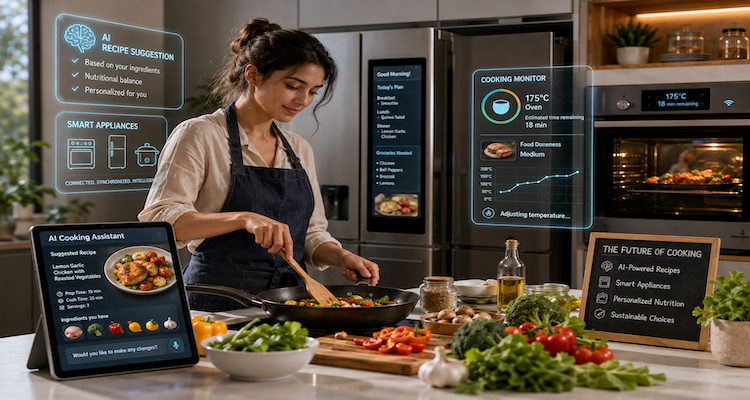
Artificial intelligence is entering the kitchen in a form that is less dramatic and potentially more useful than the idea of a robot chef replacing the home cook. The more immediate shift is happening through software that can interpret recipes, suggest meals from available ingredients, personalize cooking guidance and, increasingly, connect those instructions with sensors and smart appliances.
The important change is not simply that AI can generate a recipe. Research and product development are moving toward systems that treat cooking as a combination of language, visual information, ingredient data and real-world physical processes. That creates new possibilities, but it also exposes a central limitation: a fluent AI response is not the same thing as reliable culinary judgment. Recent research on smart kitchens continues to identify interoperability, usability, privacy and the difficulty of modelling real food as significant challenges.
Key Takeaways
- AI is shifting from recipe recommendation toward systems that can interpret ingredients, preferences, images and cooking workflows.
- Smart appliances may use sensors and computer vision to monitor cooking, but reliable performance across foods and conditions remains difficult.
- Generative AI can help explore new food combinations, including recipes optimized around nutrition or sustainability objectives.
- The biggest near-term impact may be assistance and personalization rather than fully autonomous home kitchens.
- AI-generated cooking advice still requires human judgment, especially where food safety, allergies and precise preparation are involved.
From Recipe Search to Conversational Cooking
For decades, digital cooking tools followed a relatively simple pattern: a user searched for a dish, selected a recipe and followed a fixed sequence of instructions.
Generative AI changes that interaction. A cook can describe what is available in the refrigerator, specify a time limit, mention a dietary preference or upload an image, then ask for possible meals and step-by-step guidance.
That capability is already an active area of research. The 2025 AAAI demonstration project Pic2Prep, for example, explored a multimodal cooking assistant designed to generate cooking instructions and ingredient information from images and text.
The significance lies in the shift from a static recipe to a more adaptive interaction.
A conventional recipe answers:
What ingredients do I need to make this dish?
An AI assistant can potentially address a different set of questions:
- What can I cook with these ingredients?
- What can replace an ingredient I do not have?
- How can this recipe be adapted for fewer servings?
- How can the method be simplified for the time available?
- What should happen next if the sauce is reducing too quickly?
The distinction matters because cooking rarely happens under laboratory conditions. Ingredients vary. Equipment differs. A recipe written for one oven may behave differently in another. Human cooks routinely adapt to those differences, often using sight, smell, texture and experience.
AI is beginning to move toward that kind of adaptive assistance, but it has not solved the problem of reproducing human sensory judgment.
The Kitchen Is Becoming a Data Environment
The next stage of AI in cooking involves more than chat interfaces.
Researchers are exploring ways to combine cameras, temperature sensors, timing data and machine-learning models to estimate what is happening to food during preparation. A 2025 master’s research project at Istanbul Technical University, for example, developed an AI-based approach to detecting cooking completion using visual information together with sensor-derived data.
The broader technical ambition is straightforward: instead of asking the cook to decide only by time, an appliance could attempt to evaluate the state of the food itself.
That could eventually support functions such as:
- detecting changes in browning or surface colour;
- estimating whether a dish is approaching a target level of doneness;
- adjusting cooking parameters;
- notifying the user when intervention may be needed;
- stopping or modifying a process based on sensor data.
Yet this is also where marketing language can run ahead of reality.
Food is highly variable. Thickness, moisture, ingredient composition, starting temperature and placement can all affect cooking. A recent review of AI-enabled smart kitchens notes broader challenges involving data, usability and interoperability between systems.
The kitchen, in other words, is a difficult environment for automation precisely because cooking is not a single, standardized task.
AI Can Now Help Design Food, Not Just Describe It
One of the more interesting developments is the use of generative AI for food design.
A 2026 study published in npj Science of Food used a generative model to explore burger combinations optimized around objectives including deliciousness, nutrition and sustainability. The researchers described a system that learned statistical patterns from large-scale recipe data and generated novel ingredient combinations within a structured design space.
This points to a different role for AI.
Large language models are useful for generating and explaining recipes in natural language. But specialized generative systems may be better suited to questions involving structured combinations, quantities and optimization.
For food companies, that could have implications for product development. Instead of relying exclusively on conventional trial-and-error processes, computational systems may help researchers explore a much larger set of possible ingredient combinations.
That does not mean AI can independently determine whether a new food will succeed commercially or taste good to every consumer. Human sensory testing, food science, manufacturing constraints, regulation and cultural preferences remain essential.
The more realistic opportunity is acceleration: AI may help narrow a large design space before experts perform the experiments that actually validate a product.
The Overlooked Shift: AI Is Turning Recipes Into Workflows
One of the most important but less obvious developments involves the structure of recipes themselves.
Humans can read a recipe and infer relationships between ingredients, tools and actions. A machine cannot automatically do that with the same reliability. To automate or intelligently assist cooking, a system must understand that “add,” “stir,” “reserve,” “simmer” and “until golden” are not simply words. They describe actions, dependencies and changing states.
Research published in Frontiers in Artificial Intelligence in 2026 introduced RiCoRecA, a framework for representing cooking recipes as workflows that could be interpreted by computational systems. The researchers also highlighted an important reality: today’s smart kitchen devices are often isolated rather than operating as a genuinely coordinated environment.
That is a crucial distinction.
A smart oven can be useful.
A smart refrigerator can be useful.
An AI recipe assistant can be useful.
But a truly integrated kitchen would require those systems to understand shared information and coordinate reliably.
That remains largely an engineering and interoperability challenge rather than an accomplished consumer reality.
Why the Robot Chef Is Still Not the Main Story
Robotic cooking attracts attention because it is visually impressive. But research reviews suggest that the practical challenges are substantial.
A 2026 systematic review of robot-chef research identified progress in sensing, manipulation, task planning and AI integration while also emphasizing technical barriers and the importance of human-robot interaction and user acceptance.
A robot capable of performing one carefully defined cooking task is very different from a machine capable of preparing an unpredictable home meal in an ordinary kitchen.
Food can be slippery, fragile, irregular and visually complex. Kitchens contain clutter, changing layouts and tools that were designed for human hands. A recipe may also require improvisation.
For that reason, the near-term future of AI in the kitchen is more likely to involve augmentation before replacement.
The human cook may remain responsible for judgment and physical action while AI handles parts of the information problem: planning, adaptation, timing, substitutions and monitoring.
Convenience Has Limits and So Does AI Advice
The growing availability of AI cooking assistants raises a practical question: when should users trust the answer?
Generative systems can produce convincing instructions even when the underlying guidance is incomplete or wrong. That creates particular concerns around:
- food safety;
- cooking temperatures and times;
- allergens;
- dietary restrictions;
- ingredient substitutions;
- nutrition estimates.
AI-generated recipes should therefore be treated as assistance, not unquestionable authority.
A useful rule is simple: the greater the consequence of an error, the more important independent verification becomes.
For casual questions such as finding a way to use leftover vegetables AI may be a convenient brainstorming tool. For food-safety decisions, severe allergies or medically significant dietary requirements, users should rely on authoritative guidance and qualified professionals rather than treating a chatbot’s answer as definitive.
The Business Opportunity Is Bigger Than Smart Appliances
The AI kitchen is also becoming a business platform.
The value may not come only from selling a more expensive oven or refrigerator. It can emerge from the services built around food decisions: meal planning, grocery management, personalization, recipe interpretation, inventory tracking and appliance ecosystems.
A 2025 systematic review of IoT-enabled kitchen technologies examined applications involving food storage, preparation and culinary experiences while identifying privacy and security as important challenges.
That introduces an important trade-off.
The more personalized a kitchen becomes, the more data it may need to process. Preferences, dietary choices, household consumption patterns and connected-device activity can all become part of a digital ecosystem.
Consumers may appreciate a system that remembers preferences. They may be less enthusiastic if that convenience comes with unclear data practices or unnecessary sharing between services.
For manufacturers and technology companies, trust could become as important as intelligence.
What Happens Next
The evidence suggests that the AI kitchen will probably develop unevenly.
Some functions are relatively accessible now: conversational recipe assistance, ingredient substitution, meal ideas and personalized planning. More sophisticated capabilities such as computer vision that reliably interprets cooking states across diverse foods and appliances are harder.
Fully autonomous robotic cooking in ordinary homes is harder still.
One possible outcome is that AI becomes less visible rather than more dramatic. Instead of announcing itself as an “AI chef,” it may simply become part of the tools people use to plan meals, understand recipes and manage appliances.
The deeper transformation may therefore be about decision-making rather than automation.
Cooking has always involved a continuous stream of small judgments: what to make, what to buy, what to substitute, when to stir, when something is done and what to do when the plan goes wrong. AI is increasingly capable of participating in parts of that process.
But participation is not mastery.
The most useful kitchen AI may not be the system that tries to take over cooking. It may be the one that understands enough about the cook, the ingredients and the situation to offer useful help—while leaving the final judgment where it still matters most: with the person preparing the meal.
This content is published for informational or entertainment purposes. Facts, opinions, or references may evolve over time, and readers are encouraged to verify details from reliable sources.