










The One-Person Billion-Dollar Company: Can AI Make Solo Entrepreneurs the Next Business Giants?
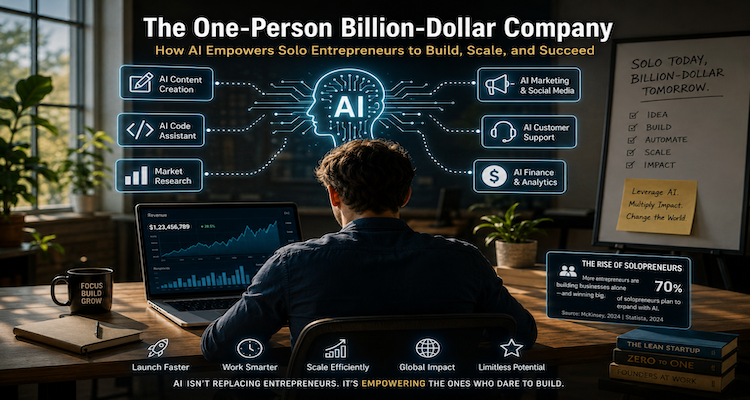
A company once needed layers of people to become large. Someone built the product. Someone wrote the code, answered customers, ran marketing campaigns, analyzed data, managed operations, prepared reports, and handled the endless administrative work that accumulates as a business grows.
Artificial intelligence is beginning to challenge that structure.
The provocative idea of a one-person billion-dollar company has become a recurring theme in technology and startup circles. The argument is not that one founder can personally perform every function forever. It is that AI systems may allow a single entrepreneur or a very small founding team to direct work that previously required dozens or hundreds of employees.
There is now evidence that the underlying ingredients are becoming more capable. Anthropic’s 2025 Economic Index found increasing use of AI for delegated tasks, with “directive” interactions rising from 27% to 39% in the analyzed Claude.ai data. In its API data, 77% of business usage showed automation-oriented patterns. Meanwhile, OpenAI’s research on Codex describes a shift toward longer, more autonomous tasks, including work that would take humans hours to complete.
But the leap from one person using AI productively to one person building a billion-dollar company is much larger than the popular narrative suggests.
AI can reduce the cost of execution. It does not automatically create customers, trust, intellectual property, distribution, strategic judgment, or a durable business model.
That distinction may define the next generation of entrepreneurs.
Key Takeaways
- AI is increasingly being used to delegate and automate business tasks, potentially expanding what a single entrepreneur can manage.
- The biggest change may be organizational leverage, not the disappearance of employees altogether.
- Software development, research, administration, and content workflows are among the areas most susceptible to AI-enabled compression.
- A billion-dollar valuation still depends on customers, defensibility, distribution, and economics not simply on producing more with fewer people.
- The strongest solo founders may become orchestrators of AI systems rather than people who personally perform every business function.
- AI could make small companies more powerful, while simultaneously making markets more competitive and easier to enter.
The real breakthrough is not automation alone it is organizational compression
Businesses have used automation for decades. Accounting software reduced bookkeeping workloads. Cloud computing eliminated the need for many companies to operate their own data centers. E-commerce platforms allowed small merchants to reach global customers.
Generative AI and AI agents introduce a different possibility: the same person can potentially coordinate multiple forms of cognitive work simultaneously.
A founder might use AI to:
- generate and review software code;
- research competitors and markets;
- analyze customer feedback;
- create first drafts of marketing materials;
- transform data into reports;
- automate parts of customer support;
- prepare sales research;
- monitor business information;
- connect workflows across software tools.
The important shift is not that AI performs every task perfectly. It does not.
The shift is that an entrepreneur can increasingly delegate portions of work that previously required hiring another specialist or outsourcing to an external provider.
Anthropic’s Economic Index offers one indication of this transition. Its research found growing task delegation and reported that business API usage was heavily oriented toward automation, particularly in areas such as software development and administrative work.
OpenAI has also described a move from short AI interactions toward longer-horizon delegated work. In research published in June 2026, the company reported that more than 70% of Codex users in its May 2026 analysis asked the system to complete tasks estimated to require a person more than an hour.
These findings do not prove that AI can replace an entire company. They do suggest that the unit of work being delegated to software is expanding.
That matters because company size has historically been tied, at least partly, to coordination costs.
The traditional startup had a hiring problem before it had a scaling problem
A startup founder who identifies an opportunity usually faces a familiar sequence.
Build something. Hire technical talent. Create marketing. Support customers. Handle operations. Analyze results. Raise capital to hire more people. Add managers as the organization grows.
AI has the potential to change the early stages of that equation.
A technically capable founder can already use AI coding tools to accelerate software development. A non-technical founder may be able to prototype interfaces or automate simple workflows that previously required outside development help. Research and content tasks can be accelerated. Repetitive administrative processes can increasingly be automated.
The consequence is not necessarily fewer businesses.
It may be more businesses capable of reaching the market before raising significant capital or building large teams.
This is one of the most important implications of the one-person-company thesis. AI may lower the minimum organizational size required to test an idea.
That could make entrepreneurship cheaper and faster.
But it could also create a more crowded marketplace.
If AI reduces the cost of building a product, competitors gain access to many of the same tools.
AI may lower the cost of execution and raise the cost of differentiation
The one-person billion-dollar narrative often focuses on productivity: one founder can now do the work of many people.
The overlooked question is what happens when everyone else receives similar leverage.
If a new software product can be designed, coded, marketed, and supported with fewer people, barriers to entry may decline. More entrepreneurs can launch. Existing companies can also move faster.
That means the scarce resources may shift.
In a world where execution becomes cheaper, the competitive advantage may increasingly come from:
Distribution
A brilliant product is not automatically a successful business.
Founders still need customers. They need access to audiences, partnerships, search visibility, communities, sales channels, or established brands.
AI can help create marketing material. It cannot guarantee that people will trust or choose it.
Proprietary assets
Businesses with unique data, intellectual property, specialized expertise, strong networks, or difficult-to-replicate infrastructure may remain harder to compete with.
If every competitor can access powerful general-purpose AI models, access to the model itself may become less differentiating than what a company builds around it.
Judgment
AI can generate options rapidly. Choosing the right option remains a different problem.
A founder must decide which market to enter, which customer problem matters, what not to build, when to spend money, when to change direction, and which risks are acceptable.
More output does not necessarily mean better strategy.
Trust and accountability
Customers may tolerate an AI-generated draft. They may be far less comfortable when AI makes consequential mistakes involving money, privacy, legal obligations, security, or health.
As businesses automate more work, responsibility does not disappear.
It becomes more concentrated.
The solo founder may become an AI manager
The phrase “one-person company” can be misleading because it suggests one human doing everything alone.
A more accurate model may be one human coordinating an expanding network of software agents, automated workflows, contractors, platforms, and specialized services.
The founder becomes less like a traditional individual contributor and more like the manager of a machine-enabled organization.
OpenAI’s current work on agentic systems reflects this direction. Its tools are designed around longer, multi-step workflows in which AI can research, analyze information, use connected tools, and perform defined tasks with varying degrees of human oversight.
That does not mean the AI operates independently in every important situation.
Agentic systems can fail, misunderstand context, make incorrect assumptions, or encounter information they cannot reliably interpret. Higher autonomy also introduces questions about security, permissions, oversight, and error detection.
The practical model is therefore likely to be human-directed automation, not a magical digital workforce requiring no management.
In fact, greater AI capability could create a new management burden: deciding what to delegate, checking outputs, establishing safeguards, and knowing when the system should not act.
The entrepreneur’s job may become less about producing every deliverable and more about designing a reliable operating system for the business.
Why a billion-dollar company is a much harder test
The “one-person billion-dollar company” phrase combines two very different achievements.
The first is building a business with enormous economic output.
The second is achieving a valuation of at least $1 billion.
Neither follows automatically from having a tiny workforce.
A company can generate significant revenue with relatively few employees. But a billion-dollar valuation depends on factors such as growth expectations, margins, market size, competitive position, investor assumptions, and the economics of the business.
A solo entrepreneur could theoretically control a company with extraordinary leverage.
Yet as a company grows, some functions become difficult to compress indefinitely.
These may include:
- negotiating major commercial relationships;
- managing complex regulation;
- responding to legal disputes;
- maintaining cybersecurity;
- handling enterprise customers;
- managing physical supply chains;
- overseeing financial controls;
- addressing crises;
- making high-stakes decisions involving people and institutions.
AI may reduce the human effort required in each area. It does not remove the consequences of getting them wrong.
The more valuable a company becomes, the more expensive certain failures can become.
That creates a paradox: AI may make it easier for one person to build a large company, while the success of that company may eventually require systems of governance that look increasingly institutional.
The founder could remain the only employee in a narrow legal sense while relying on external infrastructure, AI services, professional advisers, contractors, cloud providers, payment processors, and other organizations.
That would still be an extraordinarily lean company. But it would not truly be one person operating in isolation.
The evidence supports a smaller-company future more strongly than a one-person-billionaire future
The strongest version of the current evidence is not that AI has already created a proven path to solo billion-dollar companies.
It is that AI is changing the economics of organizational scale.
The available data shows growing delegation and automation in business AI usage, particularly in areas where work can be clearly specified and executed digitally.
The technology is also moving toward longer, more complex workflows rather than functioning solely as a conversational assistant.
Those developments support a reasonable conclusion: a smaller number of people may increasingly be able to produce what previously required much larger teams.
The evidence does not yet establish how far that compression can go.
A five-person company may become capable of operating like a company of 25 in some digital businesses. A single founder may manage workflows that once required several employees. But moving from that reality to a universally viable one-person billion-dollar corporation involves assumptions about technology reliability, markets, regulation, customer behavior, and the nature of the business itself.
The outcome will likely vary sharply by industry.
A solo founder building software may gain much more leverage than someone manufacturing aircraft, running a hospital network, or managing a global logistics company.
The next business giants may be smaller, not necessarily solitary
The most realistic transformation may be less dramatic and more consequential than the headline suggests.
AI could produce a generation of companies that reach meaningful revenue and global markets with teams that would once have been considered impossibly small.
That could alter startup financing. Entrepreneurs may need less capital before reaching product-market fit. Investors may see companies delay hiring. Traditional measures of company strength, such as headcount, may become less useful indicators of economic capability.
It could also reshape careers.
Employees may increasingly operate as highly leveraged individuals, using AI systems to perform broader roles. Specialists could build independent businesses around expertise that previously required an organization to commercialize.
But leverage cuts both ways.
The same AI that allows a founder to build faster may allow competitors to imitate faster. The same automation that reduces payroll can increase dependence on outside AI platforms and infrastructure. And the same tools that reduce the need for junior-level execution could raise difficult questions about how future professionals develop expertise.
The one-person company, therefore, is not simply a story about AI replacing employees.
It is a story about where organizations stop needing coordination and where human judgment becomes more valuable.
Conclusion
AI is making the one-person billion-dollar company more conceivable, but not yet inevitable or even proven.
What is already visible is a more fundamental shift: the relationship between headcount and business capability is weakening in some parts of the digital economy. A founder can increasingly access capabilities that once required a collection of specialists, software systems, and substantial capital.
The winners may not be the people who try to automate everything.
They may be the entrepreneurs who understand what AI is genuinely good at, where human judgment remains essential, and how to build advantages that competitors cannot reproduce simply by using the same model.
The first truly one-person billion-dollar company, if it emerges, may become a famous symbol of the AI era. The more important transformation could happen long before that: thousands of unusually small companies becoming capable of competing in markets that once belonged only to organizations with much larger teams.
That is the business shift worth watching. AI may not eliminate the company. It may radically change how few people are needed to build one that matters.
The information presented in this article is based on publicly available sources, reports, and factual material available at the time of publication. While efforts are made to ensure accuracy, details may change as new information emerges. The content is provided for general informational purposes only, and readers are advised to verify facts independently where necessary.