










Zombie Companies: How Businesses Survive Even When Their Models Stop Working
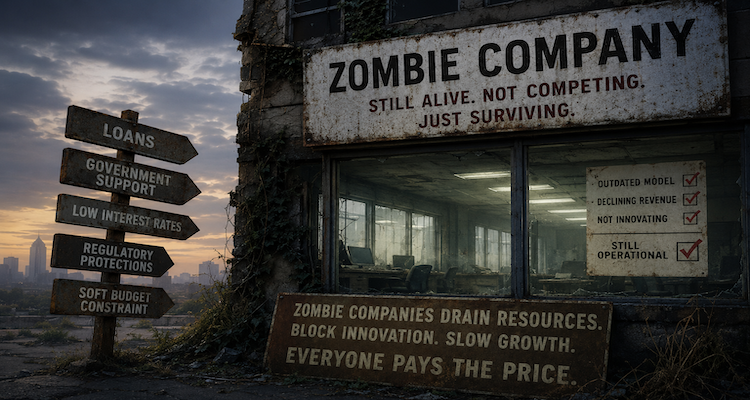
A business can continue operating long after its underlying economics have stopped making sense.
It may still employ people, sell products, occupy offices and report revenue. But its profits are too weak to comfortably service its debt, its productivity lags behind healthier competitors, and its survival increasingly depends on refinancing, creditor patience, unusually cheap funding, government support, or the reluctance of lenders to recognize losses.
Economists often describe such businesses as “zombie firms.” The label is memorable, but the underlying issue is serious: when companies that are no longer economically viable remain alive indefinitely, the cost is not limited to their shareholders and lenders. Research from the OECD and the Bank for International Settlements suggests that persistent zombie firms can trap capital and labour, distort competition and make it harder for more productive businesses to expand.
The more interesting question, however, is not simply why failing companies survive. It is why modern economies sometimes allow survival to become easier than transformation or exit.
That distinction matters because not every struggling company is a zombie. A temporary downturn, a costly investment cycle or a genuine turnaround can make a healthy business look weak for a period. The real concern begins when weakness becomes persistent and the company continues largely because the financial system, public policy or market structure postpones the consequences.
Key Takeaways
- Zombie firms are generally persistent underperformers whose weak economics make debt servicing and long-term viability increasingly difficult.
- Not every unprofitable or indebted business is a zombie; temporary distress and genuine restructuring must be distinguished from persistent non-viability.
- Cheap credit and lender forbearance can extend weak companies’ lives, sometimes without producing productive new investment.
- Zombie firms can affect healthier competitors by tying up capital, labour and market share.
- Higher interest rates can expose fragile business models, but financial stress alone does not determine whether a company is economically viable.
- The central policy challenge is separating companies worth restructuring from those whose continued survival mainly delays resource reallocation.
What Is a Zombie Company?
There is no single universal definition.
One influential OECD approach identifies zombie firms as older companies with persistent difficulty meeting interest payments. A commonly used financial measure classifies a firm as a zombie when its interest coverage ratio remains below one for at least three consecutive years and the firm is at least 10 years old. The Bank for International Settlements has also used a narrower approach that incorporates weak expected future growth prospects.
That methodological caution is important.
A startup burning cash while building a product is not automatically a zombie. Nor is an established manufacturer hit by a temporary recession, or a company undergoing a credible restructuring.
The stronger interpretation is that a zombie firm combines persistent financial weakness with limited evidence that its business can return to sustainable economic performance.
In practical terms, the warning signs may include:
- chronic inability to cover interest expenses from operating earnings;
- repeated refinancing without a convincing improvement in the underlying business;
- low productivity relative to competitors;
- dependence on unusually favourable credit conditions;
- weak investment in productive capacity despite continued access to finance;
- survival supported more by financial accommodation than by competitive strength.
The key issue is persistence. A bad year is a setback. Several years of survival without a credible path to restoring the economics of the business is a different problem.
How Can a Business Survive When Its Model Is Failing?
The answer often lies in the difference between cash survival and economic viability.
A company does not need a healthy long-term business model to remain alive in the short term. It needs enough liquidity to pay employees, suppliers and lenders when payments fall due. That liquidity can come from refinancing, new equity, asset sales, creditor concessions or external support.
Cheap money can delay the moment of reckoning
When borrowing costs are low, companies with weak profits can refinance debt more easily. Lower interest payments may keep a fragile company afloat even if its underlying productivity or competitiveness does not improve.
The BIS has examined the long-term rise of zombie firms and the relationship between persistent weak profitability, debt-servicing problems and low expected growth.
But cheap financing does not automatically create zombies. Low interest rates can also help viable companies invest, hire and survive temporary shocks.
The problem arises when financing repeatedly supports continuation without renewal.
Research on Japan, for example, found that healthier firms responded to lower borrowing costs differently from financially vulnerable firms. The healthier businesses increased investment, while vulnerable firms were more likely to use favourable financing conditions for balance-sheet restructuring rather than additional investment.
That illustrates an important distinction: access to cheaper capital does not guarantee that capital will be used to improve the productive capacity of the economy.
Banks may prefer postponement to immediate losses
A lender facing a troubled borrower has an uncomfortable choice.
Recognizing that a loan will not be fully repaid can force the bank to record losses. Extending or restructuring the loan may postpone that recognition. This does not mean every loan extension is improper restructuring viable companies is a legitimate and often economically valuable function of the financial system.
The concern is forbearance toward firms that lack a realistic path to recovery.
OECD research examining European firms found that zombie companies were more likely to be connected to weaker banks and concluded that bank health could contribute to zombie congestion and the misallocation of capital.
The result can become self-reinforcing: weak firms depend on weak lenders, while weak lenders have incentives to avoid recognizing the full scale of bad loans.
Government support can preserve both good and bad businesses
Emergency support creates another difficult distinction.
During a severe shock, governments may deliberately suspend normal market selection because allowing otherwise viable companies to collapse can cause unnecessary job losses and long-term economic damage.
The OECD’s analysis of COVID-era loan guarantees found that emergency interventions could protect productive firms from temporary distress, while also warning that large-scale and prolonged support can weaken the reallocation of credit and labour from less productive to more productive firms.
That is why the phrase “zombie company” should not be used as an argument against all business support.
A restaurant forced to close by a public-health restriction was not necessarily operating a failed business. A manufacturer disrupted by a temporary supply shock was not necessarily unviable.
The difficult policy question is when emergency preservation should give way to restructuring, recovery or exit.
The Hidden Cost: Zombies Can Affect Healthy Businesses
The most important consequence of zombie firms may be what happens around them.
A weak company that remains in the market can continue competing for customers, employees, credit and physical resources. If its continued existence is supported by financing conditions that would not be available under normal commercial discipline, healthier businesses may face distorted competition.
OECD research found that a greater share of capital tied up in zombie firms was associated with lower investment and employment growth among non-zombie firms and weaker productivity-enhancing reallocation.
This changes how the problem should be understood.
The damage is not simply that an inefficient company performs poorly. The broader concern is that resources remain attached to the past instead of moving toward businesses with better prospects.
Imagine two companies in the same industry.
One has developed a more efficient production process and wants to expand. The other has falling productivity and heavy debt but continues operating because lenders repeatedly refinance it.
The healthier company may still succeed. But if the weaker competitor retains access to scarce labour, financing and customers, the process of competitive reallocation becomes slower and more costly.
That is why zombie firms have become part of a larger debate about sluggish productivity growth.
Higher Interest Rates Are a Stress Test, Not a Definition
The period of unusually low interest rates made it easier for some highly indebted companies to refinance. As borrowing costs rise, debt that once seemed manageable can become significantly more expensive.
This can expose fragile business models.
But higher rates do not turn a healthy company into a zombie, and a company struggling with interest costs is not automatically non-viable. A financially stressed company may still have strong products, customers and a credible path to recovery.
The more useful distinction is between:
| Business condition | What it may indicate |
|---|---|
| Temporary losses with a credible recovery path | Potentially viable distress |
| Heavy investment depressing short-term profits | Possible growth or transformation phase |
| Repeated refinancing with improving operations | Potential restructuring |
| Persistent inability to cover debt costs with little operational improvement | Possible zombie characteristics |
| Survival dependent mainly on continued financial accommodation | Elevated risk of non-viability |
The classification requires judgment. Financial ratios are useful screening tools, not substitutes for understanding a company’s actual business.
The Technology Angle: Innovation Can Create a New Generation of Walking Dead
The zombie-company problem is not limited to old factories or heavily indebted industrial businesses.
Technology can create a different version of the same problem.
A company may continue operating while its underlying product is being displaced by automation, artificial intelligence, cloud services or a new platform model. Revenue can persist for years because customers move slowly, contracts remain in force and legacy systems are difficult to replace.
That means commercial survival can lag technological obsolescence.
Consider a software company built around a service that generative AI can partially automate. The company may continue reporting revenue while its pricing power weakens and its customer base gradually migrates elsewhere. If management responds by cutting costs and refinancing debt without changing the product strategy, the company may preserve the organization without restoring its economic purpose.
This does not mean AI will automatically create zombie companies. Nor does technological disruption automatically make an incumbent obsolete.
The important distinction is between adaptation and maintenance.
A business investing in new capabilities may look weak while transforming. Another may protect short-term cash flow while avoiding the strategic changes necessary for long-term survival. Financial statements alone may not fully reveal the difference.
That is one reason the zombie-company concept deserves attention beyond traditional banking and macroeconomics. In periods of rapid technological change, the real question is often not whether a company can survive another year, but whether it is using that year to build a viable future.
Why “Creative Destruction” Is Harder in the Real World Than in Economic Theory
In theory, weak companies exit and stronger companies take their place.
In practice, failure is expensive.
Companies employ people, support suppliers and anchor local economies. Their creditors may include banks, pension funds and investors. A sudden collapse can create losses that spread beyond the company itself.
This creates a genuine policy tension.
Allowing every distressed company to fail quickly can destroy viable businesses during temporary shocks. Keeping every struggling company alive indefinitely can slow the movement of resources toward more productive uses.
OECD research on insolvency regimes highlights this balance. Systems that reduce unnecessary barriers to restructuring while allowing genuinely non-viable businesses to exit can support more productive capital reallocation.
The goal, therefore, should not be a simplistic “let companies fail” approach.
A better objective is faster diagnosis:
- Which companies are temporarily distressed?
- Which have credible restructuring plans?
- Which are viable but overleveraged?
- Which are consuming new resources without a realistic path to sustainable performance?
Those questions matter for lenders, investors, policymakers and employees.
Can Zombie Companies Recover?
Yes.
The term “zombie” can sound permanent, but research does not support treating every affected company as beyond recovery. Some firms improve, restructure or adapt.
The BIS’s research on the anatomy and life cycle of corporate zombies specifically examined what happens to firms over time, including those that recover from zombie status.
That is another reason careless labeling can be misleading.
A productive company with an unsustainable debt burden may need restructuring, not liquidation. A business with an outdated product may need a strategic transformation. A company facing a temporary demand shock may need liquidity until conditions normalize.
The real failure occurs when survival becomes the strategy.
A company can cut costs, refinance debt and extend loan maturities repeatedly. None of those actions necessarily fixes a declining product, weak productivity, poor management or a business model that no longer creates sufficient value.
What Investors, Workers and Customers Should Watch
The zombie-company problem also offers a useful framework for evaluating corporate resilience.
For investors, persistent revenue growth is not enough. Important questions include whether the company generates sufficient operating earnings, how much debt must be refinanced and whether investment is producing future competitiveness.
For employees, a company can appear stable right up until refinancing becomes difficult. Employment longevity and business health are not always the same thing.
For customers, the risks may be less obvious: a financially fragile supplier may cut support, reduce investment or struggle to maintain critical products.
Some practical questions include:
- Is the company’s debt increasing faster than its ability to generate operating income?
- Are repeated refinancing deals buying time without improving performance?
- Is management investing in the future or primarily preserving short-term liquidity?
- Has technology changed the economics of the company’s core product?
- Does the company have a credible restructuring strategy with measurable operational progress?
No single answer proves that a business is a zombie. Together, however, these questions can reveal whether a company is adapting or merely extending its life.
Conclusion
Zombie companies reveal an uncomfortable truth about business failure: companies rarely disappear the moment their models stop working.
Debt can be refinanced. Creditors can wait. Governments can intervene. Assets can be sold. Costs can be cut. Technology can be deferred.
All of those actions can be useful when they give a viable business time to recover.
They become a problem when time is repeatedly purchased without changing the underlying economics.
That is the deeper lesson of the zombie-firm debate. A healthy economy does not require every struggling company to fail. But it does require a credible way to distinguish between businesses that need time to transform and businesses whose continued survival increasingly prevents capital, talent and investment from moving toward something more productive.
For companies facing technological disruption, that distinction may become even more important. The next generation of zombie businesses may not look like bankrupt factories kept alive by bad loans. They may be companies with functioning operations, loyal customers and recognizable brands yet with business models quietly losing their reason to exist.
The information presented in this article is based on publicly available sources, reports, and factual material available at the time of publication. While efforts are made to ensure accuracy, details may change as new information emerges. The content is provided for general informational purposes only, and readers are advised to verify facts independently where necessary.