










Quiet Hiring: Why Companies Are Filling New Roles Without Posting New Jobs
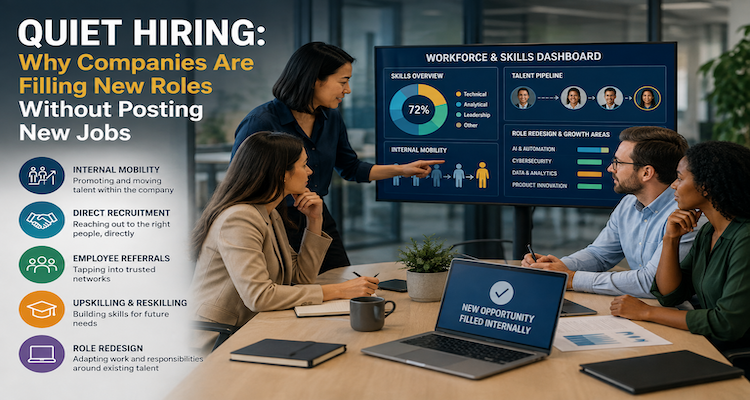
A growing share of hiring no longer begins with a public job advertisement. Instead, companies may first look inside their existing workforce, approach known candidates directly, tap employee networks, work with recruiters, or redesign responsibilities around people they already employ. The practice is commonly described as quiet hiring.
The phrase can sound like another piece of workplace jargon, but the underlying behavior is not entirely new. What is changing is the environment in which it operates. After years of rapid hiring, layoffs, skills shortages and intense pressure to control costs, employers have stronger incentives to fill capability gaps without automatically opening a conventional requisition and advertising it to the public.
For workers, that creates a more complicated job market. A company can be expanding a team without a visible vacancy. An employee may find an opportunity by developing a scarce skill or moving internally rather than applying elsewhere. At the same time, an increased reliance on informal networks can raise legitimate questions about transparency and equal access to opportunity.
The most useful way to understand quiet hiring is therefore not as a secret employment system, but as a shift in how companies allocate work and acquire skills. Public job boards remain important. They are simply no longer the only doorway into a new role.
Key Takeaways
- Quiet hiring can involve internal mobility, direct recruitment, referrals, contractors or redesigned roles rather than public job postings.
- Employers may use it to fill urgent skills gaps while reducing the cost and time associated with external recruitment.
- For workers, internal visibility and demonstrable skills can become more important when opportunities are not widely advertised.
- Quiet hiring can improve workforce flexibility, but informal hiring channels may also reduce transparency if poorly managed.
- The trend reflects a broader shift toward skills-based workforce planning rather than a simple disappearance of traditional job listings.
When the vacancy never appears
The defining feature of quiet hiring is not secrecy for its own sake. It is that the company solves a talent problem through channels other than a broadly advertised external vacancy.
That can happen in several ways:
- An existing employee moves into a new role.
- A worker takes on a new set of responsibilities without a major change in title.
- A company trains employees for skills it previously expected to recruit externally.
- A manager fills a need through referrals or direct outreach.
- A specialist is brought in temporarily through contracting or other flexible arrangements.
- Software, automation or AI changes the work enough that the company redesigns the role instead of replacing the old one.
These approaches should not all be treated as identical. An internal promotion is not the same as an employee quietly absorbing additional work without appropriate recognition or compensation. Direct recruitment is also different from a company maintaining an informal hiring culture that gives some candidates access to opportunities others never hear about.
That distinction matters because the term quiet hiring can obscure a basic question: Is the company creating a genuine opportunity, or simply redistributing work?
The answer determines whether the practice represents healthy workforce flexibility or a less transparent version of cost-cutting.
Why companies are looking inside before looking outside
The economic logic is straightforward. External hiring is only one way to acquire a capability. If an organization already has someone who understands its products, systems, customers and culture, moving that person may be faster than beginning a search from zero.
Recent labor-market and workforce research also suggests that employers are increasingly focused on skills rather than treating a job title as a fixed bundle of responsibilities. The World Economic Forum’s Future of Jobs Report 2025 identified skills gaps as a major barrier to business transformation and reported that employers expect to combine reskilling, upskilling and recruitment to address changing workforce needs.
In the Netherlands, UWV research provides a useful example of how this pressure can change employer behavior. In a 2024 survey of 2,300 employers, 42% reported adapting job tasks for workers who did not fully meet existing requirements, while 74% offered training. Those figures do not measure quiet hiring directly, but they show employers adjusting the work and developing people instead of relying exclusively on a perfect external match.
That is the larger shift behind the buzzword. The question for an employer is increasingly not simply, “Who can we hire for this job?” It may be, “What skills do we need, where do they already exist, and what is the fastest credible way to close the gap?”
Internal mobility is the most visible form of quiet hiring
Internal mobility is one of the clearest mechanisms behind this trend. LinkedIn’s analysis of aggregated member data found that the median internal mobility rate at the companies it studied rose from 18.7% in 2021 to 24.4% in 2023. Its definition was employees changing job titles while remaining with the same company.
That does not mean every company is filling one-quarter of its positions internally, nor does it prove that all of those moves replaced public recruitment. But it does show that changing roles without changing employers has become an important part of how careers and workforce planning operate.
LinkedIn’s subsequent research also found that companies with the highest internal mobility rates had longer employee tenure and more leadership promotions than companies at the low end of its comparison. These findings are associations within LinkedIn’s methodology, not proof that internal mobility alone causes those outcomes. Still, they help explain why companies may see internal movement as more than a retention perk.
The overlooked consequence is that internal hiring can create a hidden chain of vacancies.
Suppose a cybersecurity analyst moves into an AI security role. The company may announce no external opening for the new AI position because it has already been filled internally. But the analyst’s previous role may eventually need to be backfilled. The visible job market therefore captures only part of the actual movement occurring inside an organization.
For job seekers trying to interpret hiring activity, this matters. A company can be adding capabilities while publishing fewer obvious openings than its strategic expansion might suggest.
AI may make this model more practical
Artificial intelligence is unlikely to eliminate the need for recruitment, but it can make skills mapping and candidate discovery more scalable.
Recruiting platforms increasingly use skills data to help identify candidates whose experience does not match a traditional job-title search. LinkedIn’s 2025 recruiting research reported that 93% of surveyed talent-acquisition professionals considered accurately assessing candidates’ skills crucial to improving quality of hire. The same research said companies with the greatest use of skills-based searches were 12% more likely, according to LinkedIn’s own quality-of-hire methodology, to make a quality hire than companies with the least use.
The important qualification is that this is platform-based research, not a universal law of hiring. LinkedIn also defines “quality hire” through measures available in its data, including demand, retention and subsequent mobility. Different employers may measure hiring success differently.
Still, the direction is significant. AI-assisted systems can search large pools of employee and candidate data for combinations of skills that a human recruiter might not identify through titles alone.
That creates a possible future in which a company’s first search is not:
“Who has applied for this job?”
but:
“Who already has most of the capabilities required to do this work?”
For employees, this could expand access to adjacent roles. A software developer, for example, may possess skills relevant to AI implementation, cybersecurity or data engineering without having previously held those exact job titles.
But technology does not automatically make the process fairer. An algorithm trained on incomplete skills data can overlook qualified people just as a human recruiter can. And if internal opportunity systems depend heavily on who has a complete profile, a supportive manager or high visibility within the organization, the benefits may flow unevenly.
The opportunity and the risk for workers
Quiet hiring can be good news for employees when it creates real mobility.
A worker may gain:
- a new role without leaving the company;
- access to training and experience;
- exposure to a growing business area;
- a clearer path toward promotion; or
- a chance to build skills before the external market fully catches up.
But the model also has a less attractive version.
An employee can be asked to take on additional responsibilities because a position has been left vacant. If the new work becomes permanent without a revised title, compensation or career progression, calling that “quiet hiring” can turn a management decision into fashionable language.
Workers should therefore pay attention to the practical terms of any expanded role:
- Is this temporary coverage or a permanent change?
- Which responsibilities are being added or removed?
- Will the title, pay or level change?
- What training or support will be provided?
- What happens to the employee’s existing workload?
The distinction is especially important because a company can genuinely need greater flexibility without every employee being expected to absorb unlimited work.
A transparency problem companies should not ignore
Quiet hiring also raises an organizational fairness issue.
The more opportunities are filled through informal networks, manager recommendations or direct outreach, the greater the risk that some employees or candidates simply never get a chance to compete.
LinkedIn’s internal-mobility research found substantial differences by seniority, with managers and more senior employees historically much more likely to make internal moves than individual contributors. Its analysis argued that employers should improve visibility and support for internal opportunities.
That suggests a central challenge for employers: internal hiring works best when “internal” does not mean “only the people management already knows.”
A stronger system can include transparent internal job marketplaces, skills profiles, open access to training, consistent selection criteria and clear communication about temporary assignments. Those mechanisms do not guarantee equal outcomes, but they make opportunity less dependent on proximity to decision-makers.
What quiet hiring means for job seekers
For external candidates, the practical lesson is not that job boards are becoming irrelevant. Public postings remain a major route into employment. The lesson is that the visible job market is not the entire market.
A more resilient job-search strategy may therefore include:
- building relationships in industries of interest;
- making specific skills visible rather than relying only on job titles;
- following companies and understanding where they are investing;
- considering adjacent roles rather than only exact title matches; and
- asking contacts about upcoming needs, not only currently advertised vacancies.
For current employees, the strategy is slightly different. Career development may increasingly depend on knowing where the organization is heading and identifying the skills needed there before a formal vacancy appears.
That does not mean workers should constantly volunteer for extra responsibilities. It means there is value in separating strategic skill expansion from unstructured workload expansion.
The first can build a career. The second can simply create burnout.
Quiet hiring is really about how companies define a “job”
The deeper significance of the trend may lie in the gradual weakening of the traditional assumption that a job is a fixed position with a stable list of duties.
As business needs change faster, companies can respond in several ways: hire someone new, move someone internally, retrain an existing employee, redesign the work, use temporary expertise or automate part of the task.
Quiet hiring sits at the intersection of all of those choices.
That is why the trend should not be measured only by counting vacancies that never reached a job board. Its broader significance is that workforce planning is becoming more skills-oriented and less dependent on the simple creation of a new job title whenever a new capability is needed.
The evidence does not support the idea that traditional hiring is disappearing. Nor is quiet hiring automatically a positive development. Its value depends on implementation. Internal mobility can create opportunity and retain institutional knowledge; informal systems can also hide opportunities and concentrate them among already well-connected employees.
For companies, the strongest version of quiet hiring is not invisible hiring. It is transparent talent mobility: identifying skills, making opportunities visible, training people for new work and recruiting externally when internal capability cannot meet the need.
For workers, the implication is equally clear. Watching job boards is still necessary. But in a labor market increasingly organized around skills, relationships and internal movement, waiting for a vacancy to appear may no longer be the only or always the best way to find the next role.
Conclusion
Quiet hiring is less a secret alternative to recruitment than a sign that companies are changing how they solve talent shortages and capability gaps. The important shift is from filling predefined seats to finding, developing and redeploying skills.
That can make organizations more flexible and give workers new routes to advancement. But the same flexibility can become opaque if opportunities are not visible and expanded responsibilities are not properly recognized. The future of hiring may therefore depend less on whether companies post fewer jobs than on a more important question: when a new opportunity exists, who gets to know about it?
The information presented in this article is based on publicly available sources, reports, and factual material available at the time of publication. While efforts are made to ensure accuracy, details may change as new information emerges. The content is provided for general informational purposes only, and readers are advised to verify facts independently where necessary.