










The Great Unbundling: Why Consumers Are Moving Away From All-in-One Platforms
For years, the dominant logic of the digital economy was simple: put more services in one place. Search engines became browsers, browsers became workspaces, social networks added shopping, messaging and payments, and subscription bundles promised convenience in exchange for a single recurring bill.
That logic is now meeting resistance. Consumers are increasingly willing to assemble their own combinations of services rather than accept every feature inside one ecosystem. The change is visible across entertainment subscriptions, workplace software, creator platforms, AI tools and consumer apps.
The important shift is not that the all-in-one platform is disappearing. It is that convenience is no longer automatically enough to justify lock-in, higher prices, unwanted features or loss of choice.
Key Takeaways
- Consumers are increasingly managing digital services selectively, switching, cancelling and recombining subscriptions as prices and perceived value change.
- Unbundling does not necessarily mean fewer subscriptions; it often means consumers want more control over which services deserve their money.
- Specialized AI and software tools are challenging the assumption that one platform should handle every task.
- Regulation, interoperability and alternative distribution channels can reduce the practical cost of leaving a dominant ecosystem.
- The likely business advantage is shifting from simply owning a bundle to making individual services valuable enough to remain in a consumer’s personal stack.
The all-in-one promise is colliding with a new consumer calculation
The original appeal of bundling was undeniable. A single account reduced friction. One ecosystem could synchronize devices, payments, files, entertainment and communication. For companies, bundling also created a powerful strategic advantage: every additional service made the platform harder to leave.
But convenience has a limit. As platforms expand, consumers face a different kind of friction: more recurring charges, overlapping features, complicated pricing and the feeling of paying for large packages while regularly using only a small portion of them.
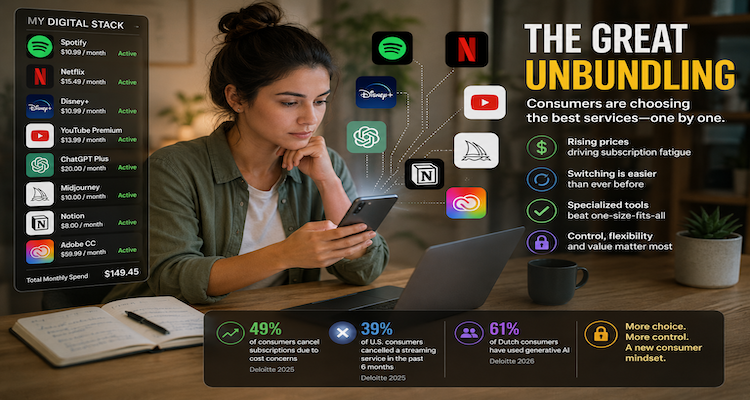
Recent subscription data illustrates the change. Deloitte’s 2025 Digital Consumer Trends research found substantial “rotational churn”: 25% of respondents had subscribed to a video service and 20% had cancelled one during the previous year. Among those who cancelled subscriptions, 49% cited excessive cost or spending too much on subscriptions.
That pattern matters because it describes a different relationship with digital services. The customer is no longer necessarily choosing one provider for the long term. Instead, many consumers are becoming portfolio managers of their own digital lives adding a service for a particular need, removing it when its value declines, and replacing it with something more suitable.
Unbundling is also happening inside the AI boom
The AI market adds an important dimension to this story. The traditional software bundle promised that one suite could cover most of a user’s needs. Generative AI has made experimentation dramatically easier.
A consumer might use one AI service for general research, another for image creation, a specialist tool for coding, and a different application for writing or transcription. A single provider can still be useful, but the assumption that the entire workflow must live inside one vendor’s environment is weaker when switching between tools is relatively easy.
Deloitte’s 2026 research into Dutch consumers provides a useful illustration of this behavior. It found that 61% of surveyed Dutch consumers had used generative AI, while many employees were also using external, often free, tools for work-related tasks. The finding does not prove that consumers are permanently abandoning integrated software suites. It does, however, show how quickly users will adopt alternatives when a specific tool appears useful.
This is one reason the AI era may accelerate unbundling. AI features can be copied across platforms, but specialized products can also improve rapidly around a narrow task. The consumer does not necessarily need one company to provide every capability. They need tools that work well enough together.
The economics of “good enough” integration
The deeper change is not simply a rebellion against large technology companies. Consumers still value integration. Music, messaging, cloud storage and device ecosystems are often more useful when their parts work together.
What is changing is the threshold.
An all-in-one platform once had a major advantage because connecting separate services could be difficult. Files would not synchronize. Data could be trapped. Accounts required repeated setup. Payments and identity systems were fragmented.
As APIs, cloud services, common standards and data-transfer tools have improved, the cost of assembling a personal technology stack has fallen in many categories. It is still inconvenient in some cases, and genuine switching costs remain, but consumers increasingly have alternatives.
European policy is reinforcing this direction. The European Commission’s first review of the Digital Markets Act, published in April 2026, said the regulation had contributed to new data-portability tools, choice screens and interoperability measures intended to give users more control and make digital markets more contestable. The Commission also highlighted developments involving alternative app stores, browsers and connected-device interoperability.
The significance is broader than any individual regulatory change: when leaving a platform becomes easier, companies must work harder to give users a reason to stay.
That does not eliminate the power of ecosystems. It changes the nature of competition inside them.
Streaming shows what the new consumer mindset looks like
Entertainment provides the clearest example because consumers can see the trade-offs in their monthly bank statements.
In Deloitte’s 2025 U.S. Digital Media Trends survey, 47% of respondents said they paid too much for the streaming services they used, while 41% said the content available was not worth the price. The survey reported that 39% had cancelled at least one paid streaming service during the previous six months, while 24% had cancelled and later renewed a service.
The Dutch picture is similarly dynamic. Deloitte’s survey of 2,000 consumers found that 25% of households had signed up for a video-streaming service during the previous year and 20% had cancelled one; price and the cumulative cost of subscriptions were among the stated reasons.
This is not a simple march toward fragmentation. In fact, companies are responding with new bundles, partnerships and ad-supported tiers.
That apparent contradiction is central to the story.
Consumers are not rejecting bundles. They are rejecting bundles that feel like poor value.
A package can still win when it saves money, removes meaningful complexity or combines services the customer genuinely wants. The vulnerable bundle is the one built on the assumption that consumers will keep paying merely because cancelling is inconvenient.
From platform loyalty to portfolio behavior
The most useful way to understand the trend is to stop thinking about “bundled” and “unbundled” as opposites.
The emerging model is more fluid.
A consumer may keep a core ecosystem for identity, payments or cloud storage while selectively choosing specialized products around it. They may rotate streaming subscriptions, maintain one preferred music service, experiment with several AI tools and abandon an app that no longer provides enough value.
This creates what might be called portfolio behavior.
Instead of asking, Which ecosystem am I joining?, consumers increasingly ask:
- Which service is best for this task?
- What am I actually using?
- Can I cancel and return later?
- How difficult is it to move my data?
- Does the bundle save money or simply make comparison harder?
- What am I giving up by staying?
The answer will differ by category. A tightly integrated smartphone ecosystem may still create substantial value. A collection of interchangeable AI applications may create far less lock-in.
That distinction matters for businesses. The same strategy cannot be applied everywhere.
Why companies should not confuse bundling with loyalty
Bundling can produce impressive customer-retention metrics because customers have more reasons to remain inside an ecosystem. But retention created by dependency is different from retention created by preference.
Regulation and better interoperability can weaken the first. Better products, clearer pricing and genuine service quality strengthen the second.
The challenge for platform companies is therefore becoming more precise: Which parts of the ecosystem are indispensable, and which parts are merely attached?
Consumers are increasingly capable of answering that question for themselves.
Spotify’s own filings, for example, show that large digital services continue to combine direct subscriptions with partnerships and bundled distribution rather than relying on a single purchasing model. As of December 31, 2025, Spotify reported 290 million Premium Subscribers and said some subscriptions were sold through partners, including telecommunications companies.
The lesson is not that bundling is failing. It is that successful digital businesses may need to support more flexible paths into and out of their services.
A consumer who can subscribe through a partner, use an ad-supported tier, cancel temporarily or return later may still remain economically valuable. The older idea of permanent, uninterrupted loyalty is becoming less realistic in markets where alternatives are only a few clicks away.
The risk of unbundling: choice can become another form of overload
There is a limit to the consumer-friendly interpretation of this trend.
More choice can produce its own problems. A fragmented technology stack can mean more passwords, privacy policies, bills, notifications and security risks. Specialized software can also create compatibility problems that an integrated platform solves automatically.
That is why a complete collapse of all-in-one platforms is unlikely.
Consumers do not necessarily want to become IT administrators for their own lives. They want selective integration: the ability to combine services when it is useful and separate them when it is not.
This may be the more durable outcome. The future is unlikely to belong entirely to giant bundles or to a universe of isolated specialist apps. Instead, the competitive advantage may increasingly belong to companies that combine three qualities:
- A strong standalone product
- Easy integration with other services
- Low-friction exit when the customer chooses to leave
The third point may seem counterintuitive. But making a service easier to leave can sometimes make customers more willing to try it—and less resentful about staying.
What consumers should watch next
The unbundling trend will be easiest to see in categories where three conditions converge: rising prices, low switching costs and specialized alternatives.
AI is a particularly important test case. As companies race to turn broad AI platforms into full ecosystems, users may simultaneously build collections of specialist tools around their specific needs.
Streaming will remain another laboratory. Consumers have already demonstrated a willingness to cancel and return, forcing providers to experiment with bundles, advertising and different pricing models.
Meanwhile, interoperability and portability rules in Europe could continue to alter the economics of switching. The European Commission says its DMA review found that the framework is already creating more choices and control, while also acknowledging that technical difficulties and enforcement questions remain.
The direction, therefore, should not be overstated. Consumers are not universally abandoning big platforms, and large ecosystems retain major advantages. But the old assumption that convenience automatically creates permanent loyalty is becoming harder to defend.
Conclusion
The great unbundling is not a mass escape from platforms. It is a renegotiation of the relationship between consumers and them.
For much of the digital economy’s growth, the winning strategy was to add another service, another subscription and another reason to stay inside the same ecosystem. Consumers are now responding with a more demanding calculation: Does this service earn its place?
That question may become increasingly important as AI expands the number of available tools, subscription costs accumulate and regulation lowers some barriers to switching.
The companies most likely to benefit will not necessarily be those that offer the biggest bundle. They may be the ones that understand a changing reality: consumers still want convenience, but they increasingly want the freedom to decide which conveniences are worth keeping.
The information presented in this article is based on publicly available sources, reports, and factual material available at the time of publication. While efforts are made to ensure accuracy, details may change as new information emerges. The content is provided for general informational purposes only, and readers are advised to verify facts independently where necessary.