









Why Are So Many People Tired All the Time? Exploring the Modern Energy Crisis
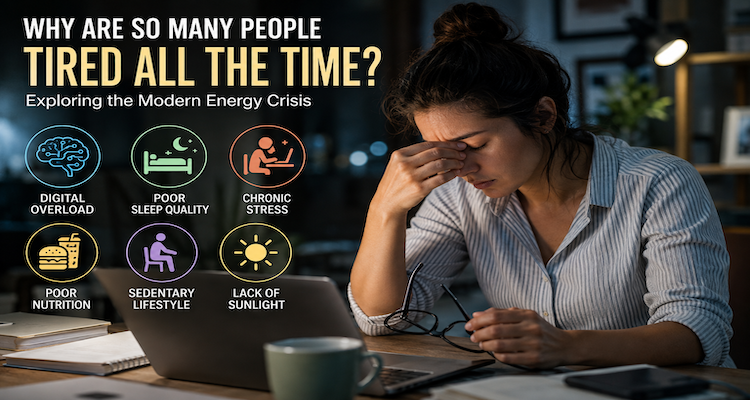
Feeling tired has become so common that many people treat it as a normal feature of adult life. The afternoon slump is met with another coffee. Exhaustion is explained away as a busy week. Sleeping poorly is postponed as a problem to solve later.
But persistent tiredness deserves a closer look.
The evidence does not support a single explanation for why so many people feel drained. Instead, the modern “energy crisis” is better understood as a convergence of pressures: insufficient or poor-quality sleep, schedules that conflict with biological rhythms, sedentary routines, stress and mental-health burdens, and in some cases medical conditions or medications that require proper evaluation.
Sleep data illustrate part of the problem. In the United States, 30.5% of adults reported sleeping less than seven hours in a 24-hour period in 2024, according to the National Center for Health Statistics. Yet hours in bed are only one part of the picture. Someone can spend what appears to be enough time sleeping and still wake unrefreshed because sleep quality, timing or an underlying disorder is interfering with restoration.
That distinction may be the most useful way to understand modern fatigue: tiredness is not always a simple shortage of energy. Sometimes it is a sign that the systems responsible for recovery are being disrupted—or that a health problem needs attention.
Key Takeaways
- Persistent tiredness can result from insufficient sleep, poor sleep quality, circadian disruption, lifestyle factors, stress or underlying medical conditions.
- In 2024, 30.5% of U.S. adults reported sleeping less than seven hours per 24-hour period.
- More time in bed does not automatically mean restorative sleep; sleep quality and timing also matter.
- Modern work and screen habits can interfere with biological cues that help regulate sleep and wakefulness.
- Regular physical activity supports sleep and health, while prolonged sedentary behavior is associated with poorer health outcomes.
- Ongoing or severe fatigue should not automatically be dismissed as “normal” and may warrant medical evaluation.
The first problem: tiredness is not one thing
People often use tired, fatigued, sleepy and exhausted interchangeably. Clinically and practically, however, they can point to different problems.
Daytime sleepiness can mean a person is prone to dozing off when they should be awake. Fatigue may feel more like depleted energy, reduced stamina or difficulty sustaining effort. Someone can experience both, but the distinction matters because the possible causes are not identical.
The U.S. National Heart, Lung, and Blood Institute describes sleep deficiency as broader than simply getting too few hours of sleep. It can involve sleeping at the wrong time, sleeping poorly, or having a sleep disorder that prevents restorative sleep. Sleep deficiency can affect concentration, reaction time, decision-making and emotional regulation, as well as physical health.
This is one reason generic advice to “just get more sleep” can be inadequate. The more useful question is: What is interfering with recovery?
A society built around tired schedules
For most adults, at least seven hours of sleep is generally recommended, although individual needs vary. Yet work schedules, caregiving responsibilities, commuting, multiple jobs and other demands can compress the time available for sleep.
The latest U.S. national data available from the National Center for Health Statistics found that 30.5% of adults had short sleep duration defined as less than seven hours on average in a 24-hour period in 2024.
The number is significant, but it should not be interpreted as proof that every tired person is simply undersleeping. It does show something more basic: for a large share of the population, obtaining the recommended minimum amount of sleep is already difficult.
There is also a structural issue. Sleep is often treated as the flexible part of the day the activity that can be shortened when work, entertainment, social obligations or family responsibilities expand. Biology does not necessarily cooperate.
The body’s sleep-wake cycle is influenced by both the pressure to sleep that builds during waking hours and an internal circadian clock that responds to environmental cues such as light and darkness. Bright artificial light late in the evening can interfere with signals that help prepare the body for sleep.
The important point is not that every screen is inherently harmful. The larger issue is that modern routines can extend activity and exposure to bright light into hours when the body may otherwise be preparing for rest.
The overlooked issue: sleep timing can matter as much as sleep duration
One of the weaknesses in popular discussions about tiredness is the assumption that sleep is simply a numerical target.
Seven hours from midnight to 7 a.m. is not necessarily equivalent, in practical terms, to fragmented sleep at irregular times. Shift work, frequent schedule changes and other disruptions can create a mismatch between when a person needs to be alert and when their internal body clock is promoting sleep.
The NHLBI notes that circadian rhythm disorders can produce excessive daytime sleepiness, extreme tiredness, reduced alertness and difficulty concentrating.
This creates a broader modern tension: many institutions operate according to fixed schedules, while human sleep biology is not infinitely adjustable.
That does not mean everyone needs the same bedtime or that ordinary variation is a medical problem. It means that “I slept for eight hours” does not always settle the question of why someone still feels exhausted.
Sedentary living creates another part of the puzzle
It may seem counterintuitive that moving less can coexist with feeling constantly exhausted. But physical activity and energy are not simply opposites.
The World Health Organization states that regular physical activity is associated with improved mental health, cognitive health and sleep, while increasingly sedentary lifestyles are linked with a range of poorer health outcomes.
Modern life often combines long periods of sitting with high levels of mental stimulation. A person may spend the day switching between meetings, messages, documents and notifications while barely moving from one physical position.
That combination can produce a subjective feeling of being “spent” without providing the physical activity that supports broader health and sleep.
This is not an argument that exercise is a universal cure for fatigue. Someone with unexplained or severe fatigue should not assume that pushing harder through exhaustion is the answer. But for people whose routines have become highly sedentary, restoring regular movement can be part of improving overall sleep and well-being.
Stress can drain attention even when the body is still
Another reason the modern fatigue problem is difficult to solve is that exhaustion is not always proportional to visible activity.
A person can spend an entire day sitting at a desk yet feel unable to think clearly by evening. Cognitive demands, emotional strain, constant task-switching and insufficient recovery can all contribute to the experience of depletion.
Sleep and mental health also interact. Sleep deficiency can affect emotional regulation and has been linked with depression and other health problems, but these relationships are complex and do not mean poor sleep alone causes every mental-health condition.
The practical consequence is important: a tired person may be dealing with more than one reinforcing problem. Stress can interfere with sleep; poor sleep can impair concentration and emotional resilience; reduced activity can further disrupt healthy routines. The result can feel like a permanent lack of energy even when no single day appears especially demanding.
This is why simplistic explanations often fail.
Sometimes persistent fatigue is a medical signal
A culture that normalizes exhaustion carries a risk: people may overlook symptoms that deserve medical attention.
Persistent daytime sleepiness, waking unrefreshed despite apparently adequate sleep, loud or frequent snoring, waking gasping or short of breath, or repeatedly dozing during routine activities can be reasons to discuss sleep and health with a medical professional. The NHLBI notes that clinicians may evaluate sleep habits, possible sleep disorders and other health conditions; testing may sometimes include assessment for conditions such as sleep-related breathing disorders.
Other medical conditions can also contribute to fatigue. The appropriate evaluation depends on the person’s symptoms and circumstances, which is why a general article cannot determine the cause for an individual.
The most important distinction is between occasional tiredness which is common and fatigue or sleepiness that is persistent, worsening, unexplained or interfering with daily life.
That is especially important when tiredness creates safety risks. Sleep deficiency can impair reaction time and increase the likelihood of mistakes and accidents.
The modern energy crisis is also a recovery crisis
The phrase “energy crisis” can suggest that people are simply overworked. The evidence points to a more complicated picture.
Modern routines can create several forms of interference at once:
- Too little time allocated to sleep.
- Sleep occurring at irregular or biologically inconvenient times.
- Evening light exposure and habits that delay bedtime.
- Sedentary routines that reduce daily physical activity.
- Stress and cognitive overload that make recovery more difficult.
- Undiagnosed sleep disorders or other health problems.
These factors do not affect everyone equally. A shift worker, a caregiver, a student with an early schedule, a person managing a chronic condition and someone with a conventional daytime office job may all say they are “tired,” while facing very different causes.
That is why treating tiredness as a single lifestyle problem can be misleading. The better model is cumulative: small deficits and disruptions can overlap, and the resulting exhaustion may have more than one source.
What can people realistically examine first?
For persistent but non-emergency tiredness, a useful starting point is observation rather than self-diagnosis.
The NHLBI recommends considering sleep patterns, daytime alertness and related habits, and notes that a sleep diary can help document when someone sleeps, wakes, naps and how rested or sleepy they feel.
Questions worth examining include:
- Am I regularly getting enough sleep for my needs?
- Is my sleep schedule highly inconsistent?
- Do I wake feeling restored, or exhausted?
- Do I unintentionally doze off during the day?
- Have I noticed loud snoring, gasping or other disrupted breathing during sleep?
- Has my level of tiredness changed significantly?
- Is fatigue affecting work, driving or everyday functioning?
- Have changes in stress, medication, health or routine coincided with the problem?
The answers can help distinguish a habit that may be adjusted from a pattern that deserves professional assessment.
The larger lesson: exhaustion should not become the default measure of a productive life
There is a cultural temptation to treat constant tiredness as evidence of commitment. A full calendar, late-night work and the ability to function on little sleep can be framed as discipline or ambition.
Biology is less impressed by the performance.
The growing visibility of exhaustion may partly reflect a simple mismatch between human recovery needs and routines designed to keep people available, connected and productive for more of the day. The newest U.S. sleep data do not prove that society is universally becoming more exhausted, but they do confirm that short sleep remains common: nearly one in three adults reported fewer than seven hours of sleep in 2024.
The more useful response is neither panic nor resignation. Tiredness is sometimes temporary. Sometimes it reflects habits that can be changed. Sometimes it points to a sleep disorder, another medical issue or a combination of factors.
What should be reconsidered is the assumption that persistent exhaustion is simply the price of modern life.
Conclusion
The modern energy crisis is not a single crisis with a single culprit. It is a recovery problem shaped by sleep quantity, sleep quality, biological timing, sedentary routines, stress and, for some people, underlying health conditions.
The practical lesson is straightforward: persistent tiredness should be investigated, not automatically normalized. Better sleep habits and regular movement can support health, but unexplained or disruptive fatigue may require medical evaluation. The goal is not to turn every tired afternoon into a health scare. It is to stop treating chronic exhaustion as proof that modern life is working normally.
This article is provided for general informational and educational purposes. It is not medical advice, diagnosis, or a substitute for consultation with a qualified healthcare professional. Health evidence can change, and individual circumstances vary.