










The Hidden Cost of Sitting: What Happens to the Body When We Stay Inactive
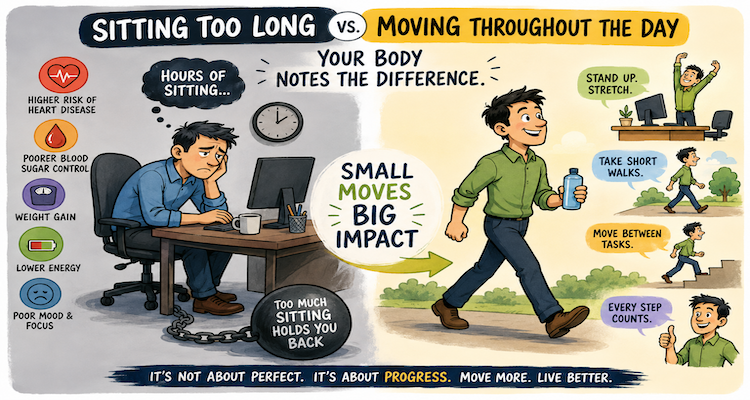
A long day at a desk can feel harmless because sitting is effortless. But the body does not experience prolonged inactivity as simply “rest.”
Hours spent seated can mean less muscular activity, lower overall energy expenditure and long, uninterrupted periods with very little movement. Over time, higher amounts of sedentary behaviour are associated with poorer health outcomes, including higher risks of cardiovascular disease, type 2 diabetes and premature death. The important distinction, however, is that sitting and physical inactivity are related but not identical. A person can exercise regularly and still spend much of the day sitting, while another may not follow a formal exercise routine but accumulate substantial movement through walking, work or daily life.
That distinction changes how we should think about the modern sitting problem. The evidence does not support a simple idea that one hour of exercise can automatically erase every consequence of an otherwise motionless day. Nor does it establish a universal number of sitting hours that suddenly becomes dangerous. What matters is the broader movement pattern: how much we sit, how physically active we are overall, and whether long sedentary stretches are interrupted.
Key Takeaways
- Higher amounts of sedentary behaviour are associated with poorer cardiovascular, metabolic and mortality outcomes.
- Exercise and sitting are not opposites; a person can meet exercise guidelines and still spend much of the day sedentary.
- Replacing sedentary time with movement, including light activity, can provide health benefits.
- Experimental studies suggest brief walking breaks can improve short-term post-meal glucose and insulin responses.
- Standing may be useful for reducing sitting, but evidence suggests movement can produce stronger metabolic effects than simply changing posture.
- There is no single evidence-based daily sitting limit that applies equally to everyone.
Sitting Is a Distinct Behaviour, Not Simply the Absence of Exercise
Public-health discussions often divide people into two groups: those who exercise and those who do not. Sedentary behaviour makes that picture more complicated.
The World Health Organization defines sedentary behaviour in adults as waking behaviour involving sitting or reclining with low energy expenditure. This includes desk work, commuting, television viewing and other seated activities. Physical activity, meanwhile, includes movement across many parts of life not only structured exercise, but also walking, cycling, work and household activity.
This means a person can complete a morning workout and still spend the following eight or nine hours almost entirely seated.
That does not make the workout meaningless. Regular physical activity has substantial and well-established health benefits. The more useful interpretation is that a daily movement pattern has multiple components. Exercise matters. Total sedentary time matters. The way sedentary time is accumulated may matter as well.
For adults, WHO recommends at least 150 to 300 minutes of moderate-intensity aerobic activity per week, or 75 to 150 minutes of vigorous activity, alongside muscle-strengthening activity on two or more days per week. It also recommends limiting sedentary time and replacing it with physical activity of any intensity, including light activity.
What Prolonged Inactivity Can Affect
The strongest population-level evidence concerns associations between greater sedentary time and adverse health outcomes.
WHO’s evidence review concluded that higher amounts of sedentary behaviour in adults are associated with all-cause mortality, cardiovascular and cancer mortality, and the incidence of cardiovascular disease, cancer and type 2 diabetes. These findings should be interpreted carefully: much of this evidence comes from observational research, which can identify patterns but cannot always prove that sitting itself directly causes every outcome. Health status, diet, socioeconomic factors and overall activity levels can also influence risk.
Still, the biological question is not purely theoretical. Experimental studies have examined what happens when prolonged sitting is interrupted.
A randomized crossover trial involving overweight and obese adults found that interrupting sitting with two minutes of light- or moderate-intensity walking every 20 minutes reduced post-meal glucose and insulin responses compared with uninterrupted sitting.
Another randomized study in inactive middle-aged men found that brief, repeated bouts of light walking improved glucose and insulin responses compared with sustained sitting. In that study, simply standing for the same short intervals did not produce the same main metabolic effects.
These studies do not prove that taking a short walk every 20 or 30 minutes will prevent diabetes or cardiovascular disease. They do show something more specific: interrupting prolonged sitting with actual movement can produce measurable short-term changes in metabolic responses.
That distinction is important because many workplace strategies focus on posture such as standing desks when the broader physiological issue may be movement itself.
Why Movement Breaks May Matter More Than We Assume
One of the most useful lessons from sedentary-behaviour research is that reducing sitting does not necessarily require replacing every seated hour with a gym workout.
Light movement can matter.
WHO explicitly states that replacing sedentary time with physical activity of any intensity can provide health benefits. That makes everyday choices more relevant than the traditional divide between “exercise” and “no exercise.”
Depending on a person’s circumstances, replacement might include:
- Walking during part of a phone call.
- Taking a short movement break between periods of focused work.
- Walking part of a commute.
- Getting up to perform routine tasks rather than accumulating them for later.
- Taking stairs when appropriate and practical.
- Adding short walks before or after meals.
The evidence does not justify prescribing one universal break schedule. WHO concluded that there was insufficient evidence to establish a precise, time-based recommendation for how frequently or how long people should interrupt sedentary behaviour.
That uncertainty is worth preserving. Popular advice such as “move for five minutes every hour” may be a reasonable behavioural strategy, but it should not be presented as a medically established threshold for everyone.
Can Exercise Offset a Sedentary Day?
This is where the conversation becomes more nuanced.
A large harmonised meta-analysis involving more than one million participants examined the relationship between sitting time, physical activity and mortality. The researchers found that higher levels of moderate-intensity physical activity roughly 60 to 75 minutes per day in the study’s highest activity groups appeared to substantially reduce or eliminate the increased mortality risk associated with high sitting time in the analysed data.
The finding is encouraging, but it should not be simplified into a slogan that “75 minutes of exercise cancels sitting.”
The study examined mortality associations across population groups and relied largely on self-reported behaviour. It does not mean that every physiological effect of prolonged sitting disappears after a specific amount of exercise, or that everyone needs exactly the same volume of activity.
The broader lesson is more practical: physical activity can substantially modify the relationship between sedentary behaviour and health.
That is also consistent with WHO guidance, which advises highly sedentary adults to aim for more than the minimum recommended levels of moderate-to-vigorous physical activity to help reduce the detrimental effects associated with high sedentary time.
The question, then, is not whether exercise or less sitting matters. Both are part of the equation.
The Modern Problem Is Often the Accumulation of Stillness
The sitting issue has become particularly relevant because modern routines can stack sedentary activities on top of one another.
A person may sit during a commute, sit at a computer for work, sit while eating, sit during entertainment and then return to a seated position for leisure. None of those activities is inherently harmful in isolation. The problem is the cumulative pattern.
This creates an overlooked challenge for people who consider themselves active because they exercise several times a week. A 30- or 60-minute workout remains valuable, but it may represent only one part of a much longer waking day.
The more useful goal is therefore not to pursue an unrealistic “zero sitting” lifestyle. Sitting is a normal human behaviour and, for many jobs and circumstances, unavoidable.
The objective is to avoid treating a single workout as the only movement that counts.
A More Realistic Strategy: Design the Day Around Movement
For many people, the most sustainable response is behavioural rather than extreme.
Instead of asking, “How can I stop sitting?” a better question may be: Where can movement naturally replace some of my sitting?
A practical framework could include three layers:
1. Protect regular exercise
Meeting established physical-activity recommendations remains an important foundation. Adults who can safely do so should work toward regular aerobic activity and muscle-strengthening exercise consistent with WHO guidance.
2. Reduce unnecessary sedentary time
Not every seated activity can be replaced, but some can. A short walk, an errand on foot or standing to perform a simple task can add movement without requiring a separate exercise session.
3. Interrupt long periods of uninterrupted sitting
Experimental evidence suggests that movement breaks can influence short-term metabolic responses, particularly after meals. Walking appears more consistently beneficial in these trials than merely standing, although the studies are relatively small and their findings should not be treated as a universal prescription.
For people with medical conditions, mobility limitations or other health concerns, appropriate activity levels may differ. Individual medical advice should come from a qualified healthcare professional.
The Bigger Lesson: Health Is Shaped by the Whole Day
The hidden cost of sitting is not that a chair is inherently dangerous. The deeper problem is the way modern life can compress movement into a small portion of the day while leaving the remaining hours remarkably still.
Research increasingly supports a more complete view of physical behaviour. Health is influenced not only by whether we exercise, but by the larger pattern of activity surrounding that exercise.
That makes the solution less dramatic and potentially more achievable. A gym session remains valuable. So does a walk. So does replacing some sedentary time with light activity. And when long periods of sitting are unavoidable, introducing movement may be more meaningful than simply changing from one stationary posture to another.
The goal is not to eliminate sitting. It is to make sure sitting does not become the dominant behaviour around which the rest of the day is built.
Conclusion
The evidence on sedentary behaviour has moved beyond the simplistic message that sitting is merely “the new smoking.” That comparison is more dramatic than scientifically useful.
What the research supports is a more nuanced conclusion: higher sedentary time is associated with important health risks, regular physical activity can substantially reduce those risks, and replacing prolonged stillness with movement is likely to be beneficial.
For most people, the practical implication is not a radical lifestyle overhaul. It is a shift in perspective. Exercise should remain a priority, but movement should not begin and end with a scheduled workout. The health value of a day may depend partly on what happens in all the hours in between.
This article is provided for general informational and educational purposes. It is not medical advice, diagnosis, or a substitute for consultation with a qualified healthcare professional. Health evidence can change, and individual circumstances vary.