









From Fan Fiction to Blockbusters: How Online Communities Are Changing Storytelling
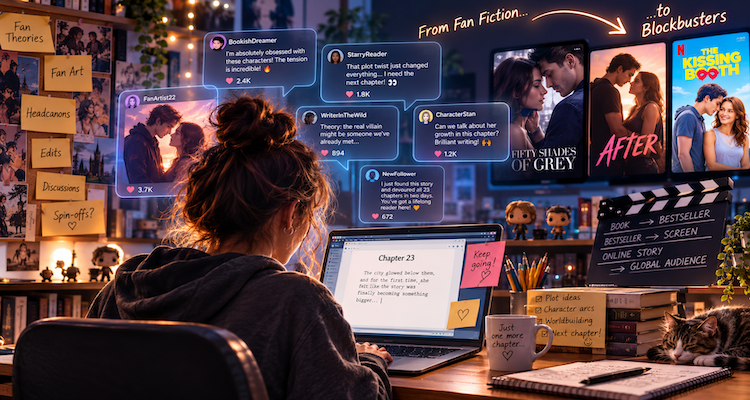
Stories increasingly begin in public. A writer posts a chapter online, readers respond, theories spread, characters gain devoted followings, and a work that once existed inside a digital community can move into publishing, television or film. The result is changing more than where stories are discovered. It is changing how audiences participate in the development, interpretation and commercial life of fiction.
Key Takeaways
- Online storytelling communities increasingly function as informal laboratories where writers test ideas, receive feedback and build audiences before traditional gatekeepers become involved.
- Fan fiction and serialized web fiction have helped weaken the old distinction between audience and creator by making interpretation and creation part of the same ecosystem.
- Success stories such as Fifty Shades of Grey, After and The Kissing Booth show how digitally born communities can become part of publishing and screen-development pipelines.
- Community engagement can reveal demand, but popularity metrics are not the same as editorial quality or a guaranteed formula for commercial success.
- AI adds a new tension: creative communities may experiment with generative tools while also questioning authorship, consent and the value of human participation.
From the audience to the creative process
The traditional model of storytelling placed a fairly clear distance between creators and audiences. Writers wrote. Publishers selected. Studios produced. Audiences bought, watched and reviewed the finished work.
Online communities have complicated that sequence.
Fan fiction sites, web-fiction platforms, forums and social networks allow stories to develop in public. A chapter can attract comments before the next one is written. Readers can debate character motivations, request particular relationships, identify inconsistencies or simply encourage an author to continue. The author remains the author, but storytelling can become an iterative process shaped by an active community around the work.
Research into online fan-fiction communities has documented the importance of feedback, participation and community support in sustaining creative activity. A 2024 study published in the Journal of Cultural Economics, using data from a major fan-fiction platform, found evidence that community feedback can encourage first-time contributors to continue publishing, while also showing that the effects of feedback differ among writers and are more complex than a simple “more comments equals better writing” formula.
That distinction matters. Online communities do not democratically “write” every successful story. What they often provide is something closer to a permanent, informal creative environment: readers, critics, collaborators, archivists and fellow enthusiasts are present while the work is still evolving.
A 2025 study of fan-fiction communities describes this broader environment as one in which reading, writing, commenting and other forms of participation are interconnected rather than neatly separated.
The deeper change, then, is not simply that the internet has made it easier to publish fiction. It has changed the timing of audience involvement. Readers no longer have to wait until a story is finished before becoming part of its cultural life.
Fan fiction became a proving ground, not just a hobby
Fan fiction has often been dismissed as a derivative activity existing outside “serious” literary culture. That view overlooks what these communities actually teach and produce.
Writing fan fiction requires creators to work with characterization, dialogue, narrative continuity, genre conventions and audience expectations. It also exposes writers to immediate reader response. Communities develop their own systems of tagging, recommendation, feedback and discovery, allowing readers to find increasingly specific forms of storytelling.
Researchers have argued that these networked practices deserve to be understood as significant forms of composition rather than merely peripheral creative activity. A 2025 paper in Computers and Composition examines fan fiction as a social genre shaped by ongoing interaction between writers, readers and online communities, arguing that these spaces can disrupt traditional assumptions about how texts are created and circulated.
That helps explain why fan communities have become culturally important even when individual works never cross into mainstream publishing.
They are training grounds in the broadest sense—not formal writing schools, but environments where creators learn through repetition, observation and feedback. A study in the Journal of Transformative Works and Cultures describes how participation can develop gradually, with less-active members observing established contributors before becoming more active themselves. The researchers describe this process as a form of “incidental mentorship” created through the community’s structure and examples.
The important insight is that participation itself has become part of the infrastructure of storytelling.
When community momentum reaches Hollywood
The path from online writing to mainstream entertainment is no longer unusual enough to be treated as a novelty, although spectacular success stories remain exceptions rather than guarantees.
One of the most prominent examples is E. L. James’s Fifty Shades of Grey. The work developed from Master of the Universe, a Twilight-inspired fan-fiction project published online before being substantially reworked into original fiction. The series moved through independent and traditional publishing and eventually became a major film franchise. Contemporary reporting and publishing-industry accounts documented both its fan-fiction origins and the speed with which existing reader momentum attracted commercial attention.
Another route emerged through serialized platforms. Anna Todd’s After began as a serialized story on Wattpad before becoming a bestselling book series and then a screen franchise. The production company Voltage Pictures described the first film as an adaptation of Todd’s five-book series that had started as a serialized story on the fan-sharing platform.
Beth Reekles’s The Kissing Booth followed another digital-to-screen trajectory. Netflix described its film adaptation as based on Reekles’s self-published coming-of-age novel, and later official material confirmed that the film became a multi-installment franchise.
These cases are different, but together they reveal an important shift in the entertainment pipeline.
A traditional pitch asks an industry gatekeeper to imagine an audience.
A digitally successful story can arrive with evidence that an audience has already begun to form.
That does not eliminate the work of editors, agents, producers or screenwriters. Online popularity cannot automatically determine whether a story can survive professional editing, legal scrutiny, adaptation or the economics of film production. But community momentum can change the conversation around risk.
The new value of a built-in audience
For publishers and studios, online communities can provide something that the traditional development process has often struggled to predict: visible engagement.
A story may have comments, followers, fan art, recommendations, discussion threads and a recognizable community before it ever reaches a traditional publisher or production company. Those signals are imperfect, but they can make an unknown creator easier to notice.
This is where the business implications become particularly interesting.
The value is not simply “lots of readers.” A community can also reveal how people are responding.
Are readers attached to a particular character? Do they return after each installment? Which relationships generate discussion? Is the audience concentrated around a niche that traditional market research has overlooked?
These questions turn online communities into a form of cultural signal detection.
However, there is an important limitation: engagement data can be misleading when treated as a substitute for editorial judgment. A highly engaged community may be too small to support a major commercial release. Platform algorithms can distort visibility. Existing fans may not represent the broader audience required for a theatrical or global streaming release.
The smarter interpretation is not that online popularity has replaced gatekeepers.
It is that gatekeepers now operate alongside visible communities that can demonstrate demand before a traditional deal is signed.
Storytelling is becoming more iterative
The influence of online communities extends beyond stories that become commercial hits.
Digital storytelling has encouraged a more iterative relationship between publication and response. The chapter-by-chapter format of web fiction, for example, creates opportunities for audience reaction while a larger narrative is still in progress.
This changes the psychology of authorship.
The writer can still reject audience expectations. In fact, preserving creative independence may be essential. But the audience is no longer necessarily a distant, silent entity represented only by eventual sales figures or professional reviews.
It is present.
Adaptation and media scholars have connected this development to broader changes in participatory culture and transmedia storytelling. Research published by Adaptation notes how digital and social media have increased the involvement of fan communities and complicated older distinctions between creation, reception and reproduction across media platforms.
This does not mean every story should become an interactive product. Some narratives benefit precisely from the distance between author and audience. Constant feedback can also create pressure to repeat popular elements, satisfy fan demands or avoid creative risks.
Community influence, therefore, can be both productive and restrictive.
The challenge for creators is not to obey the audience. It is to understand what audience participation can reveal without allowing popularity to become the sole measure of artistic value.
The overlooked role of online communities: preservation and interpretation
Another consequence receives less attention than the blockbuster pipeline.
Fan communities do not merely create stories. They preserve, categorize and interpret them.
Tags, archives, recommendation systems and discussion threads create an alternative cultural record around a work. Communities remember minor characters, abandoned plotlines and interpretations that may never appear in official criticism.
A 2025 study of Archive of Our Own (AO3) characterized fan-fiction communities as forms of digital heritage communities, arguing that their shared creative and participatory practices can function as a cultural commons built around born-digital works.
That perspective broadens the discussion considerably.
If a fan community creates thousands of stories around an existing fictional universe, the result is not simply a collection of unofficial spin-offs. It is also an evolving record of how a particular generation of readers understood, questioned and reimagined the original.
For media companies, that creates both opportunity and tension.
Fan creativity can deepen the cultural life of an intellectual property. At the same time, copyright law and commercial ownership do not automatically align with the expectations of communities built around transformative works.
The relationship between corporations and fans is therefore neither purely collaborative nor purely adversarial. It is an ongoing negotiation over ownership, participation and creative boundaries.
AI is adding a new complication
Generative AI introduces another layer to this transformation.
Online creative communities are already places where people experiment with new technologies. But AI raises questions that are especially sensitive in fan-fiction ecosystems because so much of their culture is built around voluntary contribution, attribution and community recognition.
A 2025 study examining fan-fiction communities and generative AI found a mixed response: participants saw possible creative benefits but also expressed concerns about authenticity, ethics, transparency and the potential erosion of human-centered community values.
The central issue may not be whether AI can generate text.
It clearly can.
The harder question is what happens when the social relationship around storytelling changes. If communities are valuable partly because writers receive recognition, feedback and a sense of connection, automated content may increase the volume of material without reproducing the human relationships that made the community meaningful in the first place.
There are also unresolved concerns around training data, consent and attribution.
For this reason, the future of online storytelling may not simply involve “more AI-generated stories.” A more consequential development could be a growing distinction between content generation and creative community.
The first can be automated to varying degrees.
The second depends on trust, norms, relationships and the willingness of people to participate.
What the shift means for writers and entertainment companies
The changing landscape produces different opportunities for different participants.
For writers
Online communities can provide:
- A low-barrier path to publishing and experimentation.
- Immediate access to reader response.
- Opportunities to develop a niche audience.
- A deeper understanding of genre expectations and reader behavior.
- A public record of engagement that may help demonstrate demand.
But writers also need to understand the risks. Publishing online can complicate later commercial plans depending on platform terms, rights arrangements and the nature of the material. Fan fiction involving existing intellectual property also raises legal and commercial issues that differ from publishing wholly original work.
For publishers and studios
Online communities have expanded the range of places where talent and audience interest can emerge.
The most valuable signal may not be raw scale. A smaller but intensely engaged community can sometimes reveal a storytelling niche that conventional development processes would overlook.
The risk is becoming too dependent on metrics.
If every acquisition is based on visible engagement, the industry could increasingly favor creators who already understand platform dynamics while overlooking excellent work that develops outside highly measurable online spaces.
For audiences
The line between consumer and participant is becoming less rigid.
Readers can become reviewers, archivists, collaborators, critics and eventually creators themselves. The cultural consequence is significant: stories no longer end when audiences receive them. In networked spaces, reception can become the beginning of another cycle of creation.
Conclusion
The journey from fan fiction to books, streaming franchises and blockbuster films is only the most visible sign of a larger transformation.
Online communities have changed storytelling because they have changed the relationship between stories and their audiences. A narrative can now gather readers while unfinished, evolve inside discussion, generate new interpretations and build cultural momentum before traditional entertainment institutions become involved.
That does not mean the crowd has replaced the author, or that engagement has replaced editorial judgment. The strongest lesson is more nuanced.
The future of storytelling may belong neither to creators working alone nor to audiences directing every narrative decision. It may increasingly be shaped by the space between them: the communities where people read, respond, reinterpret, recommend and occasionally turn participation into the next story.
For publishers and studios, those communities are becoming places to discover talent and demand. For writers, they offer new routes into public creative life. And for audiences, the old role of simply waiting for the next story is becoming harder to define.
The reader is increasingly part of what happens before, around and after the story itself.
This content is published for informational or entertainment purposes. Facts, opinions, or references may evolve over time, and readers are encouraged to verify details from reliable sources.