










Food Nostalgia: Why Childhood Flavors Stay With Us for Life
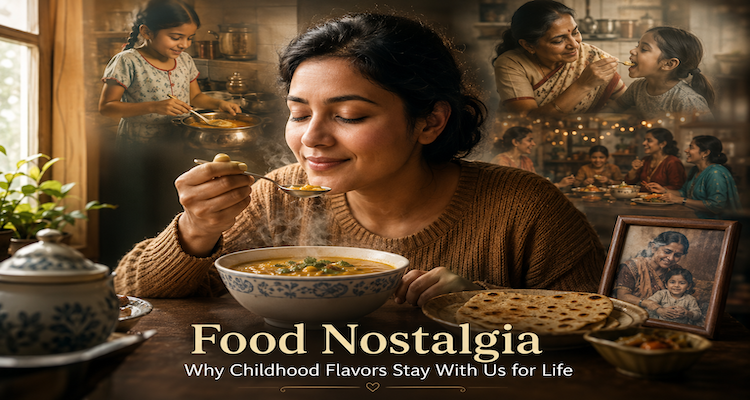
A childhood flavor can survive decades of change. A particular soup, biscuit, fruit, spice blend, or festival sweet may suddenly make an adult feel as if distance and time have briefly collapsed. The reaction is often described as nostalgia, but the experience is more than simple sentimentality: research on memory, smell, taste and autobiographical recall helps explain why food can become such a durable cue for personal history.
What makes food especially powerful is that it rarely arrives in memory alone. A remembered dish may also carry the atmosphere of a family kitchen, a school lunch, a holiday, a grandparent, a place once called home, or a period of life that can no longer be revisited. That makes food nostalgia both a scientific question about memory and a cultural question about how people preserve identity through everyday rituals.
Key Takeaways
- Childhood foods become powerful memory cues because flavor combines taste, smell, emotion, place and repeated personal experience.
- Research suggests odors can be especially effective at evoking older autobiographical memories, including memories from early childhood.
- Food nostalgia is not always about the food itself; social relationships and the circumstances surrounding eating are often part of what is remembered.
- Recent research indicates that nostalgic food experiences can increase feelings of comfort partly through social connectedness.
- Nostalgia can be positive, but a familiar food may also evoke grief, loss or ambivalent memories, depending on personal experience.
Why a Childhood Flavor Can Feel Like Time Travel
The experience is often called the Proust effect, after Marcel Proust’s famous literary description of a taste cue unlocking childhood memories. Modern research has investigated the broader phenomenon of sensory cues especially odors triggering autobiographical memories.
One reason food is such a rich trigger is that what people casually call “taste” is actually a multi-sensory experience. Flavor can involve the basic tastes detected in the mouth, aromas perceived through the olfactory system, texture, temperature and other sensory qualities. Those sensations are experienced within a particular context: a family meal, a birthday, a religious celebration, a school break or an ordinary afternoon at home.
The memory, therefore, is rarely stored in the mind as a simple record of how a dish tasted. A particular flavor can become a cue connected to a larger personal episode.
Research reviewed in Psychological Bulletin & Review has found that autobiographical memories triggered by odors can differ from memories prompted by words or pictures. Earlier studies have often found that odor-cued memories are older and can be associated with a stronger feeling of being mentally transported back in time.
That helps explain why the smell of frying spices, baking bread or a particular fruit can sometimes produce an unexpectedly vivid reaction before a person has consciously identified what it reminds them of.
The Food Is Only Part of the Memory
A common explanation of food nostalgia focuses on the sensory power of smell and taste. That explanation is important, but incomplete.
A bowl of soup may matter because it was served during winter holidays. A sweet may be inseparable from a grandparent. A snack may recall school friends, a neighborhood shop or a family that has since changed or dispersed. In these cases, the food acts less like an isolated object and more like a retrieval cue.
This distinction matters because it explains why two people can have entirely different reactions to the same food.
For one person, a dish may represent safety and family. For another, it may be associated with illness, obligation or a difficult period. Nostalgia is personal because the associations surrounding food are personal.
Research on food-evoked nostalgia has found that nostalgic foods tend to be highly autobiographically relevant and familiar. In experimental studies, food was also shown to be capable of eliciting nostalgia and was associated with psychological outcomes including positive affect, self-esteem, social connectedness and meaning in life. These findings describe relationships and measured effects within the studies; they should not be interpreted to mean that any nostalgic food will reliably produce the same benefits for every person.
Why Childhood Seems to Have Such a Strong Hold
Childhood is not automatically the “best” period of life, and food nostalgia should not be treated as proof that the past was happier. But early experiences can acquire lasting significance because they are repeated and embedded in routines.
Consider the foods that recur during childhood:
- breakfast prepared in the same kitchen;
- meals associated with festivals or holidays;
- dishes made by particular family members;
- treats linked to birthdays and celebrations;
- foods connected to a hometown or community.
Repetition can strengthen familiarity, while emotionally meaningful occasions give the experience additional personal significance. Years later, encountering the same or a closely similar sensory cue may reactivate part of that network of associations.
Studies of autobiographical odor memory have repeatedly reported an early-life pattern in which odor cues can bring back memories from childhood, although the exact distribution of recalled memories varies across studies and depends partly on the cues researchers use. More recent work has also cautioned against treating the phenomenon as a simple rule that smells always evoke more emotional or earlier memories than every other type of cue.
That nuance is important. The science supports the idea that smell can be a distinctive autobiographical memory cue. It does not support the oversimplified claim that every smell is a direct shortcut to childhood.
Smell, Taste and the Memory of Flavor
The connection between food and memory is often described as if taste alone were responsible. In practice, flavor is more complicated.
Taste and smell interact, and the recognition of a familiar food depends heavily on the combined sensory experience. Research on taste and odor memory also points to the importance of prior experience and emotional learning in how flavors are recognized and remembered.
This helps explain a familiar disappointment: a person may carefully recreate a childhood recipe and discover that it does not quite produce the expected emotional effect.
The ingredients may be nearly identical, but the original experience included much more:
- the kitchen and its smells;
- the people who were present;
- the age and circumstances of the person eating;
- the anticipation of the meal;
- the ritual surrounding it.
The remembered flavor is therefore partly sensory and partly autobiographical. Trying to reproduce only the recipe may reproduce the dish without reproducing the original moment.
Food Nostalgia Can Create Comfort Through Connection
Why do people often turn toward familiar foods during periods of stress, transition or homesickness?
One possible answer lies in the social meaning attached to those foods. A 2025 study examining food nostalgia and comfort found that nostalgia associated with food was linked with comfort, and its experimental findings suggested that social connectedness played an important role in how nostalgic food experiences increased feelings of comfort.
The broader implication is that comfort may not come solely from calories, sweetness, richness or familiarity. Sometimes the comforting element is symbolic: the food represents a relationship, a place or a period when a person felt connected to others.
This also helps explain why food traditions can remain important after people migrate, move away from family or experience major changes in their lives. Recreating a familiar dish may be a practical way of preserving continuity.
The meal becomes a small form of cultural and personal memory.
The Cultural Side of a Personal Memory
Food nostalgia is intensely individual, but it can also connect private memory with collective identity.
Recipes often travel through families and communities without being preserved in formal documents. Measurements may be approximate. Ingredients may change when people move to a new country. A dish may acquire several regional versions. Yet the emotional importance of the food can survive these changes.
This creates an interesting tension: people often describe nostalgic food as something that must taste “exactly like it used to,” even though recipes and memories are not perfectly stable.
Memory is reconstructive, not a video recording. What someone remembers as the definitive version of a childhood dish may reflect sensory experience, later repetition, family storytelling and the emotional importance the food has acquired over time. That does not make the nostalgia false. It means that the remembered meaning of food can evolve along with the person.
For culture, this has a practical consequence. A recipe can preserve more than cooking instructions. It can preserve stories about migration, family roles, festivals, local ingredients and changing ways of life.
Why Brands and Restaurants Understand the Power of Familiarity
Food nostalgia also has a business dimension.
Restaurants, packaged-food companies and marketers frequently draw on retro packaging, discontinued products, childhood snacks and familiar recipes because consumers do not evaluate food only through price and ingredients. Familiarity and personal associations can influence how a product is perceived.
But nostalgia is not a universal formula.
A product associated with childhood for one generation may mean nothing to another. A recipe marketed as “traditional” may appeal to consumers seeking continuity while alienating those who see the claim as inaccurate. And attempts to commercialize memory can feel hollow when the product lacks the sensory or cultural details that made the original meaningful.
The lesson is that nostalgia works best when familiarity has genuine substance behind it. A label can reference the past, but it cannot automatically create a personal memory.
The Limits of Food Nostalgia
Nostalgia should not be romanticized as universally beneficial.
A familiar food can evoke sadness after bereavement, discomfort connected to difficult experiences, or ambivalence about a past that was meaningful but imperfect. Research on sensory autobiographical memory also shows that results can vary depending on the cue, the study design and the individual’s associations.
Nor should food nostalgia be confused with nutritional value. A dish can be emotionally significant without being something a person should eat frequently or in large quantities. The psychological meaning of a food and its nutritional profile are separate questions.
The most useful way to understand food nostalgia, then, is not as proof that childhood food was objectively better. It is evidence that eating is often woven into the structure of personal life.
Conclusion
Childhood flavors stay with us because food is rarely experienced as food alone. A smell or taste can carry traces of place, routine, relationships and emotion, making it an unusually rich cue for autobiographical memory.
The deeper lesson is that nostalgia does not live inside a recipe. It emerges from the relationship between a sensory experience and a life that has been lived around it. That is why the same dish can mean comfort, celebration, longing or grief and why reproducing an old recipe can sometimes feel like recovering a small piece of the past, even when the past itself cannot be recreated.
For readers, the next nostalgic meal may be worth considering differently. Instead of asking only, Why does this taste so familiar?, the more revealing question may be: What else arrived with the flavor?
This content is published for informational or entertainment purposes. Facts, opinions, or references may evolve over time, and readers are encouraged to verify details from reliable sources.