










The Science of Spice: Why Humans Learn to Love Hot Food
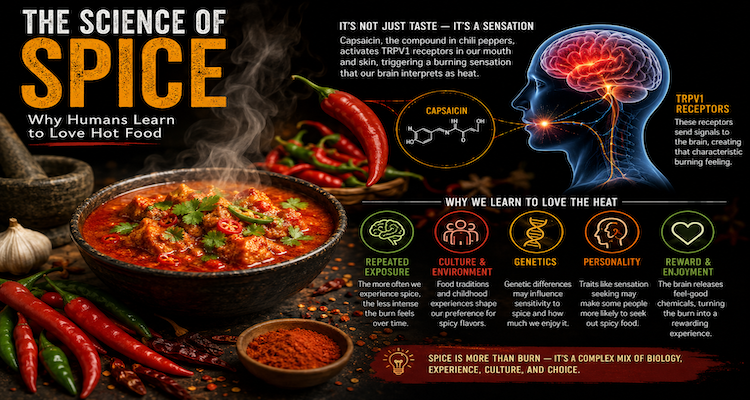
A bite of chili can make the eyes water, the nose run and the mouth feel as if it has encountered something dangerously hot. Yet millions of people deliberately seek that sensation and many gradually increase the intensity they can tolerate.
That apparent contradiction is the key to understanding spicy food. Chili heat is not simply a matter of taste. Capsaicin, the compound responsible for much of the pungency associated with chili peppers, produces a burning sensation through the body’s sensory systems. Whether that sensation becomes unpleasant, tolerable or genuinely enjoyable depends on a complicated interaction between biology, repeated exposure, culture and individual differences.
The most interesting part of the story may be this: people are not necessarily born loving heat. For many, a preference for spicy food is learned. Research suggests that repeated exposure can reduce the perceived intensity of pungency and help transform an initially aversive sensation into a familiar and sometimes desirable part of eating. But exposure is only part of the explanation. Genetics, childhood environment and personality may also influence why one person reaches for extra chili while another finds the same meal unbearable.
Key Takeaways
- Spicy food activates sensory pathways associated with burning rather than functioning as a basic taste such as sweet or salty.
- Repeated exposure can reduce the perceived intensity of chili heat and contribute to learned preference.
- Culture shapes spicy-food preferences partly by determining what people encounter repeatedly from childhood onward.
- Genetics appears to contribute to differences in pungency preference, but it does not determine who will become a chili lover.
- The appeal of spicy food is best understood as an interaction between biology, learning, environment and individual psychology.
Spiciness Is a Sensation, Not a Basic Taste
When people describe a curry, salsa or chili sauce as “hot,” they are describing something different from sweetness, saltiness or bitterness.
Capsaicin activates sensory mechanisms involved in detecting potentially harmful heat and irritation. This helps explain why spicy food can trigger physical responses such as sweating, tearing and a strong burning sensation even when the food itself is nowhere near a dangerous temperature.
That distinction matters because the human relationship with chili is not simply a question of whether the tongue detects a flavor and decides it is pleasant. The brain must interpret an intense sensory signal and experience can change that interpretation.
A person encountering a highly pungent food for the first time may focus almost entirely on the discomfort. Someone who has eaten similar food regularly may perceive the same heat differently: as one component of a larger combination of aromas, flavors and textures.
This is one reason tolerance and enjoyment should not be treated as identical. Being able to withstand more heat does not automatically mean liking it. But repeated experience can make pungency less overwhelming and can create the conditions in which appreciation develops.
How Repeated Exposure Can Turn Burn Into Preference
One of the strongest themes in research on chili preference is familiarity.
A 2022 narrative review examining 38 studies on chili pepper preference identified repeated exposure and the surrounding environment as important influences on the development of spicy-food preferences. The review concluded that chili preference can be acquired and that frequent exposure is associated with a reduction in the perceived intensity of the burn.
This pattern is important because it challenges a common assumption: that people who love very spicy food must simply be less sensitive to pain.
Research does not support such a simple explanation. In a small comparative study of regular spicy-food users and non-users, prior experience and cultural factors appeared more important in distinguishing the groups than broad differences in pain responsiveness. Regular users were also more likely to report eating spicy food from childhood.
The broader lesson is that preference is often built through experience.
A child repeatedly exposed to chili-containing dishes may learn that the burning sensation is part of a familiar meal rather than a warning to stop eating. Over time, the sensory experience can become more predictable and less disruptive. The heat may even become associated with foods, family meals and culinary traditions that the person already enjoys.
That is a fundamentally different process from simply having a naturally “strong” palate.
Culture Does More Than Supply the Chili
Spicy-food preferences are often discussed as if they are purely biological. But biology cannot explain why pungency occupies such different places in different food cultures.
Culture determines which ingredients appear regularly at home, what children encounter early, how much heat is considered normal and what foods are associated with comfort, celebration or everyday eating.
The 2022 review found that culture was one of the recurring determinants of chili preference, alongside exposure, genetics and personality. The evidence reviewed suggests that differences in culinary environments affect both how frequently people encounter chili and how they learn to interpret pungency.
This provides a useful way to think about the global popularity of hot food: people do not merely inherit a preference for heat. They often inherit or acquire a food environment in which heat is normal.
That distinction matters because it avoids treating entire populations as naturally predisposed to enjoy spicy food. Individual preferences still vary widely within the same culture. Two people raised around the same cuisine can develop very different tolerances and preferences.
Culture creates exposure and expectations. It does not erase individual biology.
Genes May Influence the Experience But They Are Not Destiny
Why does one person experience a dish as pleasantly warm while another experiences it as painfully intense?
Genetics appears to be part of the answer.
A twin study published in Physiology & Behavior investigated genetic and environmental contributions to the pleasantness of oral pungency among young adult Finnish twins. The researchers found evidence that genetic factors contributed to variation in how participants experienced and liked pungency, although environmental influences also played a major role.
More recent reviews have also examined possible genetic influences on capsaicin tolerance and sensitivity, including genes associated with sensory signaling. However, the evidence remains limited and complex. A 2024 systematic review found relatively few studies meeting its inclusion criteria and concluded that genetic variation may influence several aspects of capsaicin tolerance.
The cautious interpretation is more useful than a simplistic “spice gene” narrative.
Genes may influence sensitivity. Sensitivity may influence early experiences. But repeated exposure, culture and individual behavior can still shape what happens next.
Someone who initially finds chili unpleasant may gradually learn to enjoy moderate levels of heat. Someone with a naturally lower sensitivity may still dislike spicy food. Biology creates part of the starting point, not necessarily the final destination.
Why Some People Actively Seek the Burn
Repeated exposure explains how an unpleasant sensation can become familiar. It does not completely explain why some people go further and deliberately seek increasingly intense experiences.
Personality may contribute to that difference.
Research reviewed in recent literature has explored links between spicy-food preference and traits such as sensation seeking and responsiveness to novel experiences. The evidence is not strong enough to reduce chili preference to a single personality profile, and individual studies have produced different results. For example, the 2012 comparison of regular users and non-users found no differences in the personality traits it measured.
Still, the broader research points to an important idea: the enjoyment of pungency may partly involve how an individual interprets controlled discomfort.
The sensation is intense, but the eater usually knows the source and has chosen the experience. In that context, the burn can become part of the attraction rather than merely an obstacle to overcome.
This helps explain why spicy-food enjoyment has parallels with other voluntary experiences involving controlled discomfort or arousal. The precise psychological mechanisms are still being studied, but the basic pattern is clear: unpleasant physical sensations do not always produce unpleasant experiences when context, expectation and choice change how they are interpreted.
The Overlooked Difference Between Tolerance and Taste
Perhaps the biggest mistake in conversations about spicy food is treating heat tolerance as a competitive skill.
A person who can eat a hotter chili is not necessarily someone with a better palate. High tolerance and food preference are related but distinct.
There is also a practical culinary consequence. When excessive heat overwhelms the senses, it can obscure other elements of a dish. Chili can contribute far more than raw pungency: different peppers bring distinct aromas and flavor characteristics alongside their heat.
Learning to enjoy spicy food, therefore, does not require pursuing maximum intensity.
A more useful approach is gradual exposure:
- Start with dishes where chili is balanced by other flavors.
- Increase heat slowly enough to distinguish flavor from discomfort.
- Treat different chili varieties as ingredients, not merely measurements on a heat scale.
- Stop when the experience becomes unpleasant rather than assuming tolerance must continually increase.
This is also where the science becomes more relevant to everyday eating. The goal of understanding spice is not to prove that everyone can or should learn to enjoy extreme heat. It is to explain why preferences can change.
What the Science of Spice Reveals About Human Taste
The story of spicy food is really a story about how flexible human preference can be.
We often speak about taste as though it were fixed: you either like something or you do not. Chili offers a more complicated picture. An initially unpleasant sensation can become familiar through repeated exposure. A familiar sensation can become culturally meaningful. Biological differences can shape the starting experience, while learning and environment help determine what happens afterward.
That interaction also explains why there is no single answer to the question, “Why do people love spicy food?”
Some people may be influenced more strongly by early exposure. Others may have different sensory sensitivity. Cultural habits can make pungency an ordinary part of eating, while personality and willingness to seek intense experiences may help explain why some people deliberately push their limits.
The science does not point to one universal “spice lover” profile. It points instead to a layered relationship between the nervous system and experience.
Conclusion
Humans learn to love hot food because food preference is not governed by biology alone. Capsaicin may produce a burning sensory signal, but the meaning of that signal can change with familiarity, culture, expectation and individual experience.
That is why the person reaching for extra chili and the person asking for the mildest possible option are not simply separated by toughness. They may have arrived at different preferences through different combinations of biology and learning.
The deeper lesson extends beyond chili. What we enjoy eating is often more adaptable than it first appears—and sometimes the foods we learn to love begin with a sensation we initially wanted to avoid.
This content is published for informational or entertainment purposes. Facts, opinions, or references may evolve over time, and readers are encouraged to verify details from reliable sources.