










What Is Dharma? Understanding Purpose Through the Teachings of the Bhagavad Gita
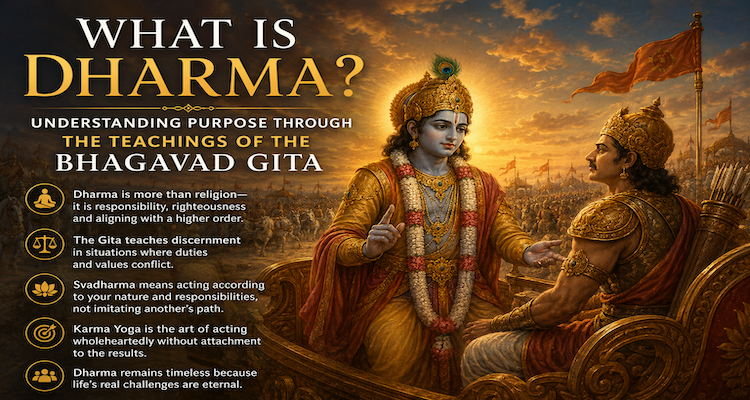
The word dharma is often translated as “duty,” “righteousness,” “religion,” or “moral law.” Yet none of these English words fully captures what the Bhagavad Gita means by it. Dharma is not simply a list of rules to obey. In the Gita, it is closely connected to the question of how a person should act when life presents conflicting responsibilities, desires, relationships and consequences.
That question stands at the heart of the Gita. Arjuna does not enter the battlefield because he lacks knowledge of right and wrong. He is paralysed because different moral obligations collide: his role as a warrior, his attachment to family, his concern about violence and the consequences of action. Krishna’s teaching addresses this deeper problem not merely what should I do?, but how can I understand my responsibility and act without being ruled by fear, attachment or the desire for personal reward?
Key Takeaways
- Dharma in the Bhagavad Gita is broader than religion and includes responsibility, ethical action and one’s role in a larger order.
- The Gita presents difficult decisions as situations requiring discernment, not blind obedience to simple rules.
- Svadharma, or one’s own duty, emphasizes acting according to one’s nature and responsibilities.
- Karma Yoga teaches action without attachment to personal reward, not indifference to consequences.
- The Gita’s idea of dharma remains relevant because modern life also involves conflicts between competing responsibilities.
Dharma Is More Than a Job or a Personal Preference
A common modern interpretation reduces svadharma to “follow your passion.” That can be useful as a starting point, but it is too narrow for the Gita.
The Sanskrit term combines sva, meaning one’s own, with dharma. In the verses most closely associated with the idea, the emphasis falls on performing the duty appropriate to oneself rather than abandoning it in imitation of another path. Chapter 3, Verse 35 and Chapter 18, Verse 47 both make this point, while linking one’s proper action to svabhava one’s nature or disposition.
That does not mean every personal desire automatically becomes dharma.
A person may strongly want wealth, status or recognition, yet those desires alone do not settle the ethical question of what they should do. The Gita places dharma within a larger framework involving action, discipline, responsibility and the consequences of attachment.
This is where the concept becomes more demanding and more useful.
Purpose, in this sense, is not simply discovered by asking, “What do I enjoy?” It may also require asking:
- What responsibilities genuinely belong to me?
- What kind of action is consistent with my nature and capabilities?
- Am I avoiding a necessary responsibility because it is uncomfortable?
- Am I copying someone else’s path because it appears more successful?
- Is my decision driven mainly by fear, ego or the desire for a particular reward?
These questions do not always produce easy answers. The Gita itself begins with a situation in which the answer is morally and emotionally difficult.
Arjuna’s Crisis Shows Why Dharma Is Not Always Obvious
The setting of the Bhagavad Gita is significant. Arjuna is not portrayed as someone casually asking Krishna for career advice. He faces a profound conflict before the battle of Kurukshetra.
His dilemma involves family, loyalty, violence, social consequences and his role as a warrior. The tension is precisely what makes the discussion of dharma more complex than a simple instruction to “do your duty.”
The Gita’s response develops over the course of the dialogue. Arjuna is repeatedly pushed to examine attachment, fear, identity and the basis on which he chooses to act.
One important editorial lesson emerges from this: dharma is not presented as a shortcut that eliminates difficult decisions. It is part of the discipline required to face them honestly.
That distinction matters today. Modern readers often encounter conflicts that have no perfectly comfortable option: professional obligations may clash with family responsibilities; personal ambition may conflict with ethical concerns; speaking up may carry consequences, while remaining silent may also have a cost.
The Gita does not offer a universal checklist capable of mechanically solving every modern dilemma. Its framework instead directs attention to the quality and motivation of action.
Karma Yoga: Acting Without Becoming Controlled by the Result
Perhaps the best-known verse connected with the Gita’s teaching on action is Chapter 2, Verse 47. In one English rendering available through the Gita Supersite, the verse says that a person has a right to action, but not to the fruits of action, while also warning against attachment to inaction.
This teaching is frequently misunderstood.
It does not mean that results are irrelevant. A responsible doctor must care about whether treatment helps a patient. A business leader must consider whether decisions harm employees or customers. A student should care about learning rather than deliberately ignoring the outcome.
The deeper point concerns attachment and control.
A person can control effort, preparation and the integrity of their actions more directly than they can control every consequence. Outcomes are influenced by circumstances, other people and factors beyond individual control. When the mind becomes completely attached to a particular result, fear of failure or hunger for success can distort judgment.
The Gita therefore presents a demanding balance:
Act seriously. Act responsibly. Do not become attached to inaction. But do not allow the anticipated reward to become the sole master of your actions.
This interpretation also changes how purpose can be understood. Purpose is not only a destination. It is reflected in the manner in which a person performs necessary and meaningful action.
The Important Distinction Between Dharma and Social Conformity
Another modern misconception is that dharma simply means obeying whatever role society assigns to a person.
The Gita’s verses on svadharma have historically been interpreted through different philosophical traditions and commentaries. The Gita Supersite, for example, preserves multiple translations and classical commentarial traditions, including those associated with Shankaracharya and Ramanujacharya. Their interpretations are part of a much broader history of reading the text rather than a single uncontested explanation.
For a contemporary reader, this makes caution important.
It would be simplistic to take a verse from an ancient text and automatically apply its social categories to every modern situation without interpretation. At the same time, dismissing svadharma as nothing more than an outdated occupational instruction can miss the larger philosophical problem the Gita addresses: What happens when a person abandons their genuine responsibility in order to pursue an identity, role or path that does not truly belong to their circumstances or disposition?
That question remains recognizable.
A person might pursue a career primarily because it impresses others. Someone may imitate a public figure’s definition of success while ignoring their own abilities and responsibilities. Another person may use “following my purpose” as an excuse to abandon commitments without considering those affected.
The Gita’s framework challenges both extremes: blind conformity and purely self-centered individualism.
Dharma Is Tested When Responsibilities Collide
One of the most useful ways to understand dharma is to stop treating it as a single label attached permanently to a person.
Human beings occupy several roles at once. A person can be a parent, child, professional, citizen, friend and member of a community. These responsibilities can sometimes support one another and sometimes collide.
The difficulty begins when two legitimate concerns point in different directions.
The Gita’s opening situation is itself built around such a conflict. Arjuna’s problem is not simply ignorance. He is caught between competing moral and emotional commitments.
For modern readers, this suggests a practical approach: when considering what dharma may require, do not ask only, “What do I want?” or “What rule applies?”
Consider a broader set of questions:
Examine the responsibility
Is there a genuine obligation involved, or is the sense of duty mainly created by social pressure, fear or habit?
Examine the motivation
Are you acting from responsibility, or primarily from anger, greed, fear, ego or attachment to a particular outcome?
Examine the consequences
The Gita’s teaching against attachment to results should not be used as an excuse to ignore foreseeable harm.
Examine your own nature and capacity
Chapter 18, Verse 47 explicitly connects one’s own dharma with action shaped by one’s nature.
Examine whether avoidance is disguised as spirituality
The warning against attachment to inaction in Chapter 2, Verse 47 is particularly relevant here. Stepping away from a difficult action is not automatically wisdom simply because it feels peaceful.
These questions cannot replace moral judgment. But they provide a more serious framework than the popular idea that purpose is merely whatever makes a person happiest at a particular moment.
What Dharma Can Mean for Modern Life
The enduring relevance of dharma may lie less in providing a ready-made answer and more in changing how people approach the question of purpose.
Modern culture often treats purpose as something hidden inside the individual a passion waiting to be discovered. The Gita offers a broader perspective. Purpose can involve the relationship between who a person is, what circumstances demand, how they act and the motives that shape that action.
This has practical implications.
A person’s dharma may not always be glamorous. It may involve caring for someone dependent on them, completing difficult work honestly, refusing an unethical opportunity or continuing a necessary task without any guarantee of recognition.
At the same time, the idea should not be misused to tell people that they must remain indefinitely in harmful circumstances or accept every expectation imposed upon them. Determining responsibility requires judgment, context and ethical reflection.
The strength of the Gita’s teaching is not that it removes human freedom. Rather, it asks people to use freedom with greater awareness of responsibility and attachment.
A Different Way to Think About Success
One of the Gita’s most challenging ideas is that the quality of action may matter independently of whether the desired outcome is achieved.
This does not make failure pleasant or success meaningless. Results still shape real lives. But a result-centered definition of worth can create a fragile sense of identity: success produces pride, failure produces paralysis, and every action becomes a calculation about personal gain or loss.
Karma Yoga offers another possibility.
A person can evaluate themselves partly through questions such as:
- Did I act with care and integrity?
- Did I fulfill a responsibility I had reason to accept?
- Did fear or ego distort my judgment?
- Did I give serious effort to what was within my control?
- Can I learn from the result without allowing it to define my entire worth?
That is not passive thinking. It can demand greater discipline because it removes some of the psychological excuses created by obsession with external validation.
Dharma Is a Practice of Discernment, Not a Slogan
The most valuable way to approach dharma may be to resist turning it into a motivational slogan.
“Follow your dharma” can sound simple. The Bhagavad Gita is not simple about the problem it explores. Its central conversation begins with confusion, grief and moral conflict. The teaching unfolds through questions rather than through a one-line formula for personal success.
The Gita repeatedly returns to action, knowledge, discipline, devotion and the problem of attachment. Within that larger philosophical framework, dharma becomes more than an occupation or social identity. It concerns how a person understands and performs the responsibilities and actions appropriate to their situation.
That is also why dharma cannot be reduced neatly to “do whatever you love” or “always obey tradition.”
Both interpretations are too narrow.
The more demanding question is whether a person can act with clarity when desire, fear, responsibility and consequence pull in different directions.
Conclusion
The Bhagavad Gita does not present dharma as a convenient formula for discovering a perfect life purpose. It presents something more challenging: the discipline of understanding one’s responsibility, acting in accordance with one’s nature and situation, and loosening the grip of attachment to personal reward.
For a modern reader, that may be its most useful lesson. Purpose is not always found by searching for an ideal identity or waiting for complete certainty. Sometimes it becomes clearer through responsible action, honest self-examination and the willingness to do what is necessary without making success, recognition or fear the sole measure of the decision.
In that sense, dharma is not merely about finding the right path. It is also about learning how to walk a difficult one.
This content is published for informational or entertainment purposes. Facts, opinions, or references may evolve over time, and readers are encouraged to verify details from reliable sources.