










Why Street Food Tastes So Good: The Psychology and Science Behind the Craving
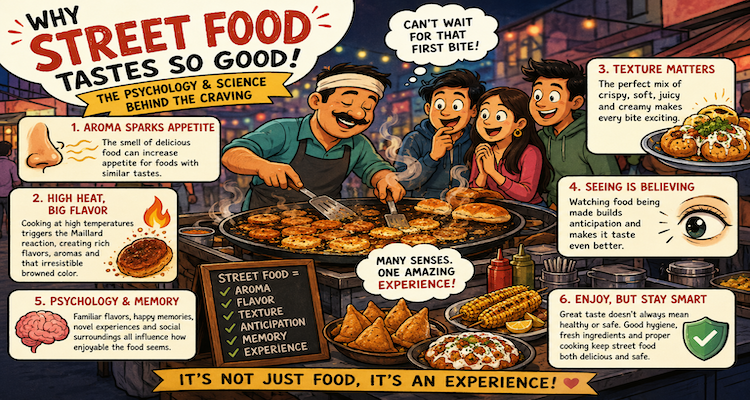
A plate of street food can be hard to resist before the first bite. The hiss of a hot griddle, the aroma of spices and browning ingredients, and the sight of food being prepared in front of you all begin shaping the experience before taste buds take over. Research suggests that food odours can increase appetite for foods with matching sensory qualities, while cooking chemistry creates many of the aroma and flavour compounds associated with browned and fried foods.
Key Takeaways
- Street food appeals to several senses at once, making eating a broader sensory experience than taste alone.
- Food aromas can stimulate appetite and increase interest in foods with similar sensory characteristics.
- High-heat cooking creates flavour and aroma compounds through processes including the Maillard reaction.
- Texture matters: contrast between crisp, soft, juicy and creamy elements can make each bite more engaging.
- Familiarity, novelty, social surroundings and anticipation can influence how enjoyable food seems.
- Great flavour does not automatically mean better nutrition or food safety, which remain separate considerations.
The flavour begins before the first bite
Street food is a useful reminder that “taste” is an incomplete way to describe why we enjoy food. What people casually call taste is usually a combination of flavour, smell, texture, temperature, appearance and expectation.
A vendor preparing food in public creates an unusually concentrated sensory environment. You may hear oil crackling, watch ingredients change colour, smell roasted spices or browning dough, and anticipate the first bite while standing close to the cooking process. By the time the food reaches your hands, your brain has already received a considerable amount of sensory information.
Research on food odours helps explain part of this effect. One study found that exposure to food odours could increase appetite for foods with congruent taste characteristics, such as savoury or sweet foods. In other words, smell does not simply accompany eating; it can help shape what we want to eat.
That makes street food interesting from both a scientific and psychological perspective. The craving is not caused by one magical ingredient. It is often the result of several systems working together.
High heat creates powerful flavour chemistry
Many popular street foods rely on grilling, roasting, frying, baking or searing. These cooking methods do more than make food hot. They trigger chemical reactions that can transform colour, aroma and flavour.
One of the best-known processes is the Maillard reaction, a complex set of reactions involving compounds including amino acids and reducing sugars during cooking and food processing. The reaction contributes to the browned colour and many of the flavour and aroma characteristics associated with cooked foods. Researchers have identified a wide variety of sensory-active compounds connected with Maillard chemistry.
Think about the browned surface of a grilled kebab, toasted bread, a crisp fried snack or a hot flatbread fresh from a tawa. The flavour difference between a raw ingredient and a browned one is often dramatic because heating changes its chemical composition and generates new aroma compounds.
This is one reason freshly prepared street food can seem especially appealing: the aromas are released while the food is being cooked, often directly into the surrounding environment.
But there is an important qualification. Browning chemistry is not automatically a nutritional advantage. Depending on the food, ingredients and cooking conditions, high-temperature processing can also generate undesirable compounds. The goal is not to treat “more browning” as universally better, but to understand why it can be so effective at producing sensory appeal.
Smell can create appetite before hunger does
Walk past a stall making roasted corn, fried snacks or grilled food and the aroma may grab your attention even if you were not actively planning to eat.
That response is not purely imaginary. Research has found that food odours can influence appetite in a sensory-specific way. In one study, exposure to an odour signalling a particular taste quality increased appetite for foods with a matching sensory profile.
This helps explain an overlooked feature of street food: the cooking process itself is part of the product experience.
In a restaurant kitchen, preparation may happen out of sight. At a street stall, the aroma often acts as a live invitation. The smell of spices hitting hot oil or food browning on a grill can create anticipation before the customer has ordered anything.
That anticipation matters because eating is not simply a reaction to nutrients arriving in the stomach. Sensory cues help the body and brain prepare for food. The result is a chain of expectation: you smell something, imagine its flavour, decide it may be enjoyable and then experience the actual taste against that expectation.
The food may still disappoint, of course. Strong anticipation does not guarantee great cooking. But when expectation and the final flavour match, the experience can feel especially satisfying.
Texture may be as important as flavour
Street food is often built around contrast.
A samosa combines a crisp shell with a softer filling. A chaat can bring together crunch, creaminess, acidity and moisture. A grilled sandwich may combine a toasted exterior with a softer centre. A taco, dumpling or fried snack can work for similar reasons.
Texture changes from bite to bite give food another dimension beyond flavour alone. A meal with only one uniform texture can become monotonous, while contrast can make eating feel more dynamic.
Temperature contributes too. Hot food can release aromas, while a combination of hot and cold ingredients can create sensory contrast. Fresh preparation also reduces the time between cooking and eating, preserving qualities such as crispness that may decline as food sits.
This is one reason a street-food dish can be difficult to reproduce exactly at home even when the ingredient list seems simple. The experience may depend heavily on timing: how long something is fried, when a sauce is added and whether it is eaten immediately.
The psychology of watching food being made
Street food frequently turns preparation into a form of performance.
Watching a cook flip, chop, grill, fry or assemble food creates a visible connection between raw ingredients and the finished dish. That visibility can also intensify anticipation. You are not simply receiving a completed product; you are watching it emerge.
This does not mean that watching food being prepared automatically makes it objectively taste better. Food preferences remain personal and are influenced by culture, familiarity and individual experience. But visual food cues can interact with other senses and affect appetite and the eating experience. Experimental research has also examined cross-modal effects involving food images and smell, showing how sensory information can combine rather than operate in isolation.
The broader lesson is that flavour is partly contextual. The same snack eaten immediately beside a busy stall may feel different from the same food delivered cold in a sealed container.
The recipe has not necessarily changed. The sensory setting has.
Familiar food, novelty and the comfort of choice
Street food also occupies an interesting psychological space between familiarity and novelty.
A person may already know the basic flavour of a dish but still encounter variations in spice, texture, preparation or presentation. That combination can be rewarding: familiar enough to feel safe, but different enough to remain interesting.
Cultural memory can also play a role. Foods associated with childhood, travel, festivals, neighbourhoods or family routines may carry meaning beyond their ingredients. A particular aroma can become linked with a place or past experience.
This is one reason there is no universal answer to the question, “What is the best street food?” The chemistry of browning and the influence of aroma may be broadly applicable, but preference remains shaped by individual history and culture.
A food that triggers nostalgia for one person may be completely unfamiliar to another.
The overlooked role of environment
The environment surrounding street food can amplify the experience.
Eating outdoors, standing near the vendor, sharing food with friends or exploring an unfamiliar market can add novelty and social context. These factors do not change the chemical composition of the food, but they can change how the experience is perceived and remembered.
This is where a purely nutritional explanation of craving falls short. Calories, salt, fat and sugar can influence palatability, but they do not fully explain why a particular food becomes memorable.
The strongest street-food experiences are often multisensory events. The smell comes first. The visual preparation builds anticipation. Heat and texture shape the first bite. Spices and sauces add complexity. The setting provides context.
The craving is therefore not just for an ingredient. Sometimes it is for the entire experience.
Delicious does not automatically mean harmless
Understanding why street food is appealing should not be confused with a claim that every street-food option is nutritionally similar or equally safe.
High palatability and food quality are separate questions. A highly enjoyable food may still be high in salt, sugar or fat, depending on the preparation. Food safety also depends on practical factors such as hygiene, separation of raw and cooked foods, thorough cooking, safe temperatures and the quality of water and ingredients.
The World Health Organization’s food-safety guidance emphasizes principles including keeping food clean, separating raw and cooked foods, cooking thoroughly, maintaining safe temperatures and using safe water and raw materials.
For consumers, the sensible approach is not to fear street food or assume that every vendor presents the same level of risk. Instead, the preparation environment matters. Fresh cooking, appropriate food handling and good hygiene practices remain important.
Why the craving feels stronger than the recipe suggests
The science behind street-food cravings reveals a larger truth about eating: we do not experience food through the tongue alone.
Street food often succeeds because it combines several advantages at once. High heat produces powerful aromas and flavours. Smell can shape appetite and anticipation. Fresh preparation preserves temperature and texture. Visual cues make the cooking process part of the experience. Culture and memory can add emotional meaning.
That combination may explain why recreating a favourite street-food dish at home can sometimes feel strangely incomplete. You may match the ingredients and still miss something.
Often, what is missing is not one secret spice. It is the sound of the cooking, the smell in the air, the timing of the first bite and the context in which the food became memorable.
Street food tastes good because it is frequently designed sometimes through generations of culinary practice rather than formal science to engage nearly every sense. The craving begins long before the food reaches the mouth, and that may be the real reason the first bite can feel so satisfying.
This content is published for informational or entertainment purposes. Facts, opinions, or references may evolve over time, and readers are encouraged to verify details from reliable sources.