










Why Comfort Food Makes Us Feel Better: The Science Behind Emotional Eating
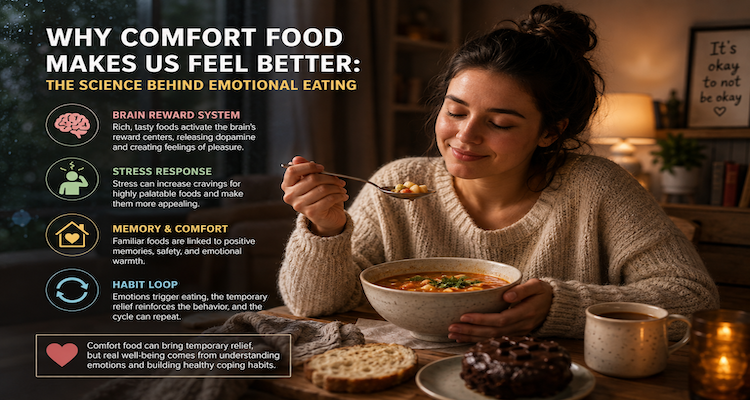
A bowl of warm soup after a difficult day. Chocolate during a stressful week. A familiar dish that suddenly feels more appealing when loneliness, frustration or sadness sets in.
These experiences are often described as comfort eating, but the explanation is more complicated than the idea that people simply “eat their feelings.” Food is closely connected to reward, memory, habit and emotion. Under stress, some people eat more, some eat less, and others mainly change what they choose to eat. Research suggests that negative emotions can shift preferences toward highly palatable foods, yet the evidence also challenges a popular assumption: comfort food does not reliably solve the underlying emotional problem, and its stress-reducing effects vary considerably between individuals.
That distinction matters. Emotional eating is not necessarily a sign of weak willpower, nor is every enjoyable meal a psychological coping mechanism. The more useful question is why food can become emotionally powerful and when a temporary sense of comfort begins turning into a learned response to stress.
Key Takeaways
- Emotional eating is influenced by stress, reward, learned associations and individual differences rather than hunger alone.
- Stress can change food preferences, often increasing the appeal of highly palatable foods without affecting everyone’s appetite the same way.
- Familiar foods may provide comfort through pleasure, memory and learned emotional associations.
- Research does not show that comfort food consistently improves stress recovery or resolves negative emotions.
- Repeatedly pairing distress with eating can reinforce a habit in which food becomes an automatic coping response.
- Recognizing the difference between physical hunger and an emotional trigger can help people choose more flexible ways to respond.
Food Does More Than Satisfy Hunger
Eating is governed by both homeostatic needs and hedonic motivation. Homeostatic eating helps meet the body’s energy requirements. Hedonic eating, by contrast, is driven more by pleasure, reward and the anticipated enjoyment of food.
The two systems frequently overlap. A person can be genuinely hungry and also strongly motivated by the pleasure of a particular food. Emotional eating generally refers to eating that is influenced by emotional states rather than physical hunger alone, especially during stress, sadness or other forms of negative affect.
Research on stress and eating consistently shows that people do not all react in the same direction. Some eat more when stressed, while others eat less. However, stress may also influence food choice, making calorie-dense and highly palatable foods more attractive even when overall food intake does not rise.
This is one reason emotional eating should not be reduced to a simple equation: stress equals overeating. For many people, the more noticeable change is a shift toward foods that feel rewarding, familiar or immediately satisfying.
Why Highly Palatable Foods Can Feel So Appealing
Foods rich in sugar and fat are often intensely pleasurable, and eating is connected with the brain’s reward and motivation systems. Researchers studying emotional and stress-related eating have explored how rewarding foods may become especially appealing when negative emotions are present.
One proposed mechanism is reinforcement. If eating a particular food is followed by even a short-lived reduction in unpleasant feelings, the brain may learn that the behavior is worth repeating when a similar emotional state appears again.
Recent research illustrates both the potential importance and the uncertainty of this process. A 2024 laboratory study involving 26 adult women found that greater lifetime stressor exposure was associated with larger decreases in negative affect after snacking following an acute social stressor. The study was small and cannot establish a universal cause-and-effect rule, but it supports the possibility that the emotional reward people experience from stress-related eating differs substantially from person to person.
The important point is that the food does not need to “fix” the source of stress to reinforce the behavior. A temporary shift in mood may be enough for the brain to remember the association.
Comfort May Also Come From Memory and Familiarity
The science of comfort food is not only about calories or brain chemistry.
A familiar meal may carry personal associations with family, celebration, childhood, safety or routine. In that sense, the comfort may come partly from the meaning attached to the food rather than from its nutritional composition alone.
This helps explain why one person’s comfort food may have little emotional significance for someone else. The category is deeply personal. A particular soup, rice dish, dessert or snack can become emotionally meaningful through repeated experience.
That insight also complicates the stereotype that comfort food must always be unhealthy. The emotional role of food can be linked to familiarity, sensory pleasure and personal memory, not simply to sugar or fat.
Does Comfort Food Actually Make Us Feel Better?
Here the scientific picture becomes less straightforward.
Some studies suggest that palatable food can improve mood or reduce negative affect in people who are especially prone to emotional eating. A 2019 study, for example, found evidence that tastiness was associated with mood improvement during eating among participants classified as high emotional eaters, while the pattern differed among low emotional eaters.
But immediate pleasure is not the same thing as meaningful stress recovery.
Another laboratory experiment involving 150 healthy women compared healthy and unhealthy comfort foods with a no-food condition around a social stress task. The researchers found that eating did not significantly reduce physiological stress reactivity or improve recovery compared with the control condition. Notably, healthier options did not appear to provide less stress relief than the unhealthy alternatives.
Taken together, these findings suggest an important distinction: food can be enjoyable and may produce temporary emotional relief for some people, but that does not mean comfort eating is a reliable treatment for stress or sadness.
That is where popular ideas about comfort food often outrun the evidence.
The Habit Loop: When Emotion Starts Triggering Appetite
The more important long-term issue may not be a single episode of emotional eating, but repetition.
Imagine a recurring pattern:
Stress or sadness → craving for a familiar food → eating → temporary pleasure or distraction.
If the experience repeatedly feels rewarding, the association may become stronger. Over time, emotional cues themselves can begin to prompt the urge to eat.
Researchers have described stress-related eating partly through models of reward and negative reinforcement: when an unpleasant emotional state decreases after eating, that reduction may make the behavior more likely to recur. However, scientists are still working to understand the precise mechanisms and why some individuals are more susceptible than others.
This is also why telling someone to “just use willpower” can miss the behavioral mechanism. Habits are often built through repeated associations between cues, actions and perceived rewards.
Emotional Eating Is Not the Same as an Eating Disorder
It is important not to medicalize every instance of eating for comfort.
Enjoying food after a hard day, celebrating with dessert or finding reassurance in a familiar meal does not automatically indicate an eating disorder. Emotional influences on eating exist on a spectrum.
Concern may arise when eating repeatedly feels uncontrollable, causes significant distress, becomes the primary way of coping with difficult emotions, or occurs alongside patterns such as recurrent binge eating. Those situations may warrant professional support rather than self-diagnosis.
Emotional eating and clinically defined eating disorders are not interchangeable concepts. Reviews of the evidence emphasize the need to distinguish ordinary emotional influences on food intake from more severe or clinically significant patterns.
A More Useful Response: Add Options Instead of Declaring Food the Enemy
The goal does not have to be eliminating comfort from food.
A more practical approach is to create a brief pause between the emotion and the automatic response. That might involve asking:
- Am I physically hungry, emotionally distressed, or both?
- What happened shortly before I wanted to eat?
- Will eating this genuinely be enjoyable, or am I trying to escape a feeling?
- Is there another action that could help alongside food?
Sometimes the answer may still be to eat and there is nothing inherently wrong with enjoying food. The difference is whether the choice is conscious or whether the emotional cue has become an automatic trigger.
The research comparing healthy and unhealthy comfort foods also offers a useful practical insight. If the goal is simply to experience something pleasant during a stressful moment, healthier foods may not necessarily mean giving up emotional benefit. In the 2019 experiment, healthier and unhealthy foods did not differ significantly in their effects on physiological stress recovery.
Other coping options may include taking a walk, speaking with someone, resting, listening to music, writing down the source of the stress or addressing the underlying problem directly. Food can remain one source of enjoyment without being required to carry the entire burden of emotional regulation.
Conclusion
Comfort food feels powerful because eating sits at the intersection of biology, reward, memory and experience. Stress can alter appetite and food preferences, while familiar and pleasurable foods may provide a temporary sense of relief for some people.
But the strongest lesson from the research is not that comfort food is either good or bad. It is that the experience is highly individual, and temporary pleasure should not be confused with solving the emotion that triggered the urge to eat.
Understanding that difference can change the conversation around emotional eating. Rather than treating every craving as a failure of discipline, it may be more useful to recognize the emotional cue, understand the learned habit behind it and build more than one way to find comfort.
This content is published for informational or entertainment purposes. Facts, opinions, or references may evolve over time, and readers are encouraged to verify details from reliable sources.