










The Loneliness Paradox: Why We Feel More Alone in a Connected World
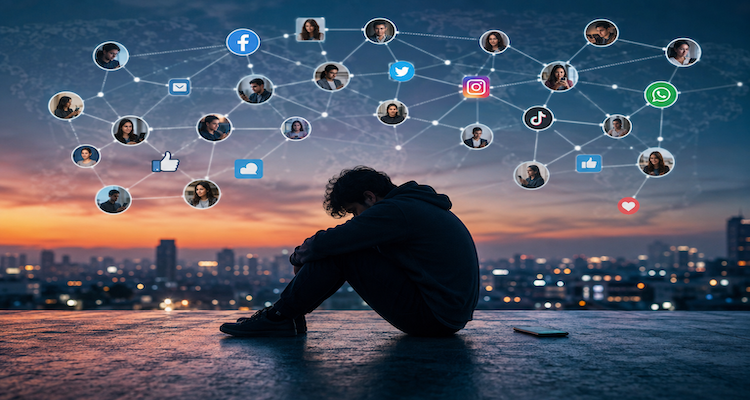
A person can exchange dozens of messages in a day, scroll through hundreds of updates, join video calls, react to friends’ photos and still end the evening feeling profoundly alone.
That contradiction sits at the heart of modern loneliness. Digital technology has made communication faster, cheaper and almost constant. Yet the ability to contact people is not the same as feeling understood, supported or genuinely connected to them.
The distinction matters because loneliness is not simply a lack of people. The World Health Organization describes it as the painful feeling that arises when a person’s relationships do not match the relationships they want or need. Social isolation, by contrast, refers more to having few relationships or infrequent social contact. Someone can be surrounded by others and still feel lonely; another person can spend substantial time alone without experiencing loneliness.
The scale of the problem has pushed social connection beyond the realm of personal advice and into public-health policy. In its 2025 global report, the WHO Commission on Social Connection estimated that about one in six people worldwide experienced loneliness between 2014 and 2023. The highest estimated rates were among adolescents and young adults.
The important question, then, is not whether technology has simply made humanity lonelier. The evidence is more complicated than that. Digital tools can sustain relationships across distance, help people find communities and reduce barriers to communication. But a connected environment can also create a gap between contact and connection and that gap may be one of the defining social challenges of the digital age.
Key Takeaways
- Loneliness is a subjective mismatch between desired and actual social connection, not simply the absence of other people.
- The WHO estimates that roughly one in six people worldwide experienced loneliness between 2014 and 2023.
- Adolescents and young adults have some of the highest estimated rates of loneliness globally.
- Digital communication can strengthen relationships, but frequent contact does not automatically create emotional closeness.
- The most useful response is not simply “spend less time online,” but to build more meaningful, reliable and reciprocal relationships.
- Social connection is increasingly being treated as a public-health and community issue, not only a private problem.
Connection Has Become Easier. Feeling Connected Has Not.
Technology has dramatically lowered the practical cost of staying in touch. A family can communicate across continents. A student can find a niche community that does not exist locally. Someone facing a difficult experience can discover support groups and information within minutes.
These are genuine benefits, and any argument that treats digital technology as inherently isolating misses an important part of reality.
The paradox emerges when availability is confused with intimacy.
A notification signals that someone has reached us. A reaction indicates that someone has seen what we posted. A large follower count can create the appearance of a broad social network. But none of these measures necessarily tells us whether a person has someone to call during a crisis, someone who understands their circumstances, or a relationship in which support flows both ways.
The digital world is exceptionally efficient at producing social contact. Human well-being, however, often depends on something harder to measure: trust, belonging, reciprocity, emotional safety and the sense that another person is genuinely present.
That distinction helps explain why loneliness can exist inside a crowded office, a busy family home or an active social-media feed.
Loneliness Is Not the Same as Being Alone
One of the most useful corrections to the public conversation is to separate solitude, social isolation and loneliness.
Solitude can be voluntary and restorative. Some people actively seek time alone for reflection, concentration or rest. Social isolation refers more directly to the quantity or frequency of social relationships and interactions.
Loneliness is different. It concerns the quality of connection as experienced by the individual.
The WHO’s explanation captures the point clearly: a person may have friends and still not feel understood or supported. Conversely, someone with a relatively small social circle may feel deeply connected to the people they do have.
This matters because simplistic solutions can miss the problem. Telling a lonely person simply to “meet more people” may not address what they actually lack. The missing ingredient may be belonging rather than company, trust rather than conversation, or continuity rather than another new contact.
Why the Digital Environment Can Intensify the Gap
There is no credible basis for reducing the loneliness problem to a single cause such as smartphones or social media. The WHO identifies multiple drivers of social isolation and loneliness, including broader social, economic and environmental conditions.
Still, digital environments can interact with existing vulnerabilities in ways worth examining.
Communication can become fragmented
Modern communication is often continuous but interrupted. Messages arrive between work tasks, during commutes and alongside countless other notifications. Conversations may be frequent without becoming sustained.
This does not mean short messages are meaningless. They can be valuable expressions of care. But when most interaction is reduced to fragments, people may experience a large volume of communication without the depth that comes from sustained attention.
Visibility can encourage comparison
Digital platforms make other people’s social lives unusually visible. Gatherings, friendships, celebrations and milestones can appear in a continuous stream.
The result can be a distorted comparison: people compare their private experience including boredom, rejection or uncertainty with highly selective glimpses of other people’s lives. For someone already feeling disconnected, repeated exposure to apparent belonging may reinforce the feeling of being left outside.
That does not mean every user experiences social media this way, or that platforms produce identical effects for everyone. The relationship between technology and well-being depends on context, individual circumstances and how the technology is used. A more careful conclusion is that digital environments can amplify social comparison and feelings of exclusion for some people while providing meaningful connection for others.
The number of connections can obscure the quality of relationships
Digital systems are exceptionally good at counting: followers, likes, views, contacts and engagement.
Human relationships do not work as neatly.
A person may have hundreds of online connections and very few relationships in which they feel safe asking for help. Another person may have a small network but strong, dependable ties.
The problem is partly cultural as well as technological. When visibility becomes a proxy for social success, the absence of deep connection can be hidden behind a highly active digital presence.
Young People Are at the Center of the Conversation
Loneliness is often stereotyped as a problem of old age. The WHO’s 2025 analysis complicates that assumption.
Globally, the Commission estimated loneliness among about 20.9% of adolescents aged 13–17 and 17.4% of young adults aged 18–29, compared with 15.1% of adults aged 30–59 and 11.8% of people aged 60 and above. These figures describe estimated prevalence across the data reviewed by the Commission, not a simple ranking of who “suffers most” in every country or circumstance.
The finding matters because adolescence and early adulthood are periods when relationships, identity, education, work and independence are all changing. Social expectations can also become unusually intense.
Technology may be part of that environment, but it is not the entire explanation. Economic insecurity, changing communities, educational pressures, mobility and the disruption of traditional social structures can also affect opportunities for meaningful connection.
The broader lesson is that loneliness should not be treated as a niche problem belonging to one age group.
The Bigger Problem May Be the Loss of Social Infrastructure
The loneliness paradox is often framed as an individual failure: call more friends, put down the phone, join a club.
Individual action can help. But the WHO’s approach points toward a larger issue. Social connection is shaped by communities, institutions, public spaces, workplaces, schools and policies not only by personal choices. The Commission’s report calls for action across policy, research, interventions, measurement and public engagement.
This is an important shift in perspective.
A person may want more connection while living in an environment that makes it difficult to build. Long working hours, financial pressure, unsafe or inaccessible public spaces, frequent relocation and the decline of shared community settings can all affect the time and opportunity available for relationships.
The United States Surgeon General’s 2023 advisory similarly argued that social connection has broad implications for individual and community health and called for action beyond the level of personal behavior alone.
That does not remove individual agency. It does suggest that advice focused entirely on personal discipline can be incomplete.
Technology Is Better Viewed as an Amplifier Than a Simple Villain
The strongest editorial conclusion is not that technology is replacing friendship. It is that technology increasingly mediates how friendship, community and belonging are formed and maintained.
That mediation can work in opposite directions.
A video call may keep a distant family relationship alive. An online community may offer belonging to someone who feels isolated in their local environment. A messaging group can coordinate real-world gatherings.
But technology can also make it easier to substitute low-effort interaction for deeper engagement, remain passive while watching others socialize, or mistake constant availability for dependable support.
The same device can support connection or merely simulate its appearance.
This means the more useful question is not, “How much technology is too much?” It is, “What kind of relationships is this technology helping us build?”
Does it lead to conversation or only consumption? Does it strengthen an existing relationship? Does it create belonging that extends beyond a screen? Does it make asking for help easier? Or does it leave a person more connected to information about other people than to the people themselves?
Those questions are harder than counting screen hours, but they are closer to the problem.
What a More Connected Society Might Actually Require
The evidence does not support a universal prescription for loneliness. People differ in culture, personality, life stage and the kinds of relationships they value. The WHO also notes limitations in the global evidence base and the need for more research across different populations and settings.
Still, a practical principle emerges: meaningful connection is usually built through repeated, reciprocal and reliable interaction.
For individuals, that may mean prioritising a smaller number of relationships over maintaining a large volume of weak contact. It may mean creating regular opportunities to meet, talk or participate in shared activities.
For employers and institutions, the question is whether systems create genuine opportunities for belonging or merely add more communication channels.
For technology companies, the challenge is more complicated. A platform can optimise for engagement without necessarily optimising for healthy relationships. The two goals may overlap, but they are not identical.
And for communities, the issue extends to whether people have places and institutions where repeated encounters can gradually become relationships.
Conclusion
The paradox of modern loneliness is not that people suddenly lost the ability to communicate. It is that communication has become abundant while meaningful connection remains difficult to guarantee.
A message can cross the world in seconds. Belonging cannot.
The WHO’s 2025 findings make clear that loneliness is widespread across regions and age groups, with particularly high estimated levels among adolescents and young adults. The evidence also makes something else clear: loneliness is not simply solved by adding more people, more platforms or more notifications.
The real challenge is to close the gap between being reachable and being known.
As digital systems become even more deeply woven into work, entertainment, education and relationships, that distinction may become increasingly important. The goal should not be a retreat from technology. It should be a clearer understanding of what technology can provide and what only sustained human relationships can.
This content is published for informational or entertainment purposes. Facts, opinions, or references may evolve over time, and readers are encouraged to verify details from reliable sources.