







Travel Far, Experience More: Why Better Travel Is About Depth, Not Distance
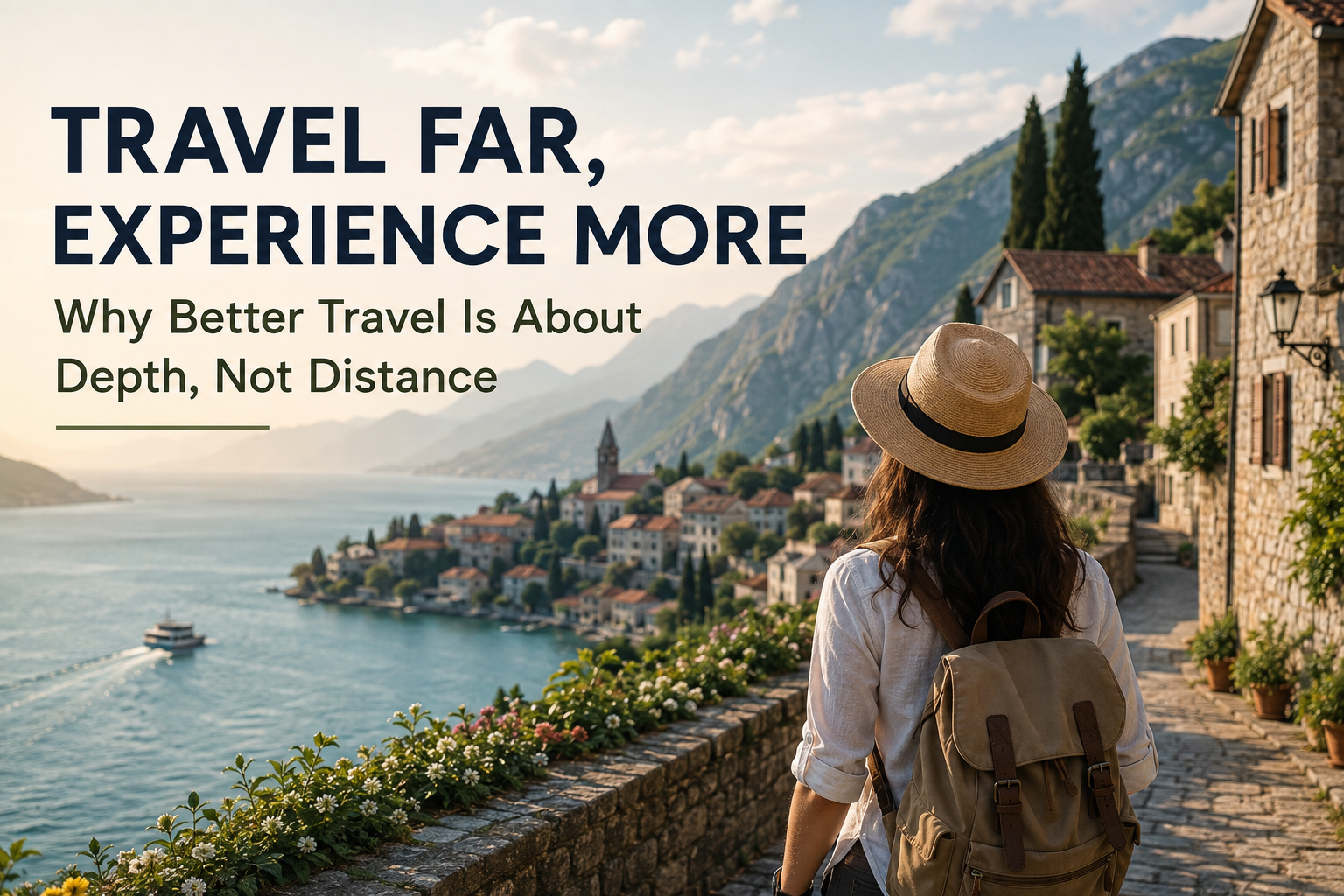
The modern travel economy has largely been built around movement: more destinations, tighter itineraries, more attractions and more photographs. Yet the most valuable travel experience is not always the one that covers the greatest distance or checks off the longest list.
A different idea is gaining relevance. As destinations confront overcrowding, rising costs, environmental pressures and changing traveller expectations, the quality of time spent in a place may matter as much as the number of places visited. The OECD’s 2026 tourism analysis points to growing interest in meaningful interactions, slower travel, lower-impact choices and experiences built around local identity, while governments increasingly try to spread visitors beyond heavily concentrated destinations.
Key Takeaways
- Travelling farther does not automatically produce a richer experience; time, attention and local engagement often matter more.
- Slower, longer stays can help travellers understand places beyond their most photographed attractions.
- Tourism destinations are increasingly trying to spread visitors across seasons and lesser-known regions.
- Overcrowding can strain infrastructure, communities and natural or cultural assets.
- Better travel requires balancing personal experience with the impact visitors have on the places they enter.
The Problem With Treating Travel Like a Checklist
There is nothing wrong with ambitious travel. Visiting several countries, taking a long road trip or pursuing famous landmarks can be deeply rewarding. The problem begins when movement itself becomes the measure of success.
A traveller can cross thousands of kilometres and still experience very little beyond airports, hotel lobbies, transport schedules and crowded attractions. A tightly packed itinerary may create the appearance of a full journey while leaving little time to understand how a place actually functions.
Depth often comes from the less dramatic parts of travel:
- returning to the same neighbourhood at different times of day;
- using local transport instead of only private transfers;
- spending time in smaller museums, markets or public spaces;
- learning why a local food, festival or landscape matters;
- allowing enough flexibility to follow an unexpected recommendation.
These experiences do not require travellers to reject famous destinations. They simply require a different measure of value.
The question changes from “How much did I see?” to “What did I actually understand?”
Why Slower Travel Matters Beyond Personal Comfort
The growing interest in slower and more meaningful travel is not only a lifestyle preference. It also connects to a larger challenge facing tourism: demand is often concentrated in a relatively small number of places.
The OECD reports that, across countries with available data, around 47% of tourist nights are concentrated in just 10% of regions. Such concentration can put pressure on infrastructure, natural resources and local communities, while less-visited areas receive fewer of tourism’s economic benefits.
That imbalance changes the meaning of “travel more.”
For travellers, exploring beyond the obvious hotspot may lead to a more relaxed and distinctive experience. For destinations, spreading visitors geographically and across different seasons can help distribute economic activity and reduce pressure on the most crowded areas.
The OECD highlights examples of countries encouraging off-peak travel, longer stays and visits to lesser-known destinations. Switzerland’s tourism initiatives, for example, have promoted travel beyond peak periods and more time in less-crowded regions, while other countries are developing routes and programs intended to connect visitors with emerging destinations.
The important point is not that every traveller must avoid popular places. Famous destinations are popular for real reasons. But a trip built entirely around the same crowded locations can produce both a thinner personal experience and greater pressure on the destination.
More Time in One Place Can Reveal What Fast Travel Misses
A destination is not a collection of landmarks.
It is a living combination of residents, businesses, history, transport systems, neighbourhoods, traditions and ordinary routines. Much of that becomes invisible when every day begins with a new checkout and ends with another arrival.
Longer stays create opportunities that rushed itineraries often eliminate. A traveller may discover which streets become quiet after day visitors leave, how a neighbourhood changes between morning and evening, or which local businesses exist beyond the areas designed primarily for tourists.
This does not mean staying longer automatically makes travel more authentic. A traveller can spend two weeks in a place without engaging with it meaningfully. But time creates the possibility for a different kind of attention.
That distinction is especially important in an era when travel planning has become remarkably efficient. Search engines, mapping apps, recommendation platforms and artificial intelligence can help people find flights, compare accommodation and construct detailed itineraries within minutes. The same tools, however, can also encourage optimisation to the point where every empty hour looks like a planning failure.
Sometimes the most useful part of an itinerary is the space left unplanned.
Technology Can Help Travellers Go Deeper If It Is Used Differently
Digital tools are reshaping tourism, according to the OECD, creating opportunities for more personalised experiences, improved tourism management and more data-driven decision-making.
For travellers, that creates an interesting possibility.
Technology can be used to fit more activities into less time. But it can also be used to reduce friction and make room for deeper experiences.
A well-designed travel plan might use technology to:
- identify less-crowded times to visit popular attractions;
- find transport connections that make smaller destinations accessible;
- understand local customs and practical rules before arrival;
- translate basic information without assuming technology replaces human interaction;
- compare routes based on time, accessibility and travel impact rather than price alone.
The goal should not be to automate the experience of travel. It should be to remove unnecessary logistical stress so that more attention can be directed toward the place itself.
There is also a limitation. Recommendation systems tend to amplify information that is already highly visible. If millions of people search for the same “must-see” list, digital platforms can reinforce the concentration of visitors in exactly the places already under the greatest pressure.
Technology can therefore improve travel, but it does not automatically improve the traveller’s choices.
The Experience Economy Is Changing What Travel Can Mean
Travel has long involved experiences, but the nature of those experiences is becoming more central to how destinations compete.
The OECD notes growing attention to tourism connected with culture, education, wellness, outdoor recreation, rural areas and other experiences rooted in the distinctive assets of a destination.
This suggests a broader shift in how a successful trip can be defined.
A memorable journey may involve fewer headline attractions but more connection to what makes a destination different. That could mean:
Local identity
Food, architecture, language, crafts, music and traditions often provide context that cannot be understood from a photograph alone.
Seasonal awareness
Travelling outside the busiest periods can sometimes offer a different relationship with a destination, though weather, closures and local conditions must still be considered.
Geographic curiosity
Moving beyond the best-known district or city can reveal regional differences that a single tourism hotspot cannot represent.
Time for interpretation
Museums, historical sites and cultural landscapes become more meaningful when travellers understand the context rather than simply moving from one attraction to the next.
The value of these experiences is difficult to measure with a simple count of destinations.
Responsible Travel Does Not Mean Perfect Travel
Travel creates economic opportunities, supports businesses and connects people with places and cultures they might otherwise never encounter. It also creates pressures.
The OECD warns that concentrated tourism can strain infrastructure and natural and cultural assets. Same-day visitors and large surges of visitors can, in some destinations, create pressure without generating economic benefits proportional to that impact.
That does not place the entire responsibility on individual travellers. Governments, tourism boards, transport providers, accommodation businesses and platforms all influence how tourism is managed.
Still, individual choices matter at the margin.
A traveller can ask practical questions before booking:
- Can I spend more time in fewer places?
- Is there a reason to visit during a less crowded period?
- Can I include smaller towns or regions without treating them as disposable stops?
- Where does my spending actually go?
- Am I visiting a place, or merely consuming a list of things associated with it?
These questions do not require guilt. They encourage awareness.
Travel Far, But Do Not Let Distance Become the Goal
The phrase “travel far” can describe physical distance, but the more meaningful journey may be intellectual and emotional.
A nearby destination can challenge assumptions, introduce unfamiliar histories and create lasting memories. A journey across continents can remain superficial if the traveller never moves beyond the standard itinerary.
The best trip is therefore not necessarily the longest, the most expensive or the most geographically ambitious.
It is the one that leaves the traveller with something more valuable than proof of having been there.
As tourism continues to grow and destinations search for ways to balance economic opportunity with environmental and community pressures, travellers may also need a better definition of getting away. Going farther can be extraordinary. But experiencing more may sometimes begin with moving a little slower, staying a little longer and paying closer attention to where you already are.
Conclusion
Travel is increasingly easy to organise, compare and optimise. Experiencing a place deeply remains harder.
The next evolution of travel may not be about discovering an endless list of new destinations. It may be about making better use of the destinations we choose: giving places more time, looking beyond the obvious, travelling with greater awareness and allowing room for discovery that no itinerary can fully predict.
Travel far if the journey calls you. But experience more by refusing to measure a meaningful trip only in kilometres travelled or landmarks completed.
This content is published for informational or entertainment purposes. Facts, opinions, or references may evolve over time, and readers are encouraged to verify details from reliable sources.