







The Towns That Become Tourist Attractions for Something That No Longer Exists
From abandoned mining communities to villages submerged beneath reservoirs, some places attract visitors not because of what remains, but because of what has disappeared. Their stories reveal how loss itself can become part of a destination’s identity.
A tourist destination usually promises something worth seeing: a remarkable building, a beautiful landscape, a famous landmark or a living cultural tradition.
But some destinations offer something stranger. People travel to them because the very thing that once made them important is gone.
In California, visitors wander through the abandoned streets of a gold-mining town where the industry that supported thousands of residents has vanished. Off the coast of Japan, sightseeing boats approach an island whose deserted apartment buildings once housed a thriving industrial community. In Wales, a reservoir covers the remains of a village whose destruction became a lasting symbol of cultural memory.
These places are not all conventional tourist towns. Some are preserved settlements, some are ruins, and others are landscapes associated with communities that no longer exist.
What connects them is a curious reversal: the disappearance of a place’s original purpose becomes the reason people remember it.
Understanding these destinations requires looking beyond their photogenic ruins. Their histories raise questions about economic change, collective memory, preservation and the uneasy relationship between tourism and loss.
Bodie, California: A Gold Town That Outlived Its Gold
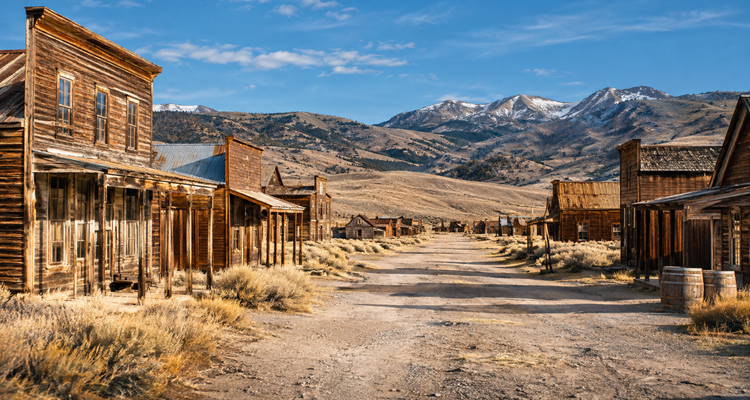
Gold discoveries transformed a remote settlement in California’s eastern Sierra Nevada into a busy mining town. By the end of the 1870s, it had thousands of residents, businesses, schools, hotels and the institutions of a functioning community.
But the prosperity depended heavily on mining.
As profitable opportunities declined, residents gradually moved elsewhere. Fires destroyed parts of the settlement, and mining operations eventually ceased in 1942.
What survived was an unusually intact collection of buildings.
Today, Bodie State Historic Park preserves the settlement in a condition described as arrested decay. Rather than restoring the town to a polished version of its former appearance, preservation work maintains its surviving structures while retaining their weathered character.
Visitors can walk its deserted streets and look through windows at interiors containing furnishings and objects associated with the town’s past.
The US National Park Service identifies Bodie as an important surviving example of a Western mining boomtown.
What makes Bodie compelling is not simply that its buildings are old. It is that their original social and economic purpose has disappeared.
A schoolhouse without pupils, a shop without customers and homes without residents communicate something that a conventional museum display cannot easily reproduce.
The town feels interrupted.
Yet that impression needs context. Bodie was not abandoned in a single dramatic moment. Its decline unfolded over decades, through changing economic conditions, migration and destructive fires.
The apparent stillness that attracts visitors today is the result of a long history of change.
Hashima Island, Japan: An Industrial Community Left Behind
From a distance, Hashima Island resembles a large vessel sitting motionless in the sea.
Its tightly packed concrete buildings create the silhouette that earned it the nickname Gunkanjima, or Battleship Island.
For much of the twentieth century, however, this was not a deserted curiosity. It was a densely populated industrial settlement built around coal mining.
The island had apartment buildings, schools, shops, medical facilities and places of worship. According to the Japan National Tourism Organization, its population reached approximately 5,300 people at its peak.
When the coal mine closed in 1974, the community was abandoned.
The island subsequently became a striking landscape of deteriorating concrete buildings and empty streets. Organized tourism began in 2009, and Hashima became part of a UNESCO World Heritage inscription in 2015.
Today, visitors can join authorized boat tours, although weather conditions and structural instability restrict access.
Hashima illustrates how a place can change meaning without changing location.
During its industrial years, its value lay in the coal beneath it and the people working above it. Today, its significance lies in the physical evidence of that vanished industrial life.
There is also a more difficult historical dimension. Hashima’s industrial heritage must be understood alongside the history of labor, including wartime forced labor associated with Japan’s industrialization.
A responsible account cannot treat the island merely as an atmospheric collection of abandoned buildings.
Its ruins are visually remarkable, but they are also evidence of working conditions, industrial ambition, human experience and the consequences of economic transformation.
Capel Celyn, Wales: The Village Beneath the Water
Not every vanished community leaves streets that visitors can walk through.
Some leave almost nothing visible at all.
Capel Celyn was a Welsh-speaking village in the Tryweryn Valley of North Wales. During the twentieth century, plans were developed to flood the valley to create a reservoir supplying water to Liverpool.
The proposal generated significant opposition in Wales.
Despite that resistance, construction proceeded. Residents were displaced, buildings were demolished and the valley was flooded in 1965.
The resulting reservoir, Llyn Celyn, covers the former village site.
According to the National Library of Wales, the destruction of Capel Celyn became an important event in the development of modern Welsh political and cultural identity. The phrase Cofiwch Dryweryn “Remember Tryweryn” remains associated with that history.
Unlike Bodie or Hashima, Capel Celyn is not a preserved ghost town available for ordinary sightseeing.
Its story survives through historical records, remembrance, cultural expression and the landscape itself.
For people who visit the area with knowledge of its history, the reservoir represents more than an expanse of water.
It marks a community that was deliberately removed.
This distinction matters. The significance of Capel Celyn is not that it provides an unusual backdrop for photographs. It is that the landscape has become inseparable from questions about political power, language, displacement and cultural identity.
The absence is the central historical fact.
Humberstone, Chile: Where an Industry Disappeared but Its Culture Survived
Humberstone and nearby Santa Laura were associated with the production of saltpeter, particularly sodium nitrate, which was widely used in fertilizer production.
The industry brought workers from Chile, Peru and Bolivia into desert settlements where communities developed around industrial employment.
These were not simply collections of factory buildings. Workers and their families created social institutions, cultural traditions and organizations that influenced Chilean labor history.
As the natural nitrate industry declined during the twentieth century, many of the settlements lost their economic foundations.
Today, Humberstone and Santa Laura Saltpeter Works form a UNESCO World Heritage Site, inscribed in 2005.
UNESCO recognizes both their industrial significance and the distinctive culture developed by their inhabitants. Former workers and descendants continue to maintain connections with this heritage through gatherings and commemorations.
Humberstone demonstrates an important difference between a vanished industry and a vanished culture.
The industrial activity may have stopped, but its influence continues through families, collective memories, labor history and regional identity.
The abandoned buildings are not the entire attraction. They are the physical setting for a much larger story about how work can shape a community long after the jobs disappear.
Oradour-sur-Glane, France: A Village Preserved Because It Was Destroyed
On June 10, 1944, a Waffen-SS unit massacred 642 people in the French village of Oradour-sur-Glane.
The original village was devastated.
After the Second World War, French authorities chose to preserve its ruins as a memorial rather than rebuild the destroyed settlement on the same site.
A new village developed nearby, while the old streets and damaged buildings remained as evidence of what had happened.
Today, the ruined village of Oradour-sur-Glane Memorial is a place of remembrance and historical education.
Its purpose is fundamentally different from that of an abandoned mining settlement. Visitors are invited to confront the consequences of wartime violence and remember its victims, not simply admire a haunting landscape.
The memorial’s official institutions emphasize remembrance, education and preservation.
This example reveals the limits of describing every abandoned or destroyed settlement as a tourist attraction.
Some places carry histories that demand a more careful vocabulary.
The ruins of Oradour-sur-Glane are not primarily an unusual travel experience. They are a memorial to lives destroyed.
That distinction should shape how the site is presented, photographed and visited.
Why Do People Travel to Places Defined by Absence?
The destinations above have different histories, but their appeal reveals several recurring ways people relate to the past.
Physical remains make historical change easier to understand
Historical events can feel abstract when described through dates and statistics.
An abandoned home, a disused factory or an empty street provides a physical connection to circumstances that might otherwise be difficult to imagine.
At Bodie, the surviving buildings help visitors understand the scale of a former mining community. At Hashima, densely packed residential blocks reveal how industrial workers once lived on a small island.
The buildings turn historical change into something visible.
Absence encourages visitors to imagine what was once present
A functioning town constantly changes. Buildings are renovated, businesses open and close, and streets adapt to new needs.
A preserved abandoned settlement creates a different experience.
Because ordinary life has stopped, visitors may become more attentive to its traces.
A classroom invites questions about the children who studied there. An empty theater suggests performances and gatherings that have ended. A deserted railway line points toward journeys no longer made.
This imaginative quality helps explain the fascination with ghost towns, although it can also encourage romanticized interpretations that overlook the hardship behind their abandonment.
Some places preserve identities that might otherwise fade
At Humberstone, the industrial past remains connected to the cultural identity of former workers and their descendants.
At Capel Celyn, the lost village became a symbol in wider debates about Welsh language, community and political representation.
In such cases, remembrance is not simply nostalgia.
It can become a means of maintaining cultural identity and communicating historical grievances to future generations.
Visitors are drawn to evidence of impermanence
There is also a broader human dimension.
Abandoned settlements challenge the assumption that communities, industries and institutions will endure indefinitely.
A town that once appeared prosperous can become economically irrelevant. A densely populated island can empty within a short period. A familiar landscape can be transformed by political decisions or infrastructure projects.
These places make change tangible.
They remind visitors that the built environment is not permanent, even when it appears solid and established.
When Does Preservation Become a Tourist Economy?
Turning a former settlement into a visitor destination can create opportunities for preservation.
Tourism may support conservation work, historical interpretation, local employment and educational activities. It can also bring attention to places that might otherwise deteriorate without recognition.
But there are tensions.
A destination’s commercial appeal may depend partly on its appearance of abandonment. Too much restoration can diminish the atmosphere visitors expect, while too little maintenance can allow historically significant structures to collapse.
Bodie illustrates this balance through its approach of arrested decay.
The objective is not to rebuild the town as a fully functioning nineteenth-century settlement. It is to stabilize what survives while preserving evidence of its age.
Other places face different questions.
At Hashima, the deteriorating buildings create safety hazards that restrict visitor access. At Oradour-sur-Glane, preservation must serve remembrance rather than spectacle.
At Capel Celyn, historical understanding matters more than creating a conventional attraction.
The central challenge is ensuring that the visitor experience does not replace the history it is supposed to communicate.
A site can become famous for its ruins while the people who lived there disappear from the story.
Responsible heritage interpretation should resist that outcome.
What Visitors Should Know Before Exploring These Places
Not every location associated with a vanished community is suitable for unrestricted exploration.
Some sites are protected historic properties. Others contain unstable structures, dangerous industrial remains or landscapes where access is restricted.
A useful starting point is to understand the kind of destination being visited.
| Destination | What remains | Visitor considerations |
|---|---|---|
| Bodie, California | Preserved mining-town buildings | Remote location, high elevation, limited services |
| Hashima, Japan | Abandoned industrial and residential buildings | Authorized tours only; weather-dependent access |
| Capel Celyn, Wales | Reservoir and associated historical memory | No ordinary access to the submerged village |
| Humberstone, Chile | Former industrial works and settlement buildings | Desert conditions and protected heritage structures |
| Oradour-sur-Glane, France | Preserved ruins and memorial facilities | Respectful conduct appropriate to a massacre memorial |
Official visitor information should always be checked before travel.
For example, California State Parks advises visitors to Bodie to prepare for difficult seasonal road conditions and the absence of commercial facilities. Japan’s national tourism organization warns that Hashima tours may be canceled because of weather and that independent visits are not permitted.
Oradour-sur-Glane’s Memory Centre is undergoing renovation, with its main exhibition facilities scheduled to remain closed until June 2027, although access to the ruined village continues under temporary arrangements.
The most rewarding approach is to learn the history before arriving, follow conservation rules and remember that a photogenic ruin may also be someone’s ancestral home, workplace or place of mourning.
The Difference Between a Ghost Town and a Place of Memory
It is tempting to group all these destinations under the familiar label of ghost towns.
But doing so can obscure important differences.
Bodie represents the decline of an extractive economy. Hashima reflects the transformation of industrial energy systems and employment. Humberstone preserves the legacy of an industry and its workers.
Capel Celyn tells a story of displacement and cultural resistance. Oradour-sur-Glane is a memorial to mass murder.
These histories are not interchangeable.
What they share is the relationship between physical places and collective memory.
In some cases, the surviving buildings are the main historical evidence. In others, the absence of buildings is itself significant.
A thoughtful visitor should ask not only what happened to a place, but also who has the authority to tell its story and whose experiences might be missing from the official presentation.
That question turns sightseeing into a deeper form of historical engagement.
Conclusion: When What Is Missing Becomes the Main Attraction
A town does not necessarily disappear when its original purpose ends.
Sometimes it survives through buildings. Sometimes through photographs, archives and oral histories. Sometimes through the determination of communities to remember what was lost.
The destinations explored here show how places can acquire new significance after their original functions vanish.
A mining settlement becomes a historic park. An industrial island becomes a heritage site. A flooded village becomes a cultural symbol. A destroyed community becomes a memorial.
The transformation is not always comfortable, and it should not be treated as automatically beneficial.
Yet these places offer something valuable when their histories are presented responsibly: they allow visitors to understand how communities are shaped, transformed, displaced and remembered.
The most important thing to see is not always what stands before us.
Sometimes it is the life that once occupied the space.
This content is published for informational or entertainment purposes. Facts, opinions, or references may evolve over time, and readers are encouraged to verify details from reliable sources.