






The Places Tourists Photograph but Never Realise Are Slowly Disappearing
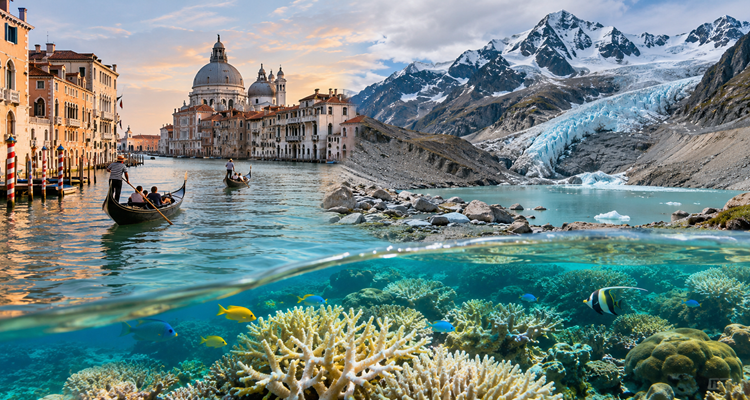
From Venice’s historic waterways to the coral gardens of Australia and the ancient monuments of Rapa Nui, some of the world’s most photographed destinations are changing in ways that a beautiful picture cannot reveal.
A photograph can preserve a perfect moment while concealing a troubling reality.
A visitor standing beside a Venetian canal sees centuries-old architecture reflected in the water. Someone snorkelling over the Great Barrier Reef photographs brilliant marine life. A traveller in Jordan captures the extraordinary sandstone façade of Petra.
These images suggest permanence. Yet the landscapes and landmarks behind them are anything but unchanging.
Across the world, famous destinations are experiencing glacier retreat, coastal erosion, coral bleaching, flooding and the gradual deterioration of historic structures. Some changes are immediately visible. Others unfold over decades, becoming apparent only when scientists compare measurements, historical records and photographs taken years apart.
The important distinction is that these places are not all disappearing in the same way. Some are losing natural features, others face damage to cultural heritage, and some are struggling to preserve the conditions that made them famous.
Understanding those differences reveals a more meaningful story than simply declaring that the world’s beautiful places are vanishing.
1. Venice, Italy: The city whose relationship with water is changing
But water, the defining feature of Venice’s beauty, is also one of its greatest long-term challenges.
Venice faces a combination of relative sea-level rise, land subsidence, periodic high tides and the difficulty of maintaining historic buildings in a lagoon environment. These pressures affect both the physical city and the surrounding ecosystem.
UNESCO recognises the vulnerability of Venice and its lagoon to natural and climate-related changes. The city’s MOSE system of mobile barriers was developed to help protect the lagoon from exceptional high tides.
For visitors, the threat can be difficult to recognise. A photograph of a gondola passing beneath a bridge may look much like one taken decades earlier. The more consequential changes are often recorded in water-level measurements, maintenance requirements and the condition of historic materials.
What is at risk: The preservation of Venice’s historic buildings, lagoon ecosystem and everyday life as a functioning city.
Venice is not about to disappear beneath the sea overnight. Its future depends on continuing investment, environmental management and adaptation.
2. The Great Barrier Reef, Australia: A living wonder that can lose its colours
Yet the reef’s appearance can change dramatically when corals experience prolonged heat stress.
Coral bleaching occurs when stressed corals lose the symbiotic algae that provide much of their colour and energy. Bleaching does not automatically mean a coral is dead. If conditions improve sufficiently, some corals can recover. Prolonged or repeated stress, however, can cause mortality and reduce the time available for recovery.
The Australian Institute of Marine Science’s August 2026 monitoring report illustrates why this distinction matters.
Its surveys of 121 reefs found that hard coral cover increased in the northern and central regions during the 2025–26 monitoring period and declined slightly in the southern region. The report also documented continuing pressure from climate-driven disturbances, cyclones and crown-of-thorns starfish.
That complexity is easy to overlook in tourism photography. A spectacular underwater image can be genuine while representing only a small, relatively healthy section of a much larger ecosystem.
What is at risk: Coral biodiversity, reef habitats, ecosystem resilience and the livelihoods connected to a healthy reef.
The Great Barrier Reef’s future is not predetermined, but limiting ocean warming is essential to its long-term survival.
3. Mount Kilimanjaro, Tanzania: The mountain losing its famous ice
For generations, the mountain’s snow and glaciers have helped define its visual identity. But that frozen landscape has been shrinking.
In a January 2025 UNESCO interview, glacier specialist Douglas Hardy explained that Kilimanjaro’s glacier surface area had declined by approximately 91% since the first mapping in 1912.
UNESCO World Heritage Centre
The loss is particularly striking because the mountain itself remains. Its volcanic slopes, trails and extraordinary elevation are not vanishing.
What is disappearing is a distinctive part of its landscape.
The mechanisms behind Kilimanjaro’s ice loss are complex, involving changing temperature, moisture, snowfall and atmospheric conditions. The retreat cannot be explained by a single hot season.
What is at risk: The mountain’s remaining summit glaciers and an irreplaceable record of past environmental conditions.
A photograph of Kilimanjaro may continue to look majestic long after its historic ice formations have changed beyond recognition.
4. Petra, Jordan: Ancient stone that is slowly being worn away
Its most photographed monument, Al-Khazneh, commonly called the Treasury, appears almost impossibly precise. The columns, decorative details and imposing façade seem to have survived unchanged for centuries.
But sandstone is vulnerable to weathering.
UNESCO identifies continuing erosion from wind and rain as a conservation concern at Petra. It also documents the risks of flash flooding, particularly along the Siq, the narrow gorge through which many visitors enter the archaeological site. Tourism pressure adds further management challenges.
In 2018, two flash floods affected the World Heritage site, prompting further work on flood-risk assessment and mitigation. UNESCO subsequently supported technical planning intended to improve protection.
Petra demonstrates a different kind of disappearance from a melting glacier.
The entire ancient city is not vanishing at a measurable, uniform rate. Instead, individual surfaces, archaeological features and vulnerable areas face gradual deterioration or episodic damage.
What is at risk: Irreplaceable carved details, archaeological remains and the integrity of the historic landscape.
Conservation work can reduce these threats, but once an original carved surface has been lost, replacing the material cannot fully restore its historical authenticity.
5. Rapa Nui, Chile: Ancient monuments at the edge of the ocean
Visitors photograph their monumental faces against open skies, volcanic landscapes and the Pacific Ocean.
Yet many of the island’s ceremonial platforms, known as ahu, stand close to the coastline, where erosion and powerful waves threaten archaeological remains.
The United Nations Environment Programme has documented the loss of carved rock heritage to coastal erosion. This is especially significant because the monuments are not simply tourist attractions: they are part of the living cultural inheritance of the Rapa Nui people.
What is at risk: Coastal ceremonial platforms, archaeological remains, ancestral heritage and the cultural landscape surrounding the moai.
The statues may appear immovable in photographs, but the ground supporting their history is not necessarily permanent.
6. The Maldives: Beaches that can change while tourists are enjoying them
Yet the low elevation of its islands makes the country especially exposed to rising sea levels, coastal flooding, erosion and saltwater intrusion.
According to the United Nations Development Programme, around 80% of Maldivian islands are approximately one metre above sea level.
The World Bank’s Maldives climate assessment projects sea-level rise of approximately 0.5–0.9 metres by 2100, with significant potential consequences for infrastructure, coastal communities and the tourism economy.
However, the claim that every Maldivian island will simply disappear by a particular year is misleading.
Coral islands are dynamic. Sand can be eroded, transported and deposited elsewhere. Some coastlines retreat while others change shape or are modified through engineering projects.
The most immediate concern is often not the complete disappearance of an island but whether its beaches, freshwater, buildings and essential infrastructure can remain safe and usable.
The Maldives has introduced coastal resilience initiatives, including projects focused on shoreline protection, monitoring and improved disaster preparedness.
What is at risk: Low-lying shorelines, freshwater resources, coastal settlements, coral ecosystems and tourism-dependent livelihoods.
A resort photograph may capture an immaculate beach without revealing the engineering, maintenance and environmental pressures involved in keeping it that way.
7. Huascarán National Park, Peru: A mountain landscape losing its frozen foundations
Huascarán National Park is admired for its extraordinary mountain scenery, but its glaciers also play an important role in regional water systems.
UNESCO’s 2022 assessment reported that glaciers in the park had shrunk by approximately 15% since 2000. Its World Heritage documentation identifies glacier retreat as a major long-term challenge for the landscape and surrounding communities.
As glaciers retreat, they can alter seasonal water availability and change the behaviour of high-altitude lakes and slopes. In some locations, unstable ice and rock can create serious hazards.
A 2025 assessment by Peru’s National Institute for Research on Glaciers and Mountain Ecosystems examined the danger of glacier and rock detachment at Huascarán Sur, reinforcing the importance of monitoring and preparedness.
For a tourist, a shrinking glacier may initially look like a slightly different snowline. For communities living downstream, it can represent a much more consequential transformation.
Why photographs often fail to reveal what is disappearing
These seven destinations have something important in common: their most familiar images show only a fraction of what is happening.
A photograph records visible conditions at one location and one moment. Environmental and heritage change often requires comparison across time.
Three factors make this especially difficult to recognise.
Change is often slower than a human visit
Most tourists spend days, not decades, at a destination.
A glacier retreating over many years or a sandstone monument losing material gradually may show little obvious change during a short trip.
Scientists detect these patterns through repeated surveys, satellite observations, historic photographs and environmental measurements.
Beauty can survive alongside deterioration
A coral reef can still contain colourful, thriving sections while nearby areas are damaged.
A historic city can remain architecturally magnificent while facing increasing maintenance costs and environmental stress.
A beach can look pristine even as its shoreline requires repeated restoration.
This means beautiful photographs are not necessarily deceptive. They are simply incomplete evidence.
The most important losses are not always visual
The disappearance of a glacier can affect water systems. Coral degradation can disrupt marine habitats. Coastal erosion can damage archaeological sites that carry deep cultural meaning.
What is lost may be ecological function, historical information or a community’s connection to a place not merely a scenic view.
Does tourism make these places disappear faster?
Tourism can contribute to environmental and heritage pressure, but it would be inaccurate to blame visitors for every threat described here.
Climate change is a major driver of glacier retreat, ocean warming and global sea-level rise. Local tourism cannot explain those changes on its own.
Nevertheless, tourism can intensify certain problems through overcrowding, physical wear, infrastructure development, waste, water demand and poorly managed coastal construction.
Petra and Venice both illustrate why visitor management forms part of broader conservation planning.
Tourism can also support preservation by providing employment, conservation funding and public interest in threatened places.
The relevant question is therefore not simply whether people should visit, but how tourism can benefit a destination without undermining what makes it valuable.
How to visit vulnerable destinations responsibly
Travellers do not need to stop appreciating remarkable places. But a more thoughtful approach can reduce avoidable pressure and make the experience more meaningful.
-
Respect protected areas and site restrictions. Stay on designated routes, avoid touching fragile monuments and follow reef protection guidance.
-
Choose responsible local operators. Look for businesses that follow environmental rules and support local conservation or heritage initiatives.
-
Learn about the people who live there. Historic cities, islands and cultural landscapes are not merely backgrounds for tourism photographs.
-
Avoid unnecessary environmental damage. Never stand on coral, disturb wildlife or remove natural or archaeological materials.
-
Support conservation without assuming that every project is effective. Prefer transparent programmes with clear objectives and evidence of their work.
-
Avoid treating vulnerable destinations as a last-chance checklist. Urgency-driven travel can increase pressure without contributing meaningfully to protection.
Before travelling, check current conditions, access restrictions and local safety guidance. Flooding, marine conditions and mountain hazards can change quickly.
Are these places destined to disappear?
Not necessarily.
One of the most misleading ideas surrounding threatened destinations is that every environmental trend leads inevitably to total loss.
Some changes, particularly the loss of ancient glacier ice or original archaeological material, cannot readily be reversed on human timescales.
Other outcomes depend substantially on conservation measures, future warming, environmental management and the ability of local communities to adapt.
UNESCO’s global glacier research offers a useful perspective. Its 2022 assessment projected that glaciers in approximately one-third of World Heritage sites containing glaciers would disappear by 2050. It also found that strong emissions reductions could help preserve glaciers in many other sites.
The difference between unavoidable loss and preventable damage matters.
It gives conservation efforts a purpose beyond documenting decline.
The photograph that future generations may see differently
There is something quietly powerful about an ordinary travel photograph.
A family posing beside a canal, a diver swimming over coral or a traveller standing beneath an ancient stone façade may believe they are recording a place that will always look much the same.
Decades later, the photograph could carry a different meaning.
It might show an ice formation that no longer exists, a reef before a major ecological change or a historic coastline before erosion altered its shape.
But that possibility should inspire understanding rather than fatalism.
These destinations are not simply attractions waiting to disappear. They are living environments, cultural landscapes and places where people continue to work, adapt and protect what matters.
The most meaningful travel photograph may not be the one that proves we visited a beautiful place. It may be the one that reminds us why the place was worth protecting.
This content is published for informational or entertainment purposes. Facts, opinions, or references may evolve over time, and readers are encouraged to verify details from reliable sources.