





The Tiny Ponds That Disappear Before Anyone Notices What They Kept Alive
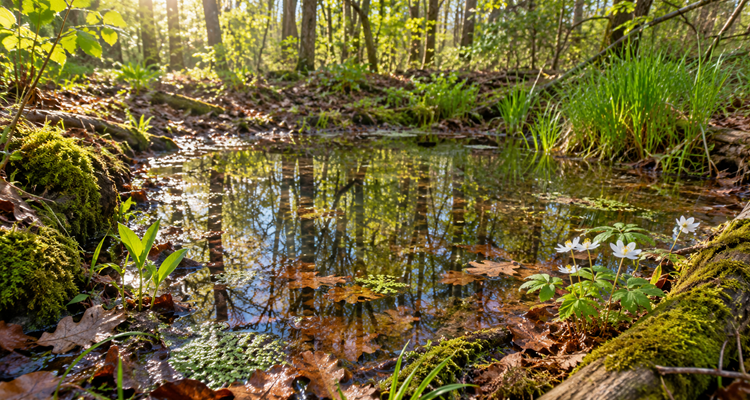
Small, seasonal ponds may look insignificant, but they can provide essential breeding grounds, shelter, and food for wildlife. Their disappearance reveals a conservation problem that often goes unnoticed until the habitat is already gone.
A shallow pool appears after a stretch of heavy rain. It gathers in a woodland hollow, a grassy depression, or an overlooked corner of farmland. Within days, insects begin moving across its surface. Frogs may arrive to breed. Beneath the water, tiny organisms feed, grow, and become part of a temporary but surprisingly complex food web.
Then the water disappears.
Sometimes this is exactly what nature intended. Many small ponds are seasonal, filling during wetter months and drying when conditions change. Their wildlife has evolved around that rhythm.
The greater danger comes when the pond itself disappears permanently filled with soil, drained for development, damaged by pollution, or cut off from the surrounding habitat.
What looks like an unimportant patch of standing water may be a breeding site for amphibians, a refuge for aquatic invertebrates, or one of the few remaining freshwater habitats in a heavily altered landscape.
Understanding these tiny ponds requires looking beyond their size. Their ecological importance lies in what happens during the brief periods when they hold water and in the life cycles that depend on their return.
A Pond Does Not Have to Be Permanent to Matter
Many people imagine a healthy pond as a permanent body of water, surrounded by vegetation and occupied by fish.
But freshwater habitats are far more varied.
Some ponds hold water throughout the year. Others appear only during rainy seasons, after snowmelt, or when groundwater levels rise. Certain temporary pools may remain dry for much of the year while still supporting specialized organisms.
Scientists often use the term temporary ponds for water bodies that predictably dry out. A particular category, known as vernal pools, typically fills seasonally and supports organisms adapted to periodic wet and dry conditions.
These habitats are not simply incomplete versions of larger lakes.
Their temporary nature helps determine which species can survive there.
In many seasonal pools, the absence of permanent fish populations is especially important. Fish can consume amphibian eggs, tadpoles, and aquatic invertebrates. Where fish cannot survive repeated drying, some vulnerable organisms gain access to breeding habitat with fewer aquatic predators.
That does not make every fishless pond equally valuable, nor does it mean temporary ponds are free from predators. Dragonfly larvae, aquatic beetles, and other organisms may still hunt within them.
Instead, seasonal drying creates a different ecological environment one that certain species are particularly well equipped to use.
The Hidden Lives Inside Shallow Water
The wildlife supported by temporary ponds varies by region, season, water chemistry, and surrounding habitat.
A pond’s importance is not measured simply by the number of animals visible at its surface.
Much of its ecological activity may occur underwater, within the sediment, or at times when few people are watching.
A shallow pool that appears almost empty in daylight may contain developing amphibians, dormant eggs, insect larvae, and microorganisms that support a wider food web.
Why Drying Out Can Be Part of Survival
The most unusual feature of a temporary pond is also one of its greatest ecological advantages: it does not always contain water.
Some organisms survive dry periods through resistant eggs or dormant life stages. Others complete their aquatic development quickly enough to leave before the habitat dries.
For amphibians, timing can be critical.
Adults may move into breeding ponds when rainfall and temperature create suitable conditions. Eggs develop into larvae, and the young must reach a stage at which they can survive on land before the water disappears.
If the pond dries too early, reproduction may fail.
If water remains long enough, however, the same seasonal habitat can support successful breeding without maintaining a year-round fish population.
This creates a delicate relationship between the duration of flooding known as the hydroperiod and the species that depend on it.
A pond that holds water for several weeks is not necessarily interchangeable with one that remains flooded for several months. Different species require different development times and environmental conditions.
That is why changing a pond’s natural water cycle can have consequences even when the pond itself remains physically present.
The Difference Between Natural Drying and Permanent Loss
A dry pond is not necessarily a dead pond.
This distinction is central to understanding seasonal freshwater habitats.
When a temporary pond dries naturally, its basin may still contain dormant eggs, seeds, and other biological material. The surrounding vegetation, soil, and seasonal water supply remain part of the habitat.
When rainfall returns, ecological activity can resume.
Permanent destruction is different.
Filling a depression, excavating its sediment, constructing a road through it, or changing the drainage of the surrounding land can eliminate the conditions that allowed the pond to function.
Even seemingly modest alterations may matter.
A drainage ditch can shorten the time water remains in a pool. Soil compaction can alter infiltration and runoff. Fertilizers and pesticides may change water quality. Removing nearby vegetation can affect shade, temperature, and the terrestrial habitat needed by amphibians.
The result is not always an immediately visible collapse.
Sometimes a pond continues to fill, but no longer holds water long enough for certain species to reproduce successfully.
Other times, the pool remains wet but becomes unsuitable for organisms that previously depended on it.
The habitat may appear to survive while its ecological function declines.
Why Small Ponds Are So Easily Overlooked
Large lakes, rivers, and wetlands are generally easier to recognize as important natural features. They appear on maps, shape landscapes, and often attract public attention.
Tiny seasonal ponds are less conspicuous.
Some are no larger than a small garden. Others occupy shallow woodland depressions or low-lying agricultural land. During dry months, their presence may be indicated only by subtle changes in soil, vegetation, or the shape of the ground.
This creates a problem for conservation.
A site inspected during the wrong season may appear to contain no freshwater habitat at all.
The University of New Hampshire Cooperative Extension explains that some vernal pools are overlooked in wetland mapping because of their small size and isolation. Construction and land alteration can therefore threaten habitats that have not been adequately identified.
A landscape containing many different ponds may support species with different ecological requirements. Losing the smallest ponds can therefore remove habitat types that larger water bodies cannot simply replace.
The Surrounding Land Is Part of the Habitat
Protecting a seasonal pond means protecting more than the water-filled depression.
For many amphibians, the pond is primarily a breeding site.
Once reproduction is complete, adults and newly developed juveniles may move into nearby woodland, grassland, or other suitable terrestrial habitats. They use these areas for feeding, shelter, and survival outside the breeding season.
The Vermont Fish & Wildlife Department notes that some woodland amphibians associated with vernal pools may travel hundreds of feet into surrounding forest habitat. Leaf litter, fallen logs, moist soil, and shaded conditions can all contribute to their survival.
Imagine a small woodland pool left untouched during a construction project. The water remains, but most of the surrounding trees are removed and roads are built nearby.
Amphibians may still reach the pond to reproduce. Yet the terrestrial habitat needed for the rest of their lives has been reduced, and their movements may become more dangerous.
Conservation therefore needs to consider the pond and its surrounding landscape together.
Climate Change Adds Another Layer of Uncertainty
Temporary ponds depend on seasonal patterns of rainfall, evaporation, temperature, and groundwater.
Climate change can alter those patterns.
In some regions, higher temperatures and changing precipitation may cause seasonal pools to dry earlier or remain flooded for shorter periods. Elsewhere, heavier rainfall or shifting seasonal conditions may change when pools fill.
The consequences depend on local climate, geology, and the organisms present.
A study published in Ecohydrology examined how vernal pools can provide breeding habitat for amphibians under drought and changing climatic conditions. It highlighted the importance of identifying pools whose water regimes remain suitable for reproduction.
Some specialized species depend on regular drying. Turning a seasonal pool into a permanent pond can alter its biological community and potentially allow fish or other organisms to become established.
The conservation challenge is to preserve the environmental conditions that support the pond’s characteristic wildlife, rather than treating permanent water as an automatic improvement.
Can a Tiny Pond Really Support a Larger Ecosystem?
Yes, although its contribution varies considerably from one pond to another.
A small pond can function as a breeding site, feeding area, seasonal water source, or refuge. It may also contribute to the movement of organisms across a landscape.
The effects extend beyond aquatic species.
Adult insects emerging from ponds may become food for birds, bats, and other insect-eating animals. Amphibians that breed in temporary water may later move through surrounding habitats, consuming invertebrates and becoming prey themselves.
Some ponds also support wetland plants and provide drinking water for terrestrial wildlife.
Freshwater Habitats Trust identifies clean ponds as important habitats for aquatic organisms and notes their broader value to farmland birds, pollinators, and mammals.
Water quality, duration of flooding, surrounding vegetation, connectivity, and the history of a site all influence its ecological value.
The important lesson is that a habitat’s size alone is a poor guide to what it supports.
What Happens When One Pond Disappears?
The consequences depend on the pond and the surrounding landscape.
If a seasonal pool is one of several suitable breeding sites within reach of a species, some organisms may be able to use alternatives.
But not every species can easily relocate.
Certain amphibians show strong fidelity to particular breeding sites, returning to the same pond across successive breeding seasons. Other organisms survive dry periods through eggs or dormant stages remaining in the sediment.
Destroying the pond basin can therefore remove not just water, but the biological material needed for future generations.
A permanent loss may involve several connected changes:
-
The disappearance of a breeding or developmental habitat.
-
The loss of dormant eggs, seeds, and specialized aquatic organisms.
-
Reduced connectivity between freshwater habitats.
-
Changes to local food webs and wildlife movement.
-
Greater pressure on remaining suitable ponds.
Not all these effects will occur at every site, and the magnitude of the impact requires local ecological assessment.
Still, the possibility of such losses makes early identification important.
Once a pond has been filled or its natural water regime substantially altered, restoring its former biological community may be difficult.
How to Recognize and Protect a Seasonal Pond
A shallow depression, water-stained leaves, distinctive sediment, or vegetation associated with periodic flooding may indicate a temporary wetland. These features alone are not enough to establish its ecological status, but they can justify closer examination.
For landowners, local communities, and conservation groups, several practical steps can help:
1. Observe the site across seasons. A single visit during dry weather may miss an important seasonal habitat.
2. Avoid unnecessary filling, drainage, or excavation. Altering the basin or its water supply can destroy the conditions that make the habitat valuable.
3. Protect surrounding vegetation. Nearby woodland, grassland, and natural ground cover may be essential for species that use the pond only during breeding.
4. Limit polluted runoff. Fertilizers, pesticides, sediment, and other contaminants can affect freshwater organisms.
5. Do not introduce fish or other aquatic animals. Introducing species can disrupt an existing community, particularly in naturally fishless ponds.
6. Seek local ecological guidance before restoration. Deepening a temporary pond or making it permanently wet is not necessarily beneficial.
These recommendations reflect an important conservation principle: protecting the existing ecological function of a habitat is often preferable to changing it based only on appearance.
Local wetland regulations and species-protection requirements should also be checked before any physical work.
The Problem With Protecting Only What We Can See
Conservation is often driven by visibility.
A large forest attracts attention when it is cleared. A river becomes a public concern when it is polluted. A lake shrinking over several years can be documented through photographs and satellite imagery.
A seasonal pond presents a different challenge.
It may disappear from view every year without anything being wrong.
That natural disappearance can make permanent destruction harder to recognize.
A person unfamiliar with the habitat might see a dry depression as unused land. A developer may encounter it outside the wet season. A passerby may never know that amphibians bred there only a few months earlier.
The distinction between temporary absence and permanent loss becomes crucial.
It also raises a broader question about how environmental value is recognized.
If a habitat is judged only by what it looks like at one moment, the organisms and ecological processes that depend on its seasonal cycle can be missed.
Protecting these places requires an understanding of time as well as space.
Why Their Future Matters
The significance of tiny ponds extends beyond the species living in any individual pool.
They demonstrate that ecosystems do not have to be large, permanent, or visually impressive to perform important ecological functions.
A temporary pond can be valuable precisely because it changes.
Its wet season allows aquatic organisms to reproduce and develop. Its dry season limits some predators and permits specialized survival strategies. Its surrounding land supports animals during the months when the water is absent.
Together, these features create a habitat that cannot always be replaced by a larger or deeper body of water.
Protecting seasonal ponds therefore requires more than preserving water wherever it appears. It means understanding which habitats naturally dry, which species depend on that cycle, and how land-use decisions affect their continued existence.
The Life That Remains After the Water Is Gone
By the end of a dry season, a temporary pond may look unremarkable.
Its surface is no longer reflective. Aquatic insects are absent from view. The shallow basin may be covered with leaves, grasses, or cracked sediment.
Yet the habitat’s story may not have ended.
Some organisms have already completed their aquatic development and moved elsewhere. Others may persist as dormant eggs or seeds, waiting for the return of suitable conditions.
What appears empty may still contain the biological potential for another season of life.
That is what makes these small freshwater habitats worth understanding before they are altered or destroyed.
Their importance is not always visible in the landscape, and it cannot always be measured by the water present on a particular day.
Sometimes the most consequential disappearance is not when a pond dries naturally, but when the place where it should return is gone forever.
This content is published for informational or entertainment purposes. Facts, opinions, or references may evolve over time, and readers are encouraged to verify details from reliable sources.