







The Strange Science of Animals Living in Human-Made Environments
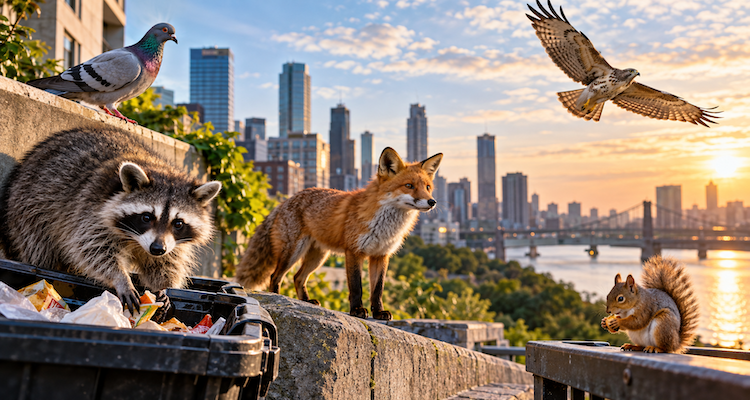
A building can be a home for people, but to wildlife it may also resemble a cliff, a tree cavity, a cave, a warm shelter or even a new feeding ground. Across cities and other human-dominated landscapes, animals are increasingly making use of structures never designed for them from bridges and rooftops to building cavities, tunnels, artificial nest boxes and wildlife crossings.
This is more than a collection of unusual animal sightings. Scientists are finding that some species can identify and exploit particular features of the built environment, sometimes adapting their behavior and even the materials they use. A 2026 study of wildlife interactions with buildings in Victoria, Australia, for example, documented 2,399 interactions involving 36 native species and 27 different building features.
But adaptation does not automatically mean success. The same structure that provides shelter can also expose an animal to predators, pollution, artificial light, disturbance or other ecological hazards. The science therefore reveals a more complicated relationship: human construction can destroy habitat, accidentally create habitat, and in some cases be deliberately redesigned to support wildlife.
Key Takeaways
- Buildings can provide wildlife with substitutes for natural nesting, roosting and shelter sites.
- Around 40% of the bat species assessed in one global study have been recorded roosting in human-made structures.
- Birds may use bridges, buildings and other structures because they resemble natural cliffs, cavities or elevated nesting sites.
- Human-made materials can become part of animal behavior, but they may sometimes reduce survival or reproductive success.
- Artificial wildlife structures work best when their design matches the ecological needs of the species they are intended to help.
- The emerging lesson is that architecture can function as habitat, whether designers intended it to or not.
When a Building Becomes a Habitat
Wild animals do not necessarily recognize a building as a “building.” They respond to its physical characteristics.
A roof cavity can provide the darkness and protection of a natural hollow. A bridge can resemble a cliff ledge. A roof can offer an elevated nesting location with fewer ground predators. A wall cavity can provide a sheltered space for an animal that would otherwise use a tree, rock crevice or cave.
This helps explain why wildlife use of buildings is not restricted to highly adaptable urban generalists.
A recent study published in People and Nature examined more than a decade of wildlife rescue records from Victoria, Australia. Researchers identified 2,399 relevant wildlife-building interactions involving 36 native species. Building cavities were the most frequently recorded locations, followed by shelters and garages, external surfaces, interior spaces, areas beneath houses and utility services.
The researchers found that animals tended to use architectural spaces in ways that corresponded with their natural ecology. Arboreal mammals, for example, were associated with upper cavities, while ground-dwelling species used spaces closer to foundations.
That observation points to an important principle: wildlife may not be adapting to buildings as a single environment. Instead, different species are effectively selecting particular architectural features that perform familiar ecological functions.
Bridges, Towers and Buildings Can Replace Natural Cliffs
Some of the clearest examples involve birds that naturally nest on cliffs.
Peregrine falcons are traditionally associated with steep cliffs, but they also nest on tall buildings and beneath suspension bridges. In cities, a high ledge can provide the elevation and relative protection that a natural cliff would provide.
The attraction is not necessarily the concrete or steel itself. It is the combination of height, shelter, visibility and access to surrounding habitat.
This distinction matters because it changes how scientists and conservationists think about urban wildlife. An animal using a building does not necessarily mean the species has fundamentally changed its ecological requirements. In some cases, the animal may simply be finding an artificial structure that happens to satisfy requirements that evolved in a very different landscape.
Birds have also been documented nesting on houses, factories, barns, bridges, pylons and other structures. A scientific review of man-made nesting sites found that these structures can provide valuable nesting opportunities where natural sites are limited.
But there is a critical qualification: an available nesting site is not necessarily a good nesting site.
Some artificial structures can become ecological traps. Animals may be attracted to a location because it appears suitable, while conditions ultimately reduce breeding success.
That distinction between attraction and actual habitat quality is one of the most important ideas in understanding wildlife living alongside people.
Bats Reveal How Widespread the Phenomenon May Be
Bats provide an especially striking global example.
A 2024 study examined anthropogenic roosting across 1,279 extant bat species. The researchers found that approximately 40% 511 species in their dataset had been recorded roosting in human-made structures.
These structures included buildings, bridges, mines and other artificial environments.
The researchers also identified characteristics associated with the ability to use human-made roosts. Anthropogenic roosting was associated with factors including broader geographic ranges, greater habitat breadth and insectivorous diets.
This does not mean that 40% of all bats live primarily in buildings, nor does it mean human structures are beneficial to bats. The finding is narrower and more useful: a substantial proportion of the species examined have demonstrated the ability to use structures created by humans as roosting sites.
That ability may become increasingly relevant as natural habitats are altered.
It also raises a deeper evolutionary question. When an animal repeatedly encounters artificial structures that resemble aspects of its natural habitat, does its existing behavioral flexibility allow it to exploit them, or can persistent urban environments eventually influence which traits are favored?
Current research cannot provide a simple answer. Adaptation occurs over different timescales, and using a building is not itself evidence of evolutionary change.
The Materials of the City Can Enter the Nest
The relationship becomes even stranger when animals begin incorporating human-made materials into structures they build themselves.
A 2026 study of 432 Azure-winged Magpie nests in Wuhan, China, examined how urbanization affected nest-material selection. Researchers found that the birds used both natural and anthropogenic materials, including polyester fibers and plastics.
The proportion of natural materials remained higher than anthropogenic materials across the studied environments, so the finding should not be interpreted as birds abandoning natural nesting materials.
Instead, the research illustrates behavioral flexibility. As birds live closer to buildings and other human infrastructure, materials associated with those environments can become locally available resources.
But availability does not guarantee that the material is harmless.
Research on clay-colored thrushes has found that exposed anthropogenic nesting materials can reduce nest survival, with synthetic materials potentially making nests more conspicuous to predators.
The broader lesson is uncomfortable: wildlife can become extremely good at using resources that humans leave behind, while still paying ecological costs for doing so.
Human-Made Habitat Can Help and Harm
The phrase “animals adapting to cities” can sound inherently positive. It is not.
An animal occupying a building may simply be surviving in a landscape where natural habitat has disappeared. A rooftop may provide safety from some predators but expose an animal to extreme heat. A nest box may solve a shortage of cavities but place birds in a location with poor food availability. A bridge may provide shelter while nearby traffic creates an entirely different danger.
Scientists therefore distinguish between habitat use and habitat quality.
This is particularly important for conservation projects. Artificial nest boxes, bat boxes, insect shelters and other structures can provide useful habitat, but their success depends on whether the surrounding environment actually supports the species.
Recent research on urban nest boxes illustrates the problem. A 2025 study of great tits and Eurasian blue tits in France found evidence that birds could show greater breeding investment in more urbanized locations while reproductive success was lower in association with urban infrastructure. The researchers interpreted this pattern as consistent with an ecological-trap mechanism.
In other words, an animal can make what appears to be a logical choice using environmental cues and still end up in a location that is less favorable for reproduction.
The New Frontier: Designing Buildings for Wildlife
This research suggests a shift in thinking about architecture.
Instead of asking only how wildlife can be prevented from entering buildings, researchers and designers can also ask which parts of buildings could safely function as habitat.
That does not mean turning every building into a wildlife sanctuary. It means identifying opportunities where architectural features can support biodiversity without creating unnecessary risks for either animals or people.
The principle is already visible in purpose-built conservation structures. Wildlife crossings, for example, are designed to reconnect habitats divided by roads and other infrastructure.
A large systematic review and meta-analysis examined 270 empirical studies of wildlife crossing structures. It found that design characteristics influenced how animals used them, and that structures designed specifically for wildlife generally performed better than structures intended for both humans and wildlife.
The Hainan gibbon provides another example. Researchers built an artificial canopy bridge across a forest gap and documented the critically endangered primates eventually using it. The bridge was not treated as a replacement for restoring forest habitat; rather, it was described as a potential short-term measure for reconnecting fragmented habitat.
That distinction is crucial.
The best artificial habitat is not necessarily the most elaborate structure. It is the structure that solves a specific ecological problem while fitting the behavior of the species.
What Cities Can Learn From Animal Behavior
The emerging science offers an unusual way to look at urban architecture.
A wall is not necessarily just a wall. A cavity can be a shelter. A bridge can be a corridor or nesting site. A rooftop can become a refuge. A poorly designed artificial habitat can become a trap.
Wildlife is effectively testing the ecological properties of the built environment every day.
For planners and architects, that creates an opportunity. Buildings can be designed with more attention to cavities, nesting opportunities, vegetation, lighting, connectivity and safe access. But such measures should be based on species-specific evidence rather than the assumption that any green or artificial feature automatically benefits wildlife.
For residents, the lesson is equally practical. Finding an animal in a roof, wall or garden does not necessarily represent an isolated curiosity. It may be evidence that a particular feature of the built environment has become part of the local ecosystem.
And for scientists, these interactions offer a natural experiment in behavioral flexibility: what happens when organisms encounter structures that did not exist in their evolutionary history but happen to resemble something they already know how to use?
Conclusion
The strangest part of animals living in human-made environments may not be that they have learned to tolerate concrete, steel and glass. It is that many of them can identify useful ecological opportunities hidden inside those materials.
A cavity can substitute for a tree hollow. A tall building can substitute for a cliff. A bridge can become a shelter or movement route. Even discarded synthetic fibers can become nesting material.
But coexistence is not measured simply by whether an animal occupies a human structure. The more important question is whether that structure actually improves the animal’s chances of surviving and reproducing.
That distinction turns an interesting collection of urban wildlife stories into a broader scientific lesson: cities are not merely places where nature has been replaced. They are increasingly complex ecosystems in which natural and artificial habitats overlap and where the design of human infrastructure can influence what wildlife is able to do next.
This content is published for informational or entertainment purposes. Facts, opinions, or references may evolve over time, and readers are encouraged to verify details from reliable sources.