






Why the Best Teacher in a Classroom May No Longer Be the Person at the Front
For generations, the classroom has been organized around a simple structure: one teacher explains, a group of students listens, and those who need additional help raise their hands. Artificial intelligence is beginning to disrupt that arrangement not by proving that machines are better teachers in every situation, but by making something previously difficult to scale much more accessible: individualized instruction.
Recent controlled studies suggest that well-designed AI tutors can provide useful explanations, ask guiding questions, adapt to a learner’s responses and sometimes produce learning gains comparable to, or better than, conventional instruction in narrowly defined settings. At the same time, the strongest evidence does not point toward removing teachers. It points toward changing what teachers spend their time doing.
The important question, therefore, is not whether AI can replace the person at the front of the classroom. It is whether the person at the front should remain the primary source of every explanation, correction and practice exercise when every student can potentially have a responsive tutor beside them.
Key Takeaways
- Controlled studies increasingly show that carefully designed AI tutoring can improve learning in specific subjects and settings.
- AI’s strongest educational advantage may be individualized feedback rather than simply providing faster answers.
- Human teachers remain essential for judgment, motivation, relationships, ethics and understanding the wider classroom context.
- Evidence also shows that poorly designed or unsupervised AI use can encourage dependence and weaken deeper learning.
- The emerging model is less “teacher versus AI” and more teacher-led learning supported by personalized AI assistance.
- The real educational advantage may come from giving teachers more time to teach what machines cannot easily reproduce.
The Classroom’s Old Bottleneck Was Individual Attention
A teacher can explain a concept to 30 students, but those students do not necessarily arrive with the same background knowledge, misconceptions or learning pace.
One student may understand a mathematical concept immediately. Another may need three examples. A third may understand the formula but not know when to apply it. A fourth may be reluctant to ask for help in front of classmates.
Individual tutoring has long been regarded as one of the most effective forms of educational support, but providing high-quality one-to-one tutoring at scale is expensive and difficult.
AI changes the economics of that problem.
A conversational tutor can interact with one learner at a time, respond to mistakes and continue explaining without requiring another teacher to be physically available. The potential is particularly significant for practice and formative feedback the moments between formal lessons when students discover that they do not understand something.
This is where the phrase “best teacher” needs to be reconsidered. The most useful instructional system may not be a single person delivering every part of a lesson. It may be a combination of human judgment and machine-scale personalization.
Evidence Is Beginning to Move Beyond the Hype
The most interesting developments are not product demonstrations but controlled experiments.
In a 2025 randomized controlled trial involving 194 Harvard undergraduates studying introductory physics, researchers compared an AI tutor with an active-learning classroom approach. Students using the AI tutor showed larger learning gains in the study’s two lessons and completed the AI-tutored material in a median of 49 minutes, compared with a 60-minute learning period in the classroom condition.
That result is significant but it needs to be read carefully.
The experiment involved a specific AI tutor designed around established principles of learning science, a specific university course and a relatively small number of lessons. It does not demonstrate that a general-purpose chatbot is better than a good teacher, nor does it establish that AI tutoring produces better long-term learning across subjects and age groups.
A second randomized trial provides another useful piece of the puzzle.
Researchers working with Eedi tested Google’s LearnLM in mathematics with 165 students aged 13 to 15 across five UK secondary schools. The AI sessions were not simply left to operate independently: expert human tutors supervised the system and could approve, edit or replace its responses.
Students receiving supervised AI tutoring performed at least as well as those receiving human tutoring on the measured learning outcomes. They were also 5.5 percentage points more likely to solve novel problems on subsequent topics.
The distinction is crucial. The experiment was not “AI replaces teachers.” It was closer to “AI generates individualized tutoring support under human supervision.”
That may be a much more realistic model for education.
The Most Powerful Change May Be Personalization
Traditional classroom teaching has to balance two competing requirements: teach the group efficiently while responding to individual needs.
AI potentially reduces that conflict.
A student can ask the same question five different ways without worrying about holding up the class. An AI tutor can generate another example, change the explanation, provide a hint rather than the answer, or ask a question designed to expose the student’s misunderstanding.
That last capability matters.
A system that simply supplies answers can make learning easier in the short term while reducing the amount of thinking a student does. A system designed around questioning and scaffolding can instead make the learner do more of the cognitive work.
Research published in 2025 reviewing 68 experimental studies found an overall positive effect of generative AI interventions on learning outcomes, but also reported very high variation between studies. The researchers found that educational level, subject, intervention length and sample size affected the results.
In other words, “AI improves learning” is too broad a conclusion.
A more defensible conclusion is that some forms of AI-supported learning can work well when the technology, instructional design, subject and learner are appropriately matched.
That distinction should remain at the center of the education debate.
Where Human Teachers Still Have an Advantage
Education is not simply the transfer of information.
A teacher sees a student who has stopped participating. A teacher can notice tension between classmates, understand a student’s circumstances, recognize when confusion is really a lack of confidence, and decide when pushing harder is useful and when it is counterproductive.
Those decisions involve social context and professional judgment.
UNESCO’s guidance on AI in education therefore emphasizes a human-centred approach. Its teacher competency framework describes education as moving toward a teacher-AI-student relationship rather than simply replacing teachers with technology.
That distinction is increasingly important as AI becomes more capable.
A machine may be able to explain Newton’s laws thousands of different ways. That does not mean it should decide what a particular student needs from school, how a classroom community should function, or what values should guide education.
Teachers also provide something difficult to reduce to an interface: accountability.
When a teacher says, “Show me how you reached that answer,” the student is being asked to demonstrate understanding. When an AI gives an immediate solution, the temptation to accept the answer without thinking can be much stronger.
The quality of the educational system will therefore depend partly on how AI is used, not simply on how intelligent the model becomes.
The Biggest Risk Is Not That AI Teaches Too Little
It may be that AI teaches too easily.
A student who can obtain an essay, solution or explanation instantly has less reason to struggle through the problem independently.
This creates a paradox. The same technology that can provide highly personalized instruction can also become a shortcut around learning.
A 2025 meta-analysis of research into ChatGPT and student engagement found positive effects across behavioral, cognitive and emotional engagement, but also identified over-reliance as a potential risk. Another 2026 systematic review of 88 empirical studies on large language models in education identified benefits alongside concerns involving over-reliance, privacy, fairness, technical reliability and assessment.
The educational question is therefore shifting from “Can AI answer students’ questions?” to a harder one:
Does the interaction make the student more capable of answering the next question without AI?
That is a much higher standard.
A good AI tutor should not merely solve today’s problem. It should help the learner develop the knowledge and reasoning required for tomorrow’s problem.
The Teacher’s Job May Become More Important, Not Less
If AI takes over some repetitive explanations, practice exercises and routine feedback, teachers could theoretically spend more time on higher-value work.
That might include discussion, mentoring, project-based learning, difficult conceptual questions, collaboration, creativity, emotional support and identifying when a student’s problem is not actually academic.
There is already evidence for this hybrid approach.
In Stanford’s Tutor CoPilot research, an AI system assisted human tutors in real time rather than replacing them. In a randomized controlled trial involving more than 1,000 students and over 700 tutors, students whose tutors used the system were four percentage points more likely to master math topics. The gains were larger among students working with lower-rated tutors.
That finding points toward a potentially important role for AI: raising the floor of instructional support rather than eliminating the teacher.
Instead of asking every teacher to become an expert in every student’s individual misconception, AI can help surface possibilities, suggest questions and provide instructional assistance.
The teacher remains responsible for deciding what matters.
A New Classroom Could Have More Than One Teacher
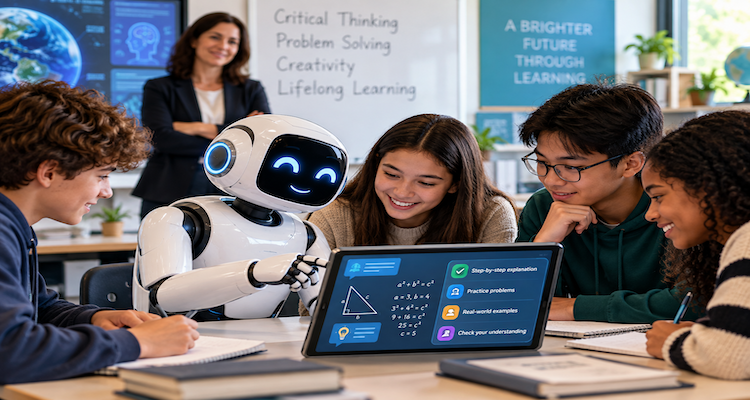
The classroom of the future may look less like a teacher standing at the front and more like an instructional network.
There could be a human teacher responsible for the class, several AI tutors providing individualized practice, digital tools tracking progress, collaborative projects requiring students to work together, and human intervention when a learner needs something technology cannot provide.
This model also creates new responsibilities.
Schools will need policies covering student privacy, age-appropriate use, assessment, bias, reliability and acceptable levels of AI assistance. Teachers will need enough AI literacy to recognize both useful and harmful applications.
UNESCO has repeatedly emphasized that AI should complement rather than substitute for teachers and that education systems need safeguards around privacy, equity and human agency.
The evidence so far supports that caution.
AI tutoring is promising. It is not universally proven. Its effectiveness depends heavily on design and context, and research into long-term effects is still developing.
The Real Competition Is Between Instructional Models
The most misleading question is whether AI will replace teachers.
The more useful question is whether schools can build better learning environments by combining the strengths of humans and machines.
AI is unusually good at scale, repetition, rapid feedback, personalization and being available whenever a learner needs help. Teachers are unusually good at judgment, relationships, motivation, context, ethics and understanding people.
Neither description is absolute. AI can make mistakes, and teachers can also provide inconsistent instruction. But the differences are meaningful enough to suggest a division of labor.
The classroom teacher may no longer need to be the person who provides every answer.
That could be a threat if it reduces teachers to supervisors of machines. It could be an opportunity if it frees teachers to spend more time on the parts of education that require human judgment.
The strongest evidence currently points toward the second possibility not a classroom without teachers, but a classroom where teachers are no longer forced to do everything alone.
Conclusion
The best teacher in an AI-enabled classroom may not be the person standing at the front, and it may not be the AI on the student’s screen.
It may be the learning system that combines both effectively.
The real breakthrough is not that a machine can explain a lesson. Machines have been doing versions of that for years. What is changing is the possibility of giving each learner individualized interaction at a scale that traditional classrooms struggle to provide.
But personalization without judgment can become dependence, and intelligence without human context is not education.
The teacher’s role is therefore likely to evolve rather than disappear. The strongest classrooms may be those in which AI handles more of the repetitive and individualized instructional work while teachers concentrate on helping students think, question, collaborate, persist and understand why knowledge matters.
The future of teaching may not put AI at the front of the classroom.
It may put a capable AI beside every student and a better-supported human teacher behind the whole system.
The information presented in this article is based on publicly available sources, reports, and factual material available at the time of publication. While efforts are made to ensure accuracy, details may change as new information emerges. The content is provided for general informational purposes only, and readers are advised to verify facts independently where necessary.