









The Earthworms That Escape From the Ground Before a Storm Nobody Can See
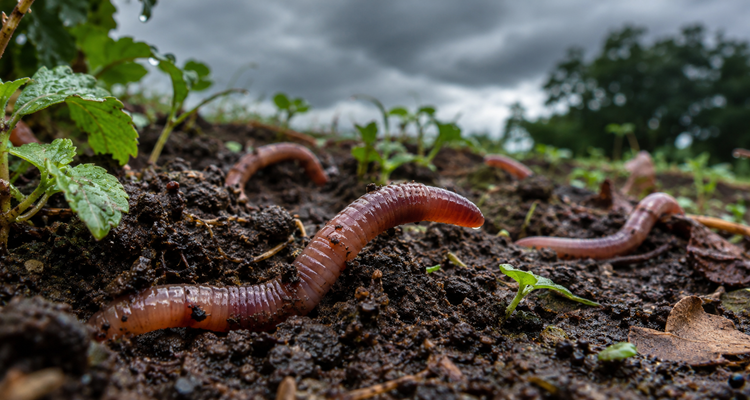
Earthworms can respond to subtle changes beneath our feet, sometimes appearing when the sky still looks calm. But are they sensing an approaching storm, or is something more complicated happening underground?
A garden can look perfectly ordinary one moment and strangely alive the next. Across the soil, earthworms begin emerging from their burrows. Some stretch across damp pathways. Others move through grass or gather near the edges of pavement.
There may be no visible rain, no thunder, and no obvious reason for their sudden appearance.
For generations, such observations have encouraged a fascinating idea: perhaps earthworms can detect approaching storms before humans notice anything unusual.
There is a scientific reason to take the question seriously. Earthworms live in an environment where moisture, oxygen availability, and vibrations can influence their survival and movement. They respond to physical conditions that people standing aboveground may barely notice.
But there is an important difference between responding to environmental changes and predicting a storm that has not yet arrived.
Research supports several explanations for why earthworms emerge from the ground. What it does not establish is that they possess a reliable, advance-warning system for approaching storms.
Understanding that distinction reveals something more interesting than a simple weather prediction: the extraordinary sensitivity of animals living beneath our feet.
The Underground World Earthworms Depend On
To understand why an earthworm might leave its burrow, it helps to imagine the soil from the worm’s perspective.
Soil is not a solid, uniform mass. Between mineral particles, organic material, and plant roots are tiny spaces containing varying amounts of air and water.
These spaces are essential to underground life.
Earthworms have no lungs. Instead, oxygen passes through their moist skin and enters their circulatory system. Carbon dioxide moves outward through the same surface.
This means their survival depends on maintaining suitable moisture while also obtaining enough oxygen.
When soil becomes too dry, earthworms risk dehydration. When it becomes excessively waterlogged, oxygen availability may decline.
Water moving into the ground fills spaces that previously contained air. At the same time, a newly wet surface can provide earthworms with an opportunity to travel without losing moisture as quickly.
According to the Earthworm Society of Britain, the reasons earthworms surface during rainy weather are not completely understood, although movement across wet ground is among the better-supported explanations.
The important point is that coming to the surface does not always indicate distress. Sometimes it may be an opportunity.
Can Earthworms Detect a Storm Before the Rain Begins?
The idea is plausible in a limited sense, but it requires careful interpretation.
An approaching storm can be associated with changes in atmospheric pressure, humidity, temperature, wind, and other environmental conditions.
Some animals respond to weather-related cues. However, that general observation cannot automatically be extended to earthworms.
There is not sufficient direct evidence to conclude that earthworms consistently detect approaching storms through atmospheric pressure changes or that they reliably emerge before rainfall begins.
An earthworm appearing under a clear sky might be responding to moisture already present in the soil, local vibrations, nighttime conditions, or another environmental factor.
The sky above a garden and the soil beneath it do not necessarily tell the same story.
For example, a lawn might remain damp after earlier rainfall or irrigation even while the weather overhead appears dry. Earthworms could take advantage of those conditions without detecting anything about the future.
This distinction matters because an unusual observation can be genuine even when its popular explanation is incorrect.
Earthworms do not need a mysterious ability to predict the weather to demonstrate remarkable environmental sensitivity.
The Surprising Role of Vibrations Beneath the Soil
One of the most intriguing findings in earthworm research concerns their response to vibrations.
Earthworms lack ears like ours, but some species are highly responsive to mechanical disturbances traveling through the ground.
Researchers have demonstrated this through an unusual traditional practice known as worm grunting.
In parts of the southeastern United States, people have long collected earthworms by driving a wooden stake into the ground and scraping it with another object.
The resulting vibrations can cause worms to emerge.
A study published in Biology Letters investigated this behavior in earthworms belonging to the genus Diplocardia. Researchers found that the animals emerged within minutes of the vibration stimulus and that fewer worms appeared as the vibrations weakened with distance.
The findings demonstrated that ground-borne vibrations can trigger a strong emergence response in these worms.
But why would an earthworm respond by moving toward the surface?
One compelling explanation involves predators.
Escaping an Enemy Underground
Moles hunt earthworms beneath the soil. Their digging creates vibrations that can travel through the surrounding ground.
For an earthworm, those disturbances may signal immediate danger.
In a separate experimental investigation published in PLOS ONE, researchers observed earthworms escaping to the surface in response to digging moles and showed that worm-grunting vibrations could imitate aspects of that threat.
Some worms even moved away from the approaching predator.
This creates an interesting possibility: certain vibrations associated with rain might resemble other disturbances underground.
However, the evidence does not show that rain and mole activity produce identical responses.
In fact, experiments involving Diplocardia earthworms found that prolonged rainfall caused very little emergence compared with the strong response to worm grunting.
The researchers’ results supported predator avoidance more strongly than the idea that these particular worms were simply mistaking rain for a mole.
That finding is important because it shows why earthworm behavior cannot be explained by a single universal rule.
Different stimuli can produce different responses, even within the same species.
Why Heavy Rain Can Drive Some Earthworms to the Surface
Another explanation involves oxygen.
When heavy rainfall saturates soil, water fills spaces that normally contain air. Oxygen moves much more slowly through water than through air, potentially making it harder for earthworms to obtain enough oxygen.
Yet the familiar explanation that all earthworms surface because they are about to drown is misleading.
Many earthworms can survive underwater for extended periods, provided enough dissolved oxygen is available. Their ability to tolerate flooded soil varies considerably between species.
A 2008 study in Invertebrate Biology examined two species with different responses to waterlogged conditions.
Researchers found that Amynthas gracilis had relatively poor tolerance to immersion and was more likely to emerge after heavy rain, particularly at night when its oxygen consumption increased.
By contrast, Pontoscolex corethrurus tolerated immersion better and did not display the same emergence behavior.
The researchers concluded that the two species used different physiological strategies to cope with low-oxygen conditions.
This helps explain why one garden may suddenly contain numerous surface-active worms while another nearby location shows little activity.
Species differences, soil structure, drainage, and local environmental conditions can all influence what happens.
It also suggests that the timing of emergence matters. Worms escaping oxygen-poor soil after prolonged rainfall are responding to an existing condition, not necessarily forecasting a future one.
Sometimes the Rain Creates an Opportunity, Not a Threat
Earthworms face an important problem when traveling aboveground: their skin must remain moist.
On a hot, dry surface, moisture loss can become dangerous. Bright sunlight and exposure make daytime travel particularly risky.
Wet weather changes that calculation.
A rain-soaked lawn or pathway provides a relatively moist environment in which earthworms can move across the surface.
This may allow them to reach new patches of soil, find food, or encounter potential mates more efficiently than they could by tunneling underground.
The US National Institute of Environmental Health Sciences explains that surface movement during wet conditions is a significant reason earthworms appear on sidewalks after rainfall.
The agency also notes that oxygenated water does not automatically cause earthworms to drown.
What looks like a mass escape from an approaching disaster may therefore be something quite different.
For some worms, a wet surface is a temporary travel corridor.
This distinction changes how we interpret their behavior.
A worm emerging during rainfall is not necessarily fleeing an uninhabitable burrow. It may simply be taking advantage of conditions that make movement safer.
What Earthworm Behavior Can and Cannot Tell Us About the Weather
EVIDENCE AT A GLANCE
| Observation or claim | What the evidence supports |
| Worms emerge during wet weather | Well documented, although the reasons vary |
| Worms detect soil vibrations | Experimentally demonstrated in certain species |
| Flooded soil can drive worms upward | Supported for some species under low-oxygen conditions |
| Worms emerge before invisible storms | Not established as a consistent, predictive behavior |
| Worms reliably predict rainfall | Insufficient scientific evidence |
The central difficulty with using earthworms as weather indicators is that the same visible behavior can have several causes.
A worm moving across a garden path might be responding to moisture, seeking another habitat, avoiding a predator, or reacting to unsuitable conditions underground.
Without measuring those conditions, an observer cannot confidently identify the cause.
And even if worms appear before a storm, that sequence alone does not prove they detected the approaching weather.
To demonstrate genuine predictive ability, researchers would need to observe earthworm emergence alongside reliable measurements of rainfall, soil moisture, atmospheric pressure, temperature, and other relevant variables.
They would also need to compare storm days with similar days when no storm occurred.
Most importantly, the behavior would have to provide a repeatable warning before rainfall, rather than simply correlate with conditions that already favor surface activity.
The existing studies discussed here do not establish such a forecasting ability.
Why Earthworms Sometimes Appear When the Sky Is Clear
A clear sky can make the appearance of earthworms seem especially mysterious.
But the conditions influencing underground animals are not always visible from above.
Consider a garden after a warm afternoon.
The air may feel dry, yet shaded soil beneath vegetation could retain moisture. Irrigation might have dampened one part of the garden while leaving another dry. A recent shower may have passed hours earlier.
Earthworms respond to their immediate surroundings, not necessarily to the weather conditions a person notices while looking toward the horizon.
There is also a timing problem.
Someone who notices worms before a storm may remember the observation because the subsequent rain makes it seem significant.
But what about the occasions when earthworms emerge and no storm follows?
Those events are less likely to become memorable stories.
This is an example of how selective observation can make an apparent pattern seem stronger than it really is.
The behavior itself deserves scientific attention. The weather-prediction interpretation requires separate evidence.
Can You Observe This Behavior in Your Own Garden?
A garden provides an accessible place to investigate how earthworms respond to changing conditions.
The most useful approach is to record observations rather than assume every appearance signals rain.
Try noting:
-
Time and weather: Whether worms appear during daylight, after sunset, before rain, or after rainfall.
-
Soil conditions: Whether the ground is dry, damp, saturated, or recently watered.
-
Location: Whether worms appear on grass, bare soil, pathways, or near drainage areas.
-
Recent disturbances: Whether digging, mowing, footsteps, or other activities might have affected the soil.
-
What happens afterward: Whether rainfall actually follows and how long the worms remain visible.
Observing the same location over several weeks can reveal patterns that a single dramatic event cannot.
For a more meaningful comparison, include days when no earthworms appear and days when no rain occurs.
Avoid deliberately flooding soil or disturbing worms to force a response. Passive observation is enough to explore the question without unnecessarily stressing the animals.
Such observations would not constitute proof of storm prediction, but they could help distinguish the effects of recent moisture from those of approaching weather.
What Happens to Earthworms That Cannot Return Underground?
Not every earthworm that reaches the surface successfully returns to the soil.
During wet weather, worms may cross sidewalks, driveways, and other exposed areas.
When those surfaces dry, conditions can become dangerous.
Because earthworms rely on moist skin for gas exchange, dehydration can interfere with their ability to survive.
An animal that was able to travel safely across a wet pavement during the night may become stranded when sunlight and rising temperatures dry the surface.
This is one reason earthworms are sometimes found dead on sidewalks after rain.
Their presence does not necessarily mean they emerged in distress. The danger may arise later, when favorable conditions disappear.
If you find a living earthworm stranded on hot pavement, gently moving it to nearby moist, shaded soil may help. Avoid placing it in standing water or handling it excessively.
The Bigger Story: A Living World Beneath Our Feet
Earthworms are easy to overlook because much of their activity takes place underground.
Yet their behavior is connected to processes that shape the health of soils and ecosystems.
As they move through the ground, many earthworm species create burrows, redistribute organic material, and contribute to decomposition and nutrient cycling.
Their activity can influence soil structure, water movement, and the conditions experienced by plant roots and microorganisms.
These ecological roles are among the reasons earthworms attract sustained scientific interest.
Understanding when and why they move is therefore more than a curiosity about rainy sidewalks.
It offers a glimpse into how underground animals navigate a changing environment.
The scientific evidence also reminds us that earthworms are not all alike. Different species inhabit different soil layers, tolerate different conditions, and respond differently to environmental disturbances.
A behavior observed in one species or region should not automatically be treated as universal.
The Mystery Is Real, Even Without a Weather-Predicting Power
The image of earthworms emerging before an unseen storm is compelling because it suggests a hidden conversation between animals and the environment.
There is some truth in that broader idea.
Earthworms are sensitive to physical conditions that humans may not readily notice. Research has demonstrated responses to underground vibrations, and other studies have shown how moisture and oxygen availability can influence emergence.
But the strongest available evidence does not establish that earthworms consistently sense distant storms before rain begins.
Their appearance may reveal something about the soil beneath our feet rather than the weather approaching from miles away.
And perhaps that is the more interesting discovery.
A garden that appears motionless to us is filled with organisms continuously responding to moisture, movement, oxygen, and danger.
The earthworms are not necessarily announcing a storm. They are responding to a world we rarely stop to notice.
This content is published for informational or entertainment purposes. Facts, opinions, or references may evolve over time, and readers are encouraged to verify details from reliable sources.