








The Animals That Can See Colours Humans Have Never Experienced
From birds that detect ultraviolet patterns to butterflies with extraordinary colour sensitivity, the natural world contains visual experiences that human eyes cannot reproduce.
Imagine looking at a flower and seeing a pattern that is completely invisible to everyone around you. Or watching a bird whose feathers display signals that human observers cannot detect, even in bright daylight.
For many animals, these abilities are part of everyday life.
Humans experience an impressive range of colours, but our vision captures only a portion of the information available in light. Birds, bees, butterflies, certain marine creatures and even reindeer can detect wavelengths or visual properties that ordinary human vision cannot access.
Some possess additional types of colour-sensitive cells. Others detect ultraviolet light, while certain species can sense the polarization of light—a property that does not appear as a separate colour to us.
But there is an important scientific distinction: detecting light that humans cannot see does not necessarily mean experiencing a completely new colour. Scientists can study what animals detect and how they respond, but they cannot directly observe another species’ subjective visual experience.
Understanding that distinction makes animal vision even more fascinating.
Why Humans Cannot See Every Colour in Nature
Human colour vision generally relies on three types of cone cells in the retina. These photoreceptors respond most strongly to different, overlapping portions of the visible spectrum, commonly described as short, medium and long wavelengths.
The brain compares their signals to construct our experience of colour.
Most people can detect light across approximately 380 to 700 nanometres, although the exact boundaries vary with the observer and viewing conditions.
Light also exists beyond those limits.
Ultraviolet light has shorter wavelengths than the violet end of our visible spectrum. Infrared light has longer wavelengths than the red end.
These forms of electromagnetic radiation are physically real, even though ordinary human vision does not reveal them.
Some animals possess visual systems adapted to detect light outside the normal human range. Others divide the visible spectrum differently, potentially allowing them to distinguish signals that look identical to us.
The result is not one universal animal version of the world. It is a collection of visual systems shaped by different evolutionary needs.
1. Birds: A Hidden Dimension in Their Feathers
A bird’s feathers may look ordinary to a human observer while communicating additional information to another bird.
Many birds possess four classes of single-cone photoreceptors involved in colour vision, compared with the three typically used by humans. Depending on the species, one of these receptor classes is particularly sensitive to ultraviolet or violet wavelengths.
This means that some birds can detect differences in plumage that humans cannot distinguish without specialized instruments.
For example, two birds may appear to have similarly coloured feathers to us, yet their feathers may reflect ultraviolet light differently.
Such signals can potentially contribute to mate choice, species recognition and other visual interactions.
A scientific review by Bennett and Cuthill, published in Vision Research, examined how ultraviolet vision might contribute to avian communication, foraging and navigation. The researchers emphasized that its function cannot simply be assumed to be identical across all bird species.
Bird vision also involves specialized oil droplets in the retina that filter incoming light and help shape spectral sensitivity.
What humans miss: Ultraviolet reflectance patterns and colour distinctions that can matter to birds but remain invisible to our unaided eyes.
2. Butterflies: More Photoreceptors Than Humans
Their eyes are structurally different from ours.
Instead of a single camera-like eye, butterflies have compound eyes made from numerous small visual units called ommatidia.
Many butterfly species possess six or more classes of photoreceptors with different spectral sensitivities.
The Japanese yellow swallowtail (Papilio xuthus) is an especially interesting example.
Its eyes contain receptors sensitive to ultraviolet, violet, blue, green, red and broader wavelength ranges.
However, having six receptor classes does not necessarily mean using all six as independent colour channels.
Research reviewed by visual scientist Kentaro Arikawa in The Journal of Physiology indicates that this butterfly uses four receptor classes—ultraviolet, blue, green and red—for wavelength discrimination.
The researchers also found that the butterflies could distinguish wavelength differences as small as 1–2 nanometres in certain regions of the spectrum, demonstrating remarkably precise discrimination under experimental conditions.
This sensitivity can help butterflies identify flowers and interpret visual signals relevant to their survival.
What humans miss: Ultraviolet information and certain fine spectral distinctions that butterflies can detect through their specialized visual systems.
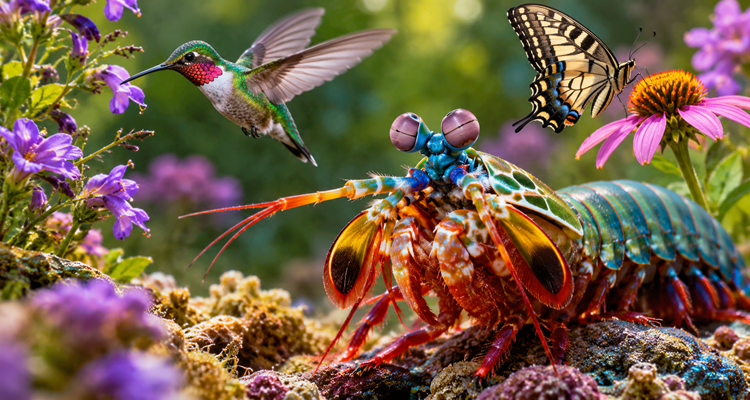
3. Mantis Shrimp: The Most Misunderstood Colour-Vision Champions
Few animals have attracted as much attention for their vision as the mantis shrimp.
These colourful marine crustaceans have some of the most elaborate eyes studied in the animal kingdom.
Certain species possess 12 types of spectral photoreceptors, with sensitivity extending from ultraviolet into the red region of the spectrum.
For comparison, humans normally use three cone classes for colour vision.
At first glance, this sounds like evidence that mantis shrimp must perceive a spectacular range of colours far beyond human imagination.
But scientific experiments revealed something unexpected.
In a 2014 study published in Science, researchers trained mantis shrimp to recognize particular wavelengths of light and tested how accurately they could distinguish nearby wavelengths.
Despite their large number of photoreceptor classes, the animals performed surprisingly poorly at fine wavelength discrimination compared with humans and some other animals.
The researchers proposed that mantis shrimp process colour differently, potentially recognizing spectral information through a system that prioritizes rapid identification rather than extremely fine comparisons.
A 2022 scientific review confirmed that many questions remain about how mantis shrimp process and use their unusual visual signals in natural environments.
Their eyes can also detect properties of polarized light, adding another remarkable dimension to their sensory abilities.
What humans miss: Ultraviolet and polarization information that mantis shrimp can detect, although their precise subjective experience remains unknown.
The important lesson is that more photoreceptors do not automatically produce better colour vision.
4. Bees: Flowers Have Signals We Cannot See
Honeybees have three principal colour-receptor classes, like humans, but their spectral sensitivities are shifted.
Their photoreceptors are sensitive to ultraviolet, blue and green wavelengths rather than the short-, medium- and long-wavelength arrangement characteristic of human colour vision.
Consequently, bees can detect ultraviolet patterns on some flowers that are invisible to us.
These markings are often described as nectar guides because they can help pollinating insects locate the parts of flowers associated with nectar or pollen.
Not every flower has such guides, and their appearance and importance vary among plant and pollinator species.
Bees also differ from humans in another way: their colour discrimination does not extend through the red region in the same manner as normal human vision.
A red flower may therefore provide a very different visual signal to a bee, depending on its reflectance across wavelengths the bee can detect.
This is a useful reminder that animal vision involves trade-offs. Bees detect ultraviolet information that humans normally cannot, but humans distinguish some long-wavelength colours differently.
What humans miss: Ultraviolet floral patterns that can help guide pollinators toward food.
5. Reindeer: Seeing Ultraviolet Light in the Arctic
The Arctic presents unusual visual challenges.
Snow and ice reflect substantial amounts of ultraviolet light, while the region’s seasonal lighting conditions differ dramatically from those experienced at lower latitudes.
For reindeer, ultraviolet sensitivity may provide useful visual information.
In a 2011 study published in The Journal of Experimental Biology, researchers investigated whether Arctic reindeer could detect ultraviolet wavelengths.
They found that the animals’ eyes transmit some ultraviolet light and that their retinas respond to it.
Interestingly, the study did not identify a dedicated ultraviolet photoreceptor mechanism. Instead, existing retinal photoreceptors appeared capable of responding to ultraviolet stimulation.
Researchers have suggested that this sensitivity could help reindeer detect important contrasts in snowy environments, potentially including food sources and predators.
However, ultraviolet sensitivity should not automatically be interpreted as proof that reindeer experience ultraviolet as an additional colour.
The experiments established retinal sensitivity, not a complete account of conscious colour perception.
What humans miss: Ultraviolet contrast information that may make certain objects more detectable against Arctic snow.
6. Hummingbirds: Colour Combinations Humans Cannot Imagine
Hummingbirds provide some of the strongest experimental evidence that animals can distinguish colour combinations beyond the normal human visual range.
In a 2020 study published in Proceedings of the National Academy of Sciences, scientists trained wild hummingbirds to distinguish coloured lights associated with food rewards.
The experiments tested combinations of wavelengths that do not correspond to ordinary human colour experiences.
These included ultraviolet combined with green, red or yellow light.
The birds successfully distinguished several of these combinations.
Researchers describe such combinations as nonspectral colours: colours produced by combinations of light rather than by a single wavelength.
Humans experience nonspectral colours too. Purple, for example, can result from combining red and blue light.
But birds’ additional cone class creates possibilities that human trichromatic vision does not provide.
The researchers also examined thousands of natural reflectance measurements from plants and bird plumage, finding that many could produce nonspectral signals for birds.
This provides a compelling explanation for why some birds may perceive differences in flowers and feathers that humans overlook.
Yet even this experiment could not establish exactly what those colours feel like to a hummingbird.
What humans miss: Colour combinations involving ultraviolet light that hummingbirds can distinguish but humans cannot experience through ordinary vision.
7. Cuttlefish: Seeing a Property of Light Instead of More Colours
Cuttlefish offer a different perspective on animal vision.
Despite their remarkable ability to change skin colour and patterns, cuttlefish are generally considered colour-blind in the conventional sense.
Their visual systems are nevertheless sensitive to the polarization of light.
Polarization describes the orientation of light’s electromagnetic oscillations. Humans generally cannot perceive differences in polarization directly with unaided vision.
In a 2010 study published in The Journal of Experimental Biology, scientists demonstrated that two cuttlefish species responded to patterns distinguished by polarization rather than ordinary brightness contrast.
Other research has shown that polarization information can help cuttlefish detect prey, including reflective fish that might otherwise be difficult to distinguish from their surroundings.
This ability does not establish that polarization appears as a colour to cuttlefish. It demonstrates that their visual world contains information unavailable to normal human vision.
What humans miss: Patterns and contrasts defined by polarized light rather than conventional colour.
How Scientists Discover Colours Humans Cannot See
Scientists cannot simply ask an animal what a colour looks like. Instead, they combine several experimental approaches to investigate visual capabilities.
One method involves measuring how photoreceptors respond to different wavelengths. This reveals which parts of the light spectrum an animal’s eyes can detect.
Another approach uses behavioural experiments.
Researchers may train an animal to associate a particular visual stimulus with food, then test whether it can distinguish that stimulus from another.
If the animal consistently identifies the correct stimulus under controlled conditions, scientists gain evidence about its discrimination abilities.
Researchers also use spectrophotometers to measure how objects reflect light. These measurements can help predict how flowers, feathers or other surfaces appear to animals with different photoreceptors.
Computer models can then produce visual approximations.
However, these representations have a fundamental limitation.
An image displayed on an ordinary human screen cannot reproduce an entirely new dimension of colour perception.
A simulation of bee vision, for example, may use purple or blue to represent ultraviolet information. Those colours are visual translations chosen for human viewers, not direct reproductions of what a bee experiences.
Which Animals Have the Most Unusual Vision?
Different species excel at different visual tasks, so there is no single scientifically meaningful winner.
| Animal | Unusual visual ability | Important limitation |
|---|---|---|
| Birds | Four cone classes in many species; UV/violet sensitivity | Capabilities vary by species |
| Butterflies | Multiple receptor classes and fine wavelength discrimination | Not every receptor contributes independently to colour vision |
| Mantis shrimp | Up to 12 spectral receptor classes in some species | Surprisingly limited fine colour discrimination |
| Bees | Ultraviolet, blue and green colour vision | Different sensitivity to long-wavelength red light |
| Reindeer | Retinal responses to ultraviolet light | An additional UV colour experience is unproven |
| Hummingbirds | Discrimination of UV-containing nonspectral colours | Subjective appearance remains unknown |
| Cuttlefish | Polarization-sensitive vision | Not evidence of additional conventional colours |
The comparison reveals something important: animal vision cannot be ranked simply by counting photoreceptors.
Evolution shapes eyes according to the information an animal needs, whether that means finding food, identifying mates, navigating a habitat or detecting danger.
Could Humans Ever See These Hidden Colours?
Technology already allows humans to detect and visualize information outside our natural visual range.
Ultraviolet photography can reveal patterns on flowers that ordinary photographs miss. Specialized cameras can record infrared radiation, while polarization imaging can uncover contrasts invisible to the naked eye.
But these devices translate information into colours that humans can already perceive.
They do not automatically create an entirely new kind of human colour experience.
The distinction becomes especially interesting when considering whether a person could ever develop genuinely expanded colour vision.
Some humans may possess variations in their cone photoreceptors that create the biological potential for four-channel colour vision. However, demonstrating a fourth receptor sensitivity is not the same as proving an additional independent dimension of colour perception.
Human colour experience depends on the brain as well as the eyes.
Even if technology supplied additional sensory signals, how those signals would be experienced would depend on how the nervous system learned to process them.
For now, we can measure hidden wavelengths, translate them into images and study how animals use them. We cannot reliably recreate the full subjective experience of another species.
The Bigger Discovery: Nature Contains More Than Human Eyes Reveal
A meadow may look colourful to us, but a bee can detect ultraviolet patterns across its flowers.
A bird may recognize distinctions in feathers that appear identical to human observers.
A mantis shrimp can sample spectral and polarization information through a visual system fundamentally different from ours.
And a hummingbird can distinguish combinations of light that fall outside normal human colour perception.
These discoveries challenge a familiar assumption: that the world looks approximately the same to every creature that can see.
It does not.
Every visual system provides a selective interpretation of the environment, shaped by biology and evolutionary history.
Humans are not necessarily seeing an inferior version of reality. We are seeing the version our visual system evolved to construct.
Other animals reveal that there are many more ways to interpret light.
The remarkable possibility is not simply that nature contains colours we have never seen. It is that the visual world we take for granted is only one of many possible experiences of the same planet.
This content is published for informational or entertainment purposes. Facts, opinions, or references may evolve over time, and readers are encouraged to verify details from reliable sources.
Related News
- The Tiny Creatures That Survive Without Oxygen by Breathing Something Else Entirely
- The Ocean Creatures That Build Homes From the Bodies of Animals They Never Met
- The Strange Reason Some Rivers Keep Flowing After Months Without Rain
- The Tiny Ponds That Disappear Before Anyone Notices What They Kept Alive