







The Buildings That Store Summer Heat Underground to Keep People Warm in Winter
An innovative approach to heating and cooling is turning the ground beneath buildings into a seasonal energy store, capturing warmth when it is abundant and bringing it back months later.
Imagine a building that collects heat during the summer, stores it deep underground, and retrieves it when winter arrives. Instead of relying entirely on a furnace or an electric heating system during the coldest months, it draws on warmth saved from an earlier season.
This is not a futuristic concept. It is an established engineering approach known as seasonal thermal energy storage, and it has already been demonstrated in residential communities, university campuses, and district heating networks.
The principle is surprisingly straightforward: heat that would otherwise be wasted during warmer months is transferred into underground soil, rock, or groundwater. When temperatures fall, that stored energy can be recovered to help warm buildings.
According to the IEA Energy Storage Technology Collaboration Programme, thermal energy can be stored for periods ranging from hours to entire seasons. Underground storage is one way to bridge the gap between when heat is available and when people need it.
The technology offers a different way to think about energy. Rather than producing all the heat a building needs at the moment it is required, why not save some of it months in advance?
How Can Summer Heat Survive Underground Until Winter?
The ground beneath our feet can absorb and retain substantial amounts of thermal energy. Soil, rock, and groundwater have heat capacity, meaning their temperatures can rise as they absorb energy and fall as that energy is removed.
Seasonal storage systems use this property deliberately.
During summer, solar thermal collectors, building cooling systems, industrial processes, or other heat sources provide energy that can be transferred underground. During winter, the system recovers some of that stored heat and delivers it to buildings.
Unlike an ordinary hot-water tank, which typically stores heat for relatively short periods, a seasonal system is designed to operate across months.
The process usually follows four stages:
-
Collect heat: Solar collectors, cooling equipment, or another source provides thermal energy.
-
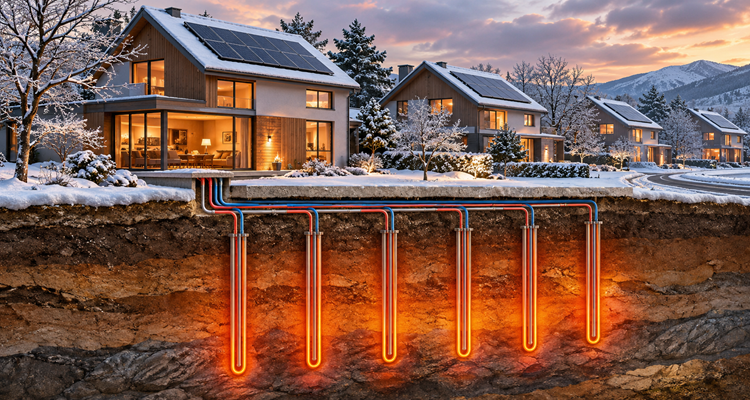
Store it underground: Pumps circulate a heat-transfer fluid through pipes or wells, transferring energy into the ground.
-
Preserve it: A large underground storage volume helps slow the loss of useful heat, although some energy inevitably escapes.
-
Recover it in winter: The system extracts stored warmth and supplies it to a building, sometimes using a heat pump to raise the temperature.
The key is scale. A sufficiently large volume of ground can hold a significant amount of energy, while carefully designed piping, insulation, and operating temperatures help improve seasonal performance.
Not every underground system works at the same temperature. Some store relatively low-temperature heat that must be upgraded by a heat pump. Others store much hotter water or ground temperatures that can serve a heating network more directly.
Three Ways Buildings Store Heat Beneath the Surface
Vertical pipes are installed in drilled holes. Fluid circulates through the pipes, transferring heat into surrounding soil or rock in summer and recovering it later. The underground water in the pipes is generally kept separate from groundwater.
Suitable underground water-bearing layers become seasonal heat and cold reservoirs. Groundwater is pumped between wells and heat exchangers, creating warmer and cooler zones that can serve buildings in opposite seasons.
Large insulated tanks or excavated, covered pits store heated water. These systems can serve entire neighborhoods through district heating networks rather than individual buildings.
These approaches differ in construction, cost, temperature, and geological requirements. The IEA Energy in Buildings and Communities technology overview identifies borehole, aquifer, tank, and pit storage as major seasonal heat-storage configurations.
A Canadian Neighborhood That Heated Homes With Summer Sunshine
One of the most remarkable demonstrations took place in Okotoks, Alberta, Canada, where a neighborhood of 52 houses was designed to use solar energy collected during warmer months to meet much of its winter heating demand.
The development, known as the Drake Landing Solar Community, began operating its seasonal heating system in 2007.
Approximately 800 solar thermal collectors were installed on garage rooftops. Instead of generating electricity, these collectors captured sunlight as heat, which was transferred through a network of pipes.
A field of 144 boreholes, extending approximately 35 meters underground, stored much of that energy in the surrounding ground.
When winter arrived, the system recovered the stored heat and distributed it through a neighborhood heating network.
The Town of Okotoks reports that solar thermal energy met more than 90% of the space-heating needs of the community’s 52 homes during the project’s successful operation.
This was a significant achievement in a region where winter temperatures can fall far below freezing.
The important lesson from Drake Landing
The project demonstrated that solar heating does not have to depend entirely on sunlight being available at the exact moment warmth is needed.
However, its history also reveals the challenges of maintaining sophisticated energy infrastructure over many years.
The community’s archived project account reports that the system experienced deterioration and maintenance difficulties around 2020 and that decommissioning began in 2024. Most homes subsequently transitioned to natural-gas furnaces.
Drake Landing therefore provides two valuable lessons: seasonal underground storage can achieve an exceptionally high share of solar heating, but long-term maintenance, replacement costs, and operational reliability are essential to making the approach sustainable.
The Netherlands Is Using Groundwater as a Seasonal Battery
While the Canadian demonstration relied on storing solar heat in the ground, the Netherlands has developed considerable experience with another method: aquifer thermal energy storage, or ATES.
This technology makes use of underground layers of water-bearing sand or rock.
During summer, cool groundwater helps remove heat from buildings. As it absorbs warmth, the water can be returned to a designated warm storage zone.
During winter, the process reverses. Warmer groundwater is extracted, and a heat pump can raise the available heat to a temperature suitable for indoor heating.
The water, now cooler, is returned to a separate cold storage zone for use during the next cooling season.
At Wageningen University & Research, aquifer thermal energy storage is part of a campus-wide approach to heating and cooling buildings and greenhouses.
The university describes a system that stores heat and cold in a water-bearing sandy layer approximately 90 meters below the surface. Heat exchangers and heat pumps allow buildings to make use of the stored energy as seasonal needs change.
The institution also notes that pumps require electricity, which it supplies using its own renewable generation.
The important distinction is that an aquifer system does not necessarily store very hot water.
Dutch research institute Deltares describes conventional systems in which the warm groundwater may be around 18°C and the cold groundwater around 6°C.
Those temperatures are useful for efficient heating and cooling, but 18°C water cannot directly provide all the heat required for a comfortable building in winter. A heat pump is generally needed to raise its temperature.
That makes seasonal storage particularly interesting when combined with efficient electric heat pumps.
Why Heat Pumps Make Underground Storage More Useful
A heat pump does not create warmth by burning fuel. It uses electricity to move heat from a lower-temperature source to a higher-temperature destination.
Even cold air and relatively cool groundwater contain thermal energy. A heat pump can extract some of that energy and deliver it indoors.
But the temperature difference matters.
When a heat pump draws energy from a relatively warm underground reservoir rather than very cold outdoor air, it may operate more efficiently, depending on system design and conditions.
Seasonal storage can therefore serve two functions.
First, it preserves energy collected or recovered during summer. Second, it can provide a more favorable heat source during winter.
This does not make the system electricity-free. Pumps, controls, and heat pumps still consume power, and some installations need backup heating during peak demand.
The advantage is that the system can reduce the amount of additional energy needed to supply comfortable indoor temperatures.
Why Not Simply Use Solar Panels and Batteries?
Solar photovoltaic panels and electrical batteries are valuable technologies, but they solve a somewhat different problem.
A photovoltaic panel converts sunlight into electricity. A battery stores electrical energy that can later operate lights, appliances, or heating equipment.
Seasonal thermal storage preserves energy in the form of heat.
If the ultimate goal is to warm a building, storing thermal energy directly can avoid some of the cost and complexity associated with converting that energy into electricity, storing it electrically for months, and converting it back into heat.
That does not mean underground thermal storage is always superior.
Electrical batteries are more versatile because stored electricity can power many different devices. Underground thermal storage is specialized: its primary purpose is to provide heating or cooling.
The technologies can also complement one another. Solar electricity may power the pumps and heat pumps that operate an underground storage system.
The choice depends on the building’s energy needs, climate, available space, and economics.
Could Underground Heat Storage Reduce Carbon Emissions?
Heating buildings is a major energy demand, particularly in colder regions. When heating relies on fossil fuels, reducing the amount burned can lower greenhouse gas emissions.
Seasonal thermal storage can contribute by making better use of solar heat, industrial waste heat, and energy that would otherwise be discarded.
For example, an industrial facility may release substantial heat during summer, when nearby buildings have little need for heating. A seasonal storage system could capture some of that energy and make it available during winter.
The International Renewable Energy Agency (IRENA) identifies aquifers, boreholes, insulated pits, and other storage methods as options for integrating renewable and recovered heat into district energy systems.
However, the actual environmental benefit depends on several factors: the source of the stored heat, the electricity used to operate the equipment, heat losses, and the fossil-fuel heating displaced.
An underground storage system powered by carbon-intensive electricity may deliver different emissions savings from one operated using renewable electricity.
The technology’s environmental value must therefore be assessed across the entire heating system, not just the underground reservoir.
What Stops Every Building From Using This Technology?
Despite its promise, seasonal underground heat storage is not a universal solution.
Geology and groundwater conditions
Aquifer systems require suitable underground formations. Some locations lack the necessary groundwater characteristics, while others have geological conditions that make drilling or heat recovery difficult.
Groundwater protection rules can also restrict installations.
Installation costs
Drilling boreholes, constructing reservoirs, installing heat exchangers, and connecting buildings to heating networks require substantial initial investment.
These costs may be easier to justify for large developments, campuses, and district heating systems than for individual homes.
Heat losses
Underground storage is not perfectly insulated. Some heat spreads into the surrounding ground and cannot be economically recovered.
Storage geometry, temperature differences, groundwater movement, and operating cycles all affect performance.
Seasonal energy balance
A system must collect enough heat during warmer months to make a meaningful contribution during colder ones.
Buildings with substantial winter heating demand but limited summer heat availability may require additional energy sources.
Maintenance and long-term operation
Underground storage is only one part of the infrastructure. Pumps, valves, controls, heat exchangers, and distribution pipes need maintenance.
The experience at Drake Landing illustrates why long-term operational planning matters as much as initial engineering success.
Research from Deltares also highlights geological suitability and regulatory differences as important barriers to wider adoption of aquifer storage.
Could Entire Cities Eventually Store Summer Heat?
The most promising applications may be larger than individual buildings.
A neighborhood, university, hospital complex, or industrial district can share heating infrastructure, spreading investment across many users.
A district heating network could collect heat from several sources, store it seasonally, and distribute it when demand rises.
This is especially interesting for cities with large heating requirements and access to solar thermal energy, industrial waste heat, or other renewable heat sources.
Researchers at Delft University of Technology have also been developing high-temperature aquifer storage designed to retain excess geothermal heat for use during periods of greater winter demand. The university describes a planned system using underground storage zones at temperatures around 50°C and 80°C, illustrating how seasonal storage can extend beyond conventional low-temperature groundwater applications.
Still, scaling the technology requires careful coordination. Underground heat stores occupy subsurface space, and neighboring systems can affect one another if poorly planned.
Cities would need to consider geology, infrastructure ownership, groundwater management, and long-term maintenance before expanding installations.
The Bigger Idea: Energy Does Not Always Need to Be Used Immediately
The most interesting aspect of seasonal thermal storage may be the change in perspective it represents.
Conventional building heating often follows immediate demand. When indoor temperatures fall, equipment produces or transfers the necessary heat.
Seasonal storage introduces another possibility: collecting energy when it is abundant and using it when it becomes valuable.
A sunny summer afternoon can help warm a home months later. Heat removed from an office building during cooling season can become part of its winter heating supply. Energy that once seemed inconvenient or surplus can become a useful resource.
The underlying physics is familiar. The innovation lies in applying it at a scale large enough to connect one season with another.
Underground thermal storage will not eliminate the need for heating equipment, electricity, or careful energy planning. Nor will every building have the right geological conditions or economics to use it.
But where the circumstances are favorable, it offers a practical way to make better use of energy that already exists.
The future of building heating may depend not only on producing cleaner energy, but also on learning how to save warmth until the moment it is needed.
The information presented in this article is based on publicly available sources, reports, and factual material available at the time of publication. While efforts are made to ensure accuracy, details may change as new information emerges. The content is provided for general informational purposes only, and readers are advised to verify facts independently where necessary.