









The AI That Can Recognise Your Voice but Cannot Tell When You Are Pretending to Be Yourself
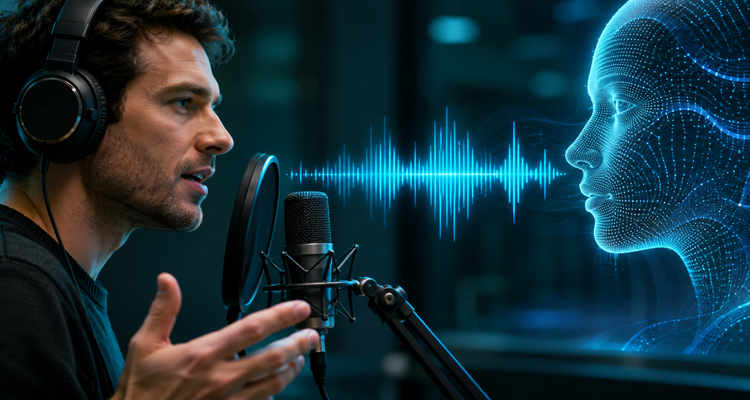
Voice recognition technology is becoming increasingly sophisticated. But identifying a familiar voice is not the same as knowing whether the person speaking is genuine, truthful, or even physically present.
Imagine receiving a phone call from someone whose voice you know better than almost anyone else’s. The accent is familiar. The pauses sound natural. Even the slight hesitation before a particular word feels unmistakable.
Then the caller asks you to transfer money.
You recognise the voice. But should you trust it?
This question captures one of the most important limitations of modern artificial intelligence: a system can learn the distinctive characteristics of a human voice without understanding the identity, intentions, or circumstances behind it.
Voice recognition, voice cloning, and AI-generated speech are increasingly blurring the boundaries between identification and impersonation. Yet the deeper problem is not simply that machines can imitate people. It is that humans and automated systems alike may confuse a convincing voice with trustworthy evidence of identity.
Recognising a Voice Is Not the Same as Recognising a Person
Human voices carry distinctive information. The shape of the vocal tract, habitual pitch, pronunciation, speaking rhythm, and other acoustic characteristics contribute to how an individual sounds.
AI-powered speaker recognition systems analyse patterns in these characteristics to estimate whether two recordings belong to the same speaker.
A typical system converts speech into a numerical representation, sometimes called a speaker embedding. This representation captures features useful for comparing voices.
When a new recording arrives, the system measures how closely its features match a previously enrolled voice.
But this process has a fundamental limitation.
The system is not directly observing a person’s identity. It is evaluating acoustic evidence associated with that identity.
That distinction matters because the evidence can be manipulated.
A sufficiently convincing synthetic voice may resemble the enrolled speaker closely enough to confuse a recognition system. Conversely, a legitimate speaker may sound different because of illness, stress, ageing, background noise, or recording conditions.
Voice recognition is therefore a probabilistic identification method, not an infallible identity test.
What Happens When Someone Pretends to Be Themselves?
The headline raises an unusual question: what if the speaker is genuinely the person the AI recognises, but is deliberately performing a different version of themselves?
Consider an actor using an exaggerated accent, a customer deliberately changing their voice, or someone speaking in an unusually cheerful tone while concealing frustration.
The person has not changed. Their behaviour has.
An AI system might still recognise the speaker if enough stable vocal characteristics remain. Alternatively, it might struggle because the altered delivery differs from the enrolled samples.
Neither outcome establishes whether the person is pretending.
That is because speaker identity, emotional expression, and sincerity are separate questions.
A person can speak in their normal voice while lying. They can disguise their voice while telling the truth. They can imitate their own usual mannerisms while concealing their intentions.
Acoustic similarity alone cannot reliably distinguish these situations.
This is particularly important when evaluating claims about AI that supposedly detects deception, authenticity, or hidden emotions from speech. Such capabilities require independent evidence and careful validation; they do not automatically follow from successful speaker recognition.
How AI Voice Cloning Changes the Problem
Modern speech-generation systems can produce increasingly natural-sounding voices using machine learning.
Depending on the technology, a system may reproduce vocal characteristics from recorded examples, convert one speaker’s speech into another speaker’s voice, or generate entirely synthetic speech.
These capabilities have legitimate applications.
They can help people who have lost their ability to speak, support accessibility tools, enable multilingual content, and assist creative production when appropriate consent and safeguards are in place.
But the same technologies can also enable impersonation.
A fraudster may attempt to create audio that sounds like a family member, colleague, or executive. The recording might include familiar expressions and a convincing emotional tone.
For the listener, the danger is that an acoustic resemblance can create a powerful impression of personal familiarity.
For an automated authentication system, the danger is that synthetic speech may reproduce characteristics the system was trained to associate with an authorised user.
These are related but distinct threats: one exploits human trust, while the other attempts to defeat a technical verification process.
The Difference Between Voice Recognition and Liveness Detection
Some voice authentication systems include safeguards designed to identify recorded or artificially generated speech.
These are often described as presentation-attack detection, spoofing detection, or liveness-related checks.
The distinctions are important:
| Technology | What it attempts to establish |
|---|---|
| Speaker recognition | Whether speech resembles that of an enrolled speaker |
| Voice anti-spoofing | Whether audio appears to be genuine speech rather than a replay or synthetic imitation |
| Liveness or challenge-response checks | Whether a speaker can respond appropriately to a fresh interaction |
| Identity verification | Whether the claimant is the authorised person, potentially using several independent factors |
| Emotion recognition | Whether acoustic patterns correlate with emotional states, with substantial interpretive limitations |
Even when these technologies work together, none can establish that a speaker is being sincere.
A live person can lie. A genuine voice can be used under coercion. A successful challenge-response interaction does not prove that the speaker’s intentions are benign.
And sophisticated attackers may exploit weaknesses in both voice recognition and anti-spoofing systems.
The security question is therefore broader than whether the audio sounds real.
It is whether the entire interaction provides sufficient evidence that the right person is acting with appropriate authorisation.
Why Even Deepfake Detectors Cannot Guarantee the Truth
Researchers are developing systems that analyse speech for evidence of artificial generation, audio manipulation, or unusual signal patterns.
Some models look for spectral inconsistencies. Others examine temporal patterns or use neural networks trained to distinguish authentic recordings from synthetic ones.
However, identifying synthetic audio is an evolving technical challenge.
Research associated with the ASVspoof initiative has demonstrated that detection performance can vary substantially across different attacks. A 2025 paper describing the ASVspoof 5 evaluation resources examined synthetic speech, voice conversion, and adversarial attacks, highlighting weaknesses that can emerge even in sophisticated systems.
A separate evaluation of deepfake speech detectors found that performance can deteriorate when systems encounter unfamiliar recording conditions, datasets, or synthesis methods.
This reveals an important distinction between laboratory performance and practical reliability.
A detector that identifies most synthetic recordings in a controlled experiment may not achieve the same results when confronted with an unfamiliar cloning model, compressed telephone audio, or a recording combining authentic and manipulated speech.
There is also a more fundamental limitation: detecting whether audio was generated by AI does not establish whether its message is true.
An authentic recording can contain a deliberate lie. A synthetic recording can reproduce words that a person genuinely authorised.
Audio authenticity and human honesty are not interchangeable concepts.
Why Voice Biometrics Alone Are Not Enough for Security
Voice authentication is appealing because it can be convenient. A person does not need to remember a complicated password or carry specialised equipment.
But convenience does not eliminate security risks.
The UK’s National Cyber Security Centre identifies replay attacks, speech synthesis, voice conversion, and imitation among the threats relevant to speaker recognition systems. It also notes that voice biometrics can offer useful verification when appropriately implemented and protected.
The US National Institute of Standards and Technology takes a particularly cautious position. Its SP 800-63B digital identity guidance states that voice-based biometric comparison must not be used under that standard’s biometric authentication requirements.
This does not mean every commercial voice recognition application is useless or prohibited. It means voice matching should not automatically be treated as sufficiently strong proof of identity.
For sensitive transactions, organisations need security controls that consider more than vocal resemblance.
These may include independent authentication factors, transaction confirmation, fraud monitoring, and procedures for escalating suspicious requests.
The most important principle is to avoid making a familiar-sounding voice the sole authority for a consequential decision.
When Familiarity Becomes a Security Weakness
Humans are naturally accustomed to recognising people by their voices.
We often identify a friend or family member before they introduce themselves. A familiar laugh, accent, or speaking rhythm can be enough.
This ability is valuable in ordinary life, but it can also create a vulnerability.
The US Federal Trade Commission has warned that scammers can use AI-generated voice imitations in family-emergency fraud. Someone may receive a call that appears to come from a relative in distress, accompanied by an urgent request for money.
The effectiveness of such an attempt does not necessarily depend on perfect audio.
A frightened listener may be concentrating on the apparent emergency rather than evaluating subtle vocal inconsistencies.
Urgency, secrecy, and emotional pressure can make independent verification less likely.
The lesson is not that every unusual call should be treated as fraudulent. It is that voice familiarity should be considered a clue rather than conclusive evidence.
How to Protect Yourself From AI Voice Impersonation
A few practical habits can reduce the risks associated with convincing voice imitations.
1. Verify urgent requests independently. If someone calls asking for money or sensitive information, contact them using a phone number you already know. Do not rely on a callback number supplied during the suspicious interaction.
2. Be cautious about secrecy and pressure. Requests to act immediately, avoid telling others, or use difficult-to-reverse payment methods deserve additional scrutiny.
3. Use a separate confirmation method. For important financial or workplace decisions, verify the request through an established channel or approved authentication process.
4. Consider a family verification phrase. A privately agreed phrase can provide an additional check, although it is not foolproof and should not replace independent contact.
5. Treat AI detection results as supporting evidence. A tool that labels audio as genuine or synthetic may be useful, but its output should not be regarded as definitive proof.
These precautions reflect the FTC’s broader advice to independently confirm unexpected emergency requests, particularly when a caller sounds like someone familiar.
The Deeper Question: Can AI Understand Authenticity?
The most intriguing part of this technological problem is not whether AI can recognise a person’s voice.
It is whether recognising a pattern amounts to understanding the person behind it.
A voice recognition system can compare measurable characteristics. A language model can analyse words, conversational context, and patterns of expression. A multimodal system may combine audio with other information.
These capabilities can support useful inferences.
But none automatically grants access to a speaker’s private intentions.
Consider three situations:
A person speaks in their ordinary voice while deliberately misleading someone.
A person adopts an artificial accent while expressing a sincere belief.
A synthetic voice delivers a message that its real-life owner explicitly approved.
In the first situation, the audio may be genuine while the statement is dishonest. In the second, the performance is deliberate but the statement may be truthful. In the third, the voice is artificial but the communication may be authorised.
A system that classifies all three using a single genuine-or-fake label would overlook the most important distinctions.
Authenticity is not one measurable property.
It can refer to the origin of a recording, the identity of its speaker, the authorisation behind a message, the accuracy of its contents, or the sincerity of the person communicating.
Each requires different evidence.
This is why the question of whether someone is pretending to be themselves is more complicated than it initially appears. Human identity remains continuous even as behaviour, presentation, and intentions change.
An AI system may recognise the voice without knowing what the performance means.
The Future of Voice Recognition May Depend on Trust, Not Just Accuracy
As synthetic speech becomes more capable, the goal of secure voice technology cannot simply be to produce increasingly accurate speaker-matching scores.
Systems also need to withstand impersonation attempts, accommodate legitimate variations in human speech, and avoid treating uncertain evidence as conclusive.
This requires technical improvements, careful testing, and security procedures designed around real-world behaviour.
It also requires a more realistic understanding of what AI can establish.
A machine may be very good at determining whether two recordings sound like the same person. That is a narrower achievement than proving that a conversation is genuine, authorised, or truthful.
The distinction will become increasingly important as people encounter synthetic voices in customer service, entertainment, accessibility applications, and everyday communication.
The challenge is not to abandon voice technology. It is to use it without granting it more authority than the evidence supports.
Conclusion: A Recognisable Voice Is Not Proof of a Trustworthy Speaker
The paradox of an AI that recognises your voice but cannot tell when you are pretending to be yourself reveals a broader limitation of automated identification.
Recognition is about matching evidence. Authenticity requires understanding what that evidence actually proves.
A voice can be familiar without being genuine. It can be genuine without being sincere. And it can be synthetic without necessarily being unauthorised.
As AI becomes more convincing, these distinctions will matter more, not less.
The safest approach is to treat voice recognition as one useful signal within a larger process of verification.
Because knowing what someone sounds like has never been quite the same as knowing who they are or whether what they are saying deserves to be believed.
This content is published for informational or entertainment purposes. Facts, opinions, or references may evolve over time, and readers are encouraged to verify details from reliable sources.